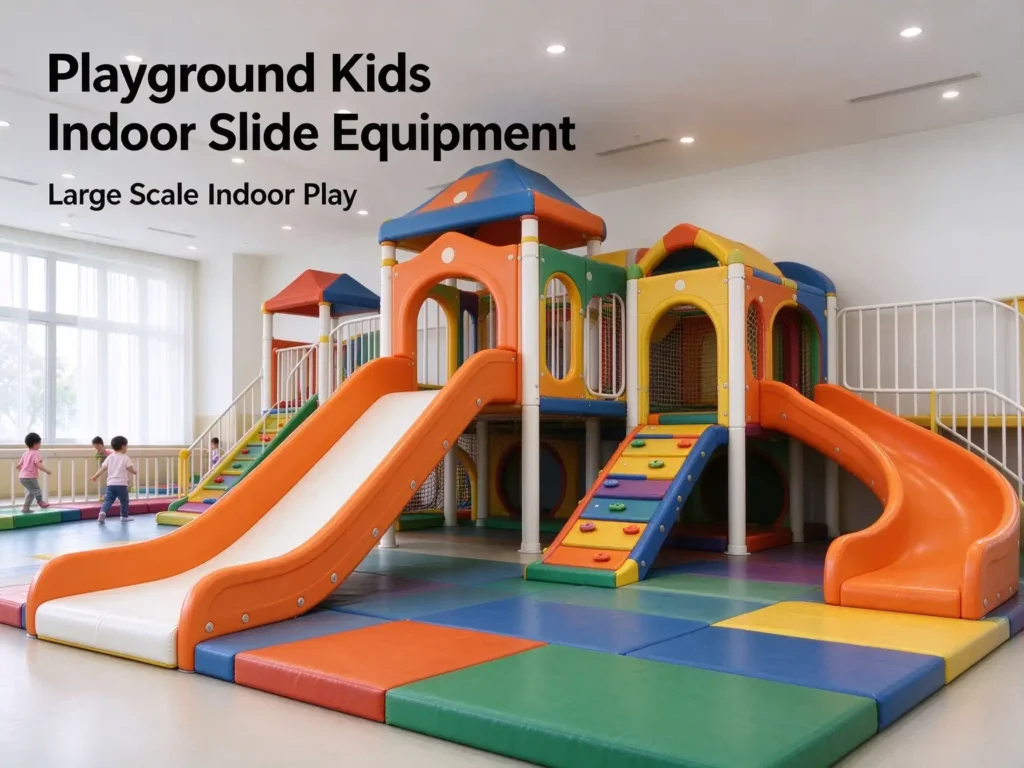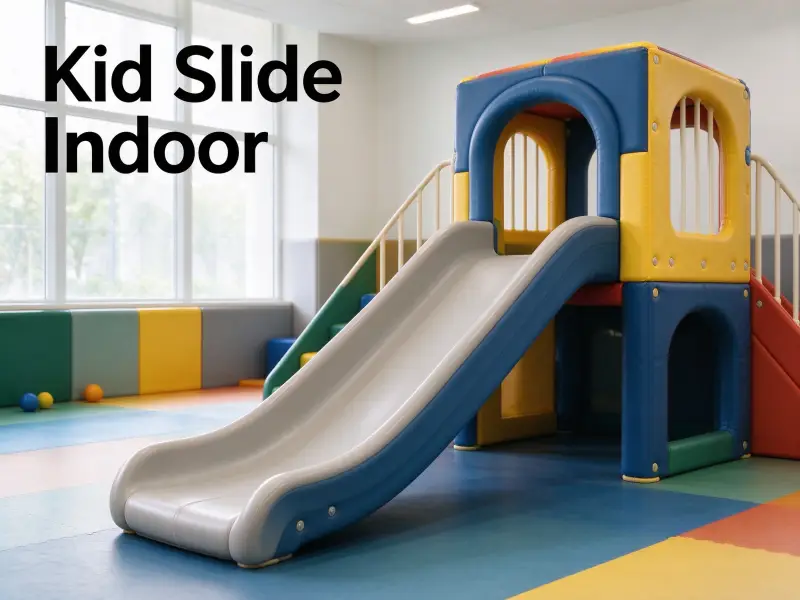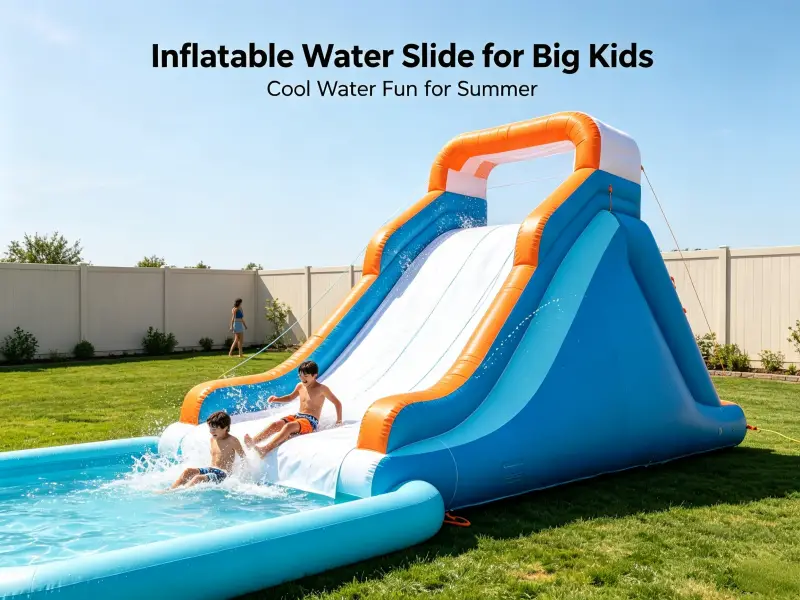
A slide is usually the first thing a child runs toward in any play space, and it is often the piece of equipment visitors judge first. For kindergartens, shopping malls, family entertainment centers, and even home playrooms, an indoor kids’ play slide anchors the layout and sets the tone for the whole area. Choosing one, however, involves more than picking a color. Platform height, material, slope, floor space, and safety compliance all decide whether the slide works for your space and passes inspection.
A kid slide indoors should be chosen by matching three things: the age group, which sets platform height and slope; the material, with rotomolded plastic the default for most indoor use and fiberglass or stainless steel reserved for high-traffic or custom builds; and the safety standards that apply in your market, ASTM F1487 and F1292 in the US or EN 1176 and EN 1177 in Europe. Measure your ceiling height, plan a run-out zone beyond the slide exit, and buy from a manufacturer that can supply test reports and installation support.
The sections below compare slide types, materials, age fit, space needs, and costs, so you can shortlist the right model before requesting a quote.

What is a kid slide indoor, and who buys it?
An indoor kid slide is a slide designed for enclosed spaces such as playrooms, kindergartens, malls, and indoor playgrounds. Both families and commercial operators buy them, but the requirements differ sharply between the two.
Home use vs. commercial use
Home slides are small and light. Foldable plastic models for toddlers sit on carpet or foam mats and can be stored away at night. Price, footprint, and a soft landing matter more than certification, though parents should still check for sharp edges and recalls.
Commercial slides face different conditions. They carry daily traffic from dozens or hundreds of children, so they need certified non-toxic materials, anchored steel frames, impact-attenuating surfacing, and documented load ratings. Insurance carriers and local inspectors often ask for this paperwork before a venue opens.
Who buys commercial indoor slides?
The typical commercial buyers are
- Kindergarten and preschool chains, which place one or two slides in soft play zones
- Mall operators, who add play areas to extend family dwell time
- Family entertainment centers, where a large slide acts as the anchor attraction
- Hotels and resorts with indoor kids’ clubs
- Daycare centers and early learning facilities
For these buyers, a slide is throughput equipment. How many children can use it per hour, whether the supervision desk can see both the stairs and the exit, and how the unit affects insurance costs all matter as much as how it looks.
Kid slide types compared
The main types are straight, wave, tube, spiral, double-lane, and combination slides. Straight and wave models suit small rooms, while spiral and tube designs add capacity and excitement where ceiling height allows.
| Type | Best for | Typical age | Key notes |
|---|---|---|---|
| Straight slide | Small playrooms, toddler zones | 2–6 | Simplest design, easiest to supervise |
| Wave slide | Kindergartens, preschools | 3–8 | Bumps slow the descent and add fun |
| Tube slide | Malls, FECs | 4–12 | Fully enclosed; needs more ceiling clearance |
| Spiral slide | Anchor attractions | 5–12 | Stacks a long drop into a small footprint |
| Double-lane slide | High-traffic zones | 3–10 | Side-by-side racing reduces queues |
| Combination unit | Themed playgrounds | 2–12 | Slide plus climbers, bridges, and ball pits |
Outdoor kid slides for backyards and parks
Many buyers searching for kid slides actually want an outdoor model. Outdoor playground equipment covers these designs, and the selection logic changes in three ways. First, materials must handle sun and rain, so UV-resistant rotomolded plastic or stainless steel replaces indoor-grade plastics. Second, a big kid slide for backyard use usually sits higher off the ground, which means the frame must be anchored and the landing area filled with grass-rated or rubber surfacing rather than carpet. Third, outdoor slides for parks and schoolyards are often sold as combination units with climbers and bridges attached, because children spread out across more features when the space allows.
An outdoor slide for 5-year-old children generally falls between the toddler and big-kid classes: tall enough to feel exciting, with full guardrails and non-slip steps, but not the multi-meter tower structures aimed at ages 8 and up.
Pool slides for kids
A kid slide for the pool is a separate product class, not a dry slide placed near water. Pool slides use water-resistant materials such as fiberglass or rotationally molded polyethylene, slip-resistant steps, and a mounting system fixed to the pool deck. They also need a continuous water feed to lubricate the sliding surface. Never repurpose a standard playground slide for pool use, since the materials corrode, the surface friction is wrong, and the anchoring is not rated for a wet environment. Buy a slide designed and tested for water from the start.
Choosing by age: little kid slides vs. big kid slides
Toddlers need low platforms, gentle slopes, and enclosed sides. School-age children handle taller structures with spiral or wave profiles, and a 5-year-old usually fits in between, on slides with moderate platforms and full guardrails.
Commercial guides for family entertainment centers segment indoor slides into three size classes: toddler slides for ages 1 to 4 with roughly 4 to 6 ft platform heights and 25 to 30 degree slopes, junior slides for ages 5 to 10 with 8 to 12 ft platforms in commercial settings, and full-height slides for ages 8 and up that start near 14 ft and need ceilings above 20 ft (per Ginflatables’ commercial equipment guide, checked 28 September 2026). Home versions scale down from these figures, but the proportions hold.
| Age group | What to look for |
|---|---|
| 1–4 (little kid slide) | Low platform, 25–30 degree slope, enclosed sides, wide base, short run-out |
| 5–7 | Moderate platform height, full guardrails, non-slip steps, wave profiles |
| 8–12 (big kid slide) | Taller platforms, spiral or tube options, higher load ratings, clear supervision sightlines |
A little kid slide fails when it tries to serve everyone. If your venue serves a wide age range, buy two separate zones instead of one compromise structure. A toddler who shares a slide built for 10-year-olds faces fall risks the guardrails were never designed to manage, and older children find toddler slides boring, which pushes them toward unsafe play on equipment too small for them.

Materials: plastic, fiberglass, or stainless steel?
Rotomolded plastic is the default for indoor slides because it is smooth, quiet, and comfortable at room temperature. Fiberglass suits high-traffic themed builds, and stainless steel appears mostly in custom outdoor and showcase designs.
| Material | Strengths | Watch-outs | Typical use |
|---|---|---|---|
| Rotomolded plastic | UV and impact resistant, warm to the touch, low maintenance | Thin-wall economy versions crack early. | Indoor playgrounds, kindergartens |
| Fiberglass | Strong colors, complex curves, long life under heavy use | Higher upfront cost | Malls, FECs, water parks |
| Stainless steel | Longest service life, weatherproof | Heats up in direct sun, needs padding or shading | Public parks, custom-themed slides |
| Steel frame plus plastic bed | Balances strength and comfort | Check weld and joint quality. | Most commercial combination units |
The common question is whether plastic or metal slides work better indoors. Plastic wins for enclosed spaces: metal surfaces stay cold in winter and can sweat with condensation, while plastic keeps a consistent, comfortable surface temperature year-round. Stainless steel still earns its place outdoors and in signature custom builds, where its lifespan and finish justify the cost. For any equipment marketed to children under 12 in the US, lead and phthalate limits under CPSIA apply across all four material classes, so ask suppliers for test certificates rather than verbal assurances (per industry compliance guides, checked 28 September 2026).
Space and safety requirements for indoor slides
Plan for at least 3 ft of clearance above the slide’s highest point, a run-out zone beyond the exit, and surfacing that meets the fall-height standard in your market. In the US that means ASTM F1487 for equipment and F1292 for surfacing; Europe uses EN 1176 and EN 1177.
Before you fall in love with a model, measure the room and check these points:
- Ceiling clearance. Allow a minimum of 3 ft between the top of the slide structure and the ceiling, and remember HVAC ducts, sprinkler heads, light fixtures, and hanging decorations reduce usable height.
- Run-out zone. Every slide needs deceleration space at the base. Commercial guides recommend budgeting roughly 6 to 8 ft of extra floor length beyond the slide exit for safety matting (per Ginflatables’ commercial guide, checked 28 September 2026).
- Total footprint. A practical rule of thumb is to multiply the slide’s stated dimensions by about 1.4 to cover buffer zones and approach space.
- Supervision sightlines. Position the climbing side where your staff can see both the stairs and the exit lane. This is non-negotiable for enclosed tube slides.
- Surfacing. Landing surfaces must meet the impact-attenuation requirements for the equipment’s critical fall height.
The CPSC Public Playground Safety Handbook is the plain-language US reference for use zones, supervision layouts, and surfacing, and it is worth reading before you sign any purchase order. In the US, public-use equipment is governed by ASTM F1487, with F1292 covering surfacing tests; in the EU, venues follow EN 1176 for equipment and EN 1177 for surfacing.
How much does a kid slide cost?
Home slides run from roughly $40 to $800. Commercial permanent indoor slides typically start near $8,000 and can exceed $25,000 once height, custom theming, and surfacing are added, with lead times of 6 to 12 weeks.
| Tier | Price range | Typical buyer |
|---|---|---|
| Foldable toddler slide | $40–$120 | Families |
| Freestanding plastic slide | $150–$800 | Families, home daycares |
| Commercial-grade permanent slide | $8,000–$25,000+ | Kindergartens, malls, FECs |
| Commercial inflatable slide | $1,500–$6,000 | Seasonal and pop-up operators |
These ranges come from published commercial equipment guides and wholesale listing platforms (checked 28 September 2026) and should be read as orientation, not quotes. Final pricing depends on platform height, theming complexity, materials, shipping, and installation. Inflatable slides cost less and can be reconfigured in hours, but they last 3 to 7 years under daily commercial use, while permanent fiberglass or rotomolded structures can serve 15 to 20 years with periodic resurfacing (per the same guide). Treat a slide as a long-term purchase: the cheapest unit that fails inspection in year two costs more than the certified unit bought once.
Customization and working with a manufacturer
Most commercial buyers order customized slides rather than catalog models, and the manufacturer you choose affects safety documentation, lead time, and spare parts availability as much as the slide design itself.
Customization usually covers three layers. Visual theming matches colors, cartoon shapes, and patterns to your venue, which is why whale, insect, and space themes dominate kindergarten and mall projects. Structural customization adapts the slide to your floor plan, combining it with climbers, ball pits, or double lanes where traffic demands. Material customization moves between plastic beds, fiberglass curves, and custom stainless steel builds depending on budget and location.
When you compare suppliers, ask five questions:
- Can you provide test reports for ASTM F1487, EN 1176, or CPSIA compliance?
- Is pricing factory-direct, or are middlemen involved?
- Do you offer installation guidance on site or remotely?
- Are replacement parts available years after purchase?
- Can you show completed projects in venues similar to mine?
JQK (JinQiKai) designs and manufactures indoor and outdoor play equipment from its own factory, supplying kindergartens, malls, and family entertainment centers with themed slides and combination units. Working with a source manufacturer means factory-direct pricing, custom designs matched to your floor plan, eco-friendly certified materials, and installation support from the team that built the equipment. Browse the outdoor playground equipment range to see combined slide units built for parks, schoolyards, and backyards, then send JQK your floor plan and target age group through the contact page for a layout proposal and quotation.

FAQ
How long does a commercial indoor slide last?
A permanent fiberglass or rotomolded slide lasts 15 to 20 years with periodic resurfacing and routine inspections, while commercial inflatable units typically serve 3 to 7 years under daily use. Maintenance records also affect insurance and inspection outcomes, so keep a simple log of checks.
Can one slide work for both toddlers and older kids?
Only with separated lanes. A double-track or zoned combination unit can place a low toddler lane beside a taller lane for older children, each with its own stairs and exit. A single shared surface that mixes age groups does not, because slope and platform height cannot be right for both.
Do indoor slides need special flooring?
Yes. The landing area must meet the impact-attenuation requirement for the slide’s critical fall height, which usually means foam or rubber mats sized and certified for that height. Ordinary carpet or bare tile does not qualify, and inspectors check the surfacing certificate alongside the equipment itself.