Every play area, from a kindergarten courtyard to a shopping mall atrium, tends to organize itself around one piece of equipment: the slide. It is the feature children return to again and again, and the one that buyers most often get wrong. A slide that is too tall intimidates younger users, a slide built from the wrong material weathers badly within a few seasons, and a slide installed without enough clearance creates risks that no amount of supervision can fully manage. Because the market offers everything from a compact little kid slide for a playroom to a multi-lane combined structure for a public park, the buying decision deserves more thought than a catalog page suggests.
The right kid slide comes down to four things: who will use it, where it will stand, what it is made of, and which safety standards it meets. Little kid slides stay low with gentle slopes and full side rails. A big kid slide needs more height, more speed, and sturdier construction, especially for a backyard or schoolyard. Indoor slides favor compact footprints and quiet, smooth materials, while outdoor and pool slides must handle sun, water, and hard use.
For commercial buyers, the fastest route to a correct choice is to match the slide type and material to the daily user age group, confirm the site has room for a proper use zone, and buy from a manufacturer that builds to recognized playground standards.
This guide walks through each of those decisions in order: slide types, placement scenarios, materials, safety checks, and what a factory like JQK can customize for a specific project.

Types of kid slides and who each one fits
The main kid slide types are straight, wave, spiral, tube, double-track, and combined structures. Straight and wave slides suit most budgets and age groups, spiral and tube slides add excitement for school-age children, double-track models let two children ride at once, and combined structures turn a slide into the centerpiece of a larger play system.
Each type trades off footprint, thrill, and price differently. The table below summarizes the fit.
| Slide type | Best age range | Footprint | Typical setting |
|---|---|---|---|
| Straight | 2–8 | Small | Kindergartens, home yards, small parks |
| Wave | 4–10 | Small to moderate | Schools, community playgrounds |
| Spiral | 5–12 | Small (vertical build) | Malls, commercial sites, tight spaces |
| Tube/enclosed | 5–12 | Moderate | Large parks, themed venues |
| Double-track | 3–10 | Moderate | Kindergartens, malls, family venues |
| Combined structure | 2–12 | Large | Public parks, resorts, campground projects |
Two points matter when reading this table. First, a slide’s thrill level rises with both height and length, so a tall straight slide can deliver more speed than a short spiral one. Second, spiral and tube designs save horizontal space by stacking the run vertically, which is why they appear so often in malls and other indoor commercial settings.
Little kid slides vs. big kid slides
A little kid slide is defined less by its color or theme than by its geometry. Deck heights stay low, slopes stay gentle, entry steps are shallow, and side rails run the full length of the chute. These features let a two- or three-year-old climb and descend without help. Toddler-focused guidance from safety bodies consistently points to low platforms and gentle angles as the core design response for this age band.
A big kid slide serves users from roughly five years old and up. These children want speed and height, and they use equipment more roughly, so the structure needs a taller deck, a longer run, deeper chute walls, and heavier anchoring. This is the profile to look for when a search like “outdoor slide for 5-year-old” comes up: the answer is not simply a bigger version of a toddler slide, but a different balance of slope, run-out, and structural strength.
For mixed-age sites, and most real projects are mixed-age, the practical solution is zoning. Keep a low-profile little kid slide in one area and a big kid slide or combined structure in another, separated enough that an older child sprinting between attractions cannot plow into a toddler. A combined unit with two slide heights can also work, provided the entry points are clearly separated.
Indoor slides, outdoor slides, and pool slides: matching the slide to the space
The same child can need three different slides for three different locations. Indoor slides prioritize compact footprints, smooth non-marking materials, and quiet rides. Outdoor kid slides prioritize weather resistance, UV stability, and impact-absorbing ground cover. Pool slides add water-safe surfaces, drainage, and slip control. Buying an outdoor model for a playroom, or the reverse, is the most common and most expensive mismatch.
Indoor kid slides for playrooms, kindergartens, and malls
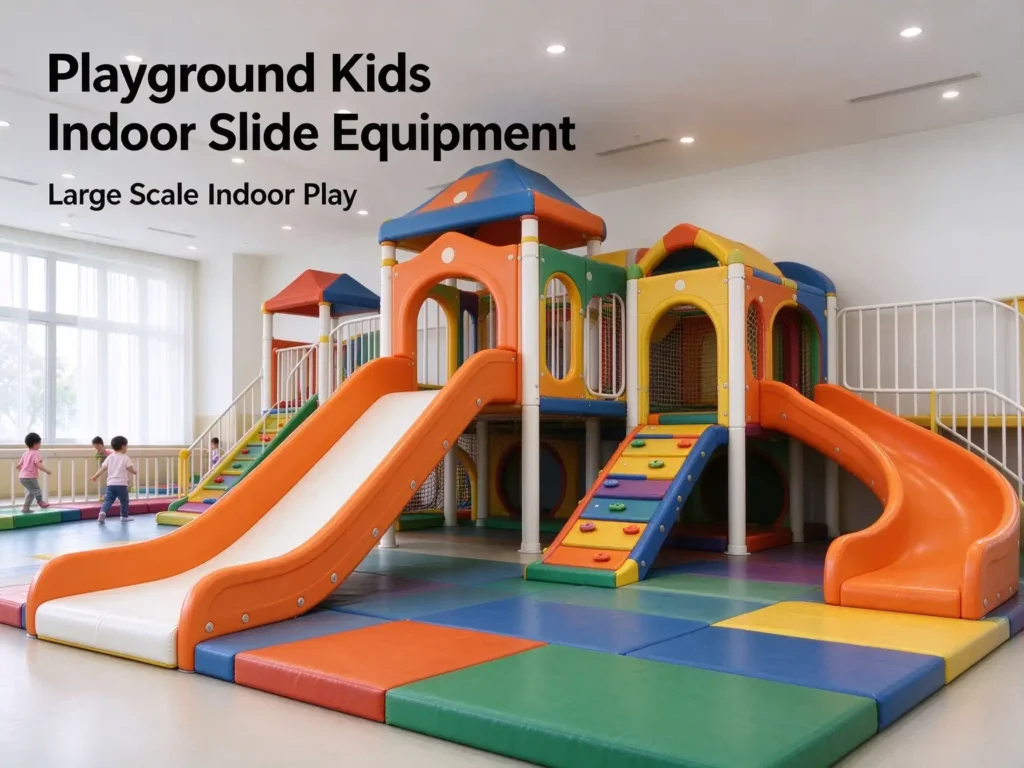
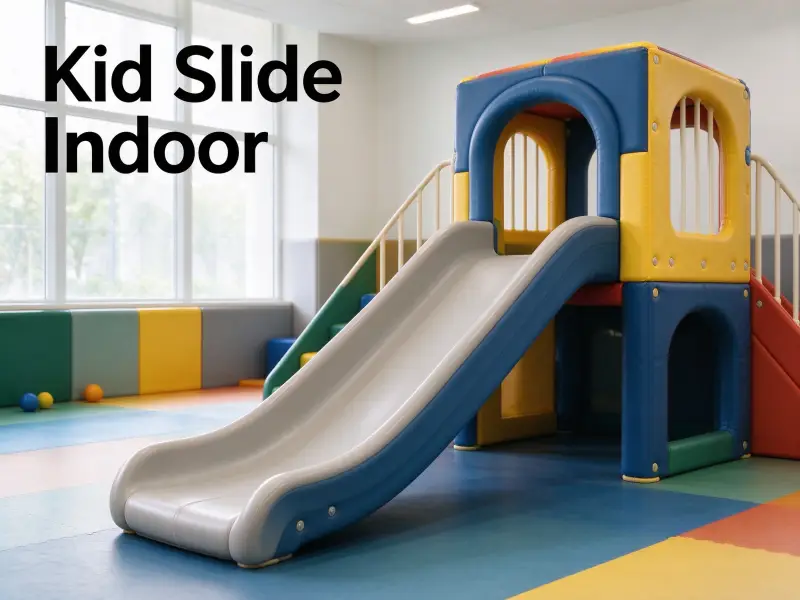
A kid slide indoor setting imposes constraints an open yard never will. Ceiling height caps how tall the structure can be. Floor loading matters in multi-story buildings, especially for heavy combined units. Noise matters in malls and residential buildings, which favors smooth polyethylene chutes over metal ones. And the footprint has to leave circulation space for strollers and groups.
Commercial indoor spaces, such as kindergarten halls and mall play zones, usually pick double-track or spiral designs for a simple reason: throughput. Two children sliding side by side halves the queue at the platform, and a queue at the top of a slide is itself a safety problem. JQK’s double-track indoor model for kindergartens and malls is built around exactly this problem, with an eco-friendly plastic body, a guardrail platform, and a footprint sized for interior use.
Indoor slides should also sit on a surface that grips. Smooth chutes deliver children to the floor at speed, so the exit area needs a flat run-out zone, and any adjacent flooring should be impact-absorbing rather than bare tile or concrete.
Outdoor kid slides for backyards, parks, and schools
Outdoor use is a materials and siting question. Sunlight degrades untreated plastics, so look for UV-stabilized polyethylene or powder-coated and galvanized steel. Rain and freeze-thaw cycles stress joints, so drainage and rust protection matter. And every outdoor kid slide needs a use zone: a clear, soft-surfaced area around the structure where a falling child lands on something forgiving rather than on pavement or a fence line.
For a big kid slide for backyard use, the layout checks are simple but easy to skip. Measure the full footprint, including the slide run and ladder, add clearance on every side so children do not exit into a wall or garden bed, and confirm the ground is level before anchoring. Backyard installations also tend to serve siblings of very different ages, so either pick a moderate-height slide that both can use with supervision, or accept the two-zone approach described above.
Schools and parks add volume to the equation. A structure that serves twenty children a day at home may serve hundreds at a school, which pushes buyers toward heavier frames, thicker plastics, stainless steel fittings, and modular parts that can be replaced individually.
Kid slides for pool areas
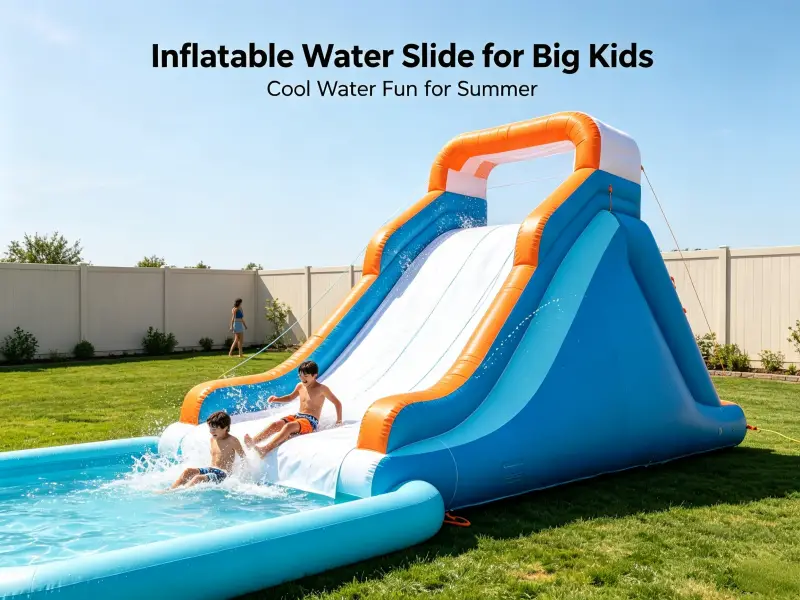
A kid slide for pool use is a different product category, not just an outdoor slide that got wet. Water on a slide bed changes the friction profile entirely: the ride is faster, the exit is wetter, and the climbing surface becomes the single most important safety feature. Pool slides therefore need textured, non-slip steps, side rails tall enough to grip with wet hands, materials that tolerate chlorinated or salt water, and drainage paths so water does not pool on platforms.
Depth is the other half of the equation. A slide must end over water deep enough for the rider to decelerate safely, and the run-out direction should point into open water rather than toward a pool edge or ladder. For hotel, resort, and water park buyers, this is also where local pool codes and inspection regimes apply, so confirm requirements with the installer before ordering rather than after.

Materials compared: plastic, stainless steel, and wood
Most commercial kid slides today combine rotationally molded HDPE plastic components with a galvanized steel or stainless steel frame. Plastic chutes stay cool in sun, resist cracking, and feel comfortable to touch. Steel carries the structural load and survives heavy use. Wood appears in premium-themed installations but demands regular sealing and inspection.
| Material | Strengths | Watch-outs | Best fit |
|---|---|---|---|
| HDPE / LLDPE plastic | Cool in the sun, no splinters, no rust, colorfast with UV stabilizers | Cheaper grades fade and get brittle. | Chutes, panels, most residential and commercial bodies |
| Galvanized steel | High strength, heavy-use durability | Needs coating quality checks; heats in direct sun | Frames, posts, high-traffic structures |
| Stainless steel | Corrosion resistance, premium finish, long service life, custom shapes | Higher cost; polished sheets heat in strong sun | Custom themed slides, coastal sites, poolside |
| Wood | Natural look, blends into landscapes | Sealing, splinters, rot checks | Landscape-themed parks, resort projects |
A note on metal chutes: bare metal slide beds in direct sunlight can reach contact-burn temperatures, which is a long-standing CPSC warning for public playgrounds. This is why commercial outdoor slides almost always pair steel frames with plastic or well-shaded chutes and why stainless steel slide bodies for outdoor use are usually specified with UV-resistant coatings or shading in hot climates.
For buyers comparing quotes, the material list is where cheap quotes hide their costs. A thinner plastic wall or an unpainted weld may not show in a product photo, but it shows within two summers outdoors. Asking a supplier to state the plastic type, wall thickness, steel treatment, and fastener material in writing is the cheapest insurance in this purchase.
Safety features and standards every buyer should check
A safe kid slide has five non-negotiables: full-length side rails, non-slip steps with handrails, a slope matched to the user age group, an impact-absorbing surface in the use zone, and no gaps or protrusions that can catch clothing or limbs. For public installations, equipment should be built to recognized standards such as ASTM F1487 for public playground equipment, and buyers should request test reports rather than take compliance claims on faith.
Safety guidance from the Public Playground Safety Handbook published by the U.S. Consumer Product Safety Commission ties design choices directly to age groups. Its framework is useful even outside the United States, because it explains the reasoning behind the numbers: low deck heights and gentle slopes for toddlers, moderate heights for preschoolers, and more complex structures reserved for school-age users, each with a corresponding use zone and surfacing requirement.
When you audit a supplier’s proposal, the checklist looks like this:
- Entry and climb: steps textured against slipping, handrails at a graspable height, and a platform big enough for a child to sit and position before sliding.
- Chute: side walls high enough to prevent roll-off, a slope within the safe band for the target age, and a run-out that lets a child stop before encountering an obstacle.
- Structure: rounded edges, capped fasteners, no openings that trap fingers or heads, and anchoring rated for outdoor wind loads where relevant.
- Ground: an impact-attenuating surface, such as engineered wood fiber, rubber mulch, or rubber mats, covering the use zone around the exit and the sides of elevated platforms.
- Documentation: the supplier’s test reports for the applicable standard, plus age labeling and installation instructions in the delivery package.
Space, height, and use zone planning
Sizing errors cause most of the avoidable injuries associated with slides. Three measurements decide whether a slide fits a site safely. The deck height sets the fall severity and should match the youngest regular user, not the oldest. The slide run-up and run-out determine the length of clear space needed beyond the exit. And the use zone, the buffer around the whole structure, must stay free of obstacles and covered with forgiving surfacing.
A practical rule for commercial buyers: walk the site and mark the use zone on the ground with tape before ordering anything. It takes ten minutes, and it catches the conflicts, a door swing here, a walkway there, that otherwise surface during installation.
How JQK builds and customizes kid slides
JQK (JinQiKai) manufactures playground equipment as its core business, producing slide-based play structures for kindergartens, malls, parks, and residential projects, with theme customization and project-based configuration as standard practice rather than an upsell.
Because slides anchor the wider outdoor playground equipment range, JQK’s catalog is organized around them: space-themed combined slides with double and spiral runs, forest and insect-themed structures for nature-oriented kindergartens, ocean-themed stainless steel builds for custom landscape projects, and compact double-track indoor units for malls. Themes are not decals applied after the fact; the structures are modeled around the concept, which matters for buyers whose venue has its own visual identity.
For a project inquiry, JQK’s process runs roughly like this: you describe the site, the daily user age range, and the intended theme or color scheme; the factory proposes a layout with equipment dimensions and configuration options; production follows confirmed drawings, and the shipment arrives with installation drawings and hardware. Custom requests, such as a specific platform height, a stainless steel body for a poolside or coastal site, or a combination with climbing and sand-play elements, are handled at the proposal stage.
If you are planning a playground project and want a configuration matched to your site rather than a catalog guess, you can contact JQK through the product pages to request a proposal and quote directly from the factory.
Maintenance tips to keep a kid slide safe year after year
A slide stays safe on a schedule, not on luck. Monthly checks should cover fasteners, plastics, and the surfacing in the use zone; seasonal care should address UV wear, drainage, and weather-specific damage.
Routine checks and weather care
A workable routine for a commercial operator looks like this:
- Monthly: walk the structure and check bolts and caps, run a hand along the chute bed for cracks or rough seams, and confirm the surfacing under the exit has not thinned or drifted.
- Quarterly: tighten the hardware that settles in the first year after installation, clean the chute with mild soap and water, and clear drainage holes so water does not pool on platforms.
- Seasonally: before summer, inspect for UV fading and brittleness on plastic parts; before winter, cover or store portable units and check that fixed structures shed water rather than trapping it.
Wood components need sealing on a recurring cycle, and any splintered area should be sanded and sealed promptly rather than scheduled for later. For stainless steel in coastal or poolside locations, a periodic rinse removes salt residue that would otherwise dull the finish over years. None of this is complicated, and together it is the difference between a slide that serves a site for a decade and one that becomes a complaint magnet by its third summer.

FAQ
How long does a commercial kids slide last?
Service life depends far more on material quality, climate, and usage volume than on any fixed number. A well-built HDPE and steel structure with UV-stabilized plastics, properly treated frames, and a routine inspection schedule can serve a busy site for many years, while a thin-plastic unit in harsh sun may need replacing within a couple of seasons. The practical way to predict lifespan for your site is to ask suppliers what plastic grade and steel treatment they use, whether replacement parts are available individually, and what their warranty actually covers.
Can one slide work for both toddlers and older kids?
Sometimes, but rarely as a single chute. The geometry that protects a two-year-old, a low deck and a gentle slope, is exactly what a nine-year-old finds boring, and the geometry that thrills a nine-year-old is unsafe for a toddler. Dual-height combined structures with separate entry points, or simply placing two age-appropriate slides in separate zones, solve this better than any compromise design. If a catalog claims one slide suits all ages, check the deck height and slope against the youngest user who will actually climb it.
What information should I prepare before requesting a slide quote?
Five details get you an accurate proposal on the first round: the site’s usable dimensions and any height limits, the age range and expected daily number of users, whether the installation is indoor or outdoor and over what surface, any theme or color requirements, and the delivery market, since compliance expectations differ by region. Photographs of the site help a factory spot conflicts early, such as a walkway crossing the natural use zone. With these details, a manufacturer can return a layout, dimensions, and pricing without a chain of follow-up questions.