A backyard water slide looks like a simple purchase until a nine-year-old rides it for the fourth hour straight. Then the seams start weeping, the blower runs hot, and by late August the whole unit is a folded heap in the garage. Parents ask the same question every spring, and venue owners ask a harder version of it because a kid slide that fails in public takes bookings down with it.
The best inflatable water slide for 10-year-old riders and the best long-term kid slide are usually not the same product. An inflatable earns its place when it goes up for a weekend, gets used hard, and comes down dry before the wind picks up. If a slide stays inflated all summer, or if paying visitors climb it six days a week, a permanent structure built from stainless steel or UV-stabilized plastic ends up cheaper per season and produces the inspection paperwork insurers ask for.
This guide covers both paths, the numbers worth checking before money changes hands, and the documentation to request from a manufacturer, starting with the category most parks and communities end up buying from: outdoor playground equipment.
What an inflatable water slide for big kids actually is
It is a fabric envelope held up by air pressure rather than a rigid frame, and every limitation follows from that one fact.
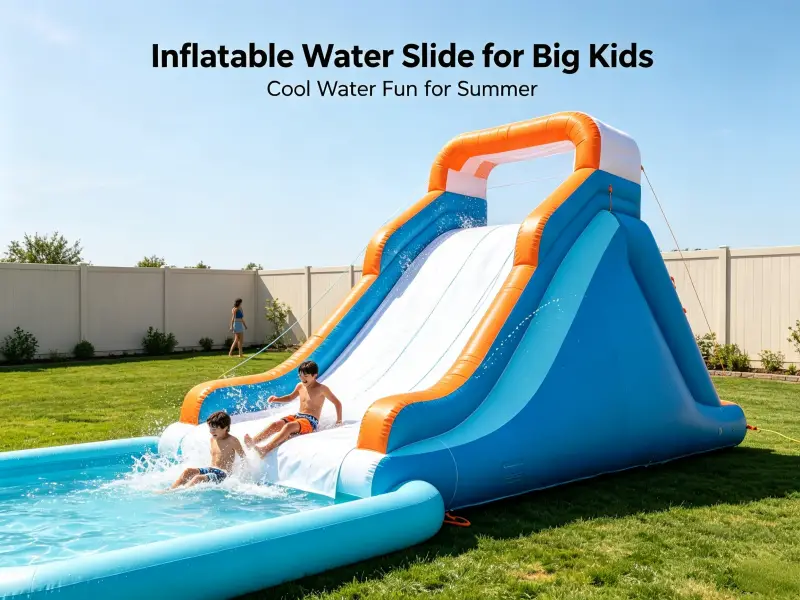
A commercial inflatable is coated PVC fabric kept inflated by one or more blowers, with the whole structure held down by anchor points at the edges. Remove the power and the shape disappears. That is why the standards split the problem in two. In the United States, ASTM F2374-24 covers design, manufacture, operation, and maintenance of commercial inflatable amusement devices, and it leans heavily on how the unit is run, not only on how it was built. In the UK, third-party inspection schemes such as PIPA exist specifically to tag and re-check inflatable play equipment against European requirements.
For a family, the practical translation is blunter. An inflatable water slide for kids lives or dies by three things:
- Airflow. A blower that stalls mid-use deflates the structure with children on it.
- Anchoring. Ground stakes or ballast have to match the surface. Soft turf, decking, and hardstanding each need different hardware.
- Wind. Inflatables are sails. Most operators shut down well before a rigid slide would be considered risky.
Age and weight limits on a big kid slide are set by the manufacturer, and they are not marketing language. A unit rated for younger children will bottom out under an adult-sized ten-year-old, and the landing zone takes the punishment.
Where inflatables work, and where they fall short
Inflatables win on portability and lose on repetition, so the deciding question is how many days per year the slide will actually be up.
Two scenarios cover almost every buyer.
Backyard weekends
For a big kid slide for backyard use, an inflatable is hard to beat. It arrives folded, stores on a shelf, and lets a family test whether a water slide is even the right purchase. Setup is fast, the footprint is temporary, and nothing needs planning permission in most locations. The trade-off is that wet fabric left inflated in the sun is the single fastest way to shorten its life.
If the same backyard will host water play every summer, a compact outdoor slide for 5-year-old riders and up, built from plastic and galvanized steel, costs more once and then stops asking for blower power every weekend. That is the usual answer for anyone weighing an inflatable water slide for big kids against a fixed install.
Daily commercial use
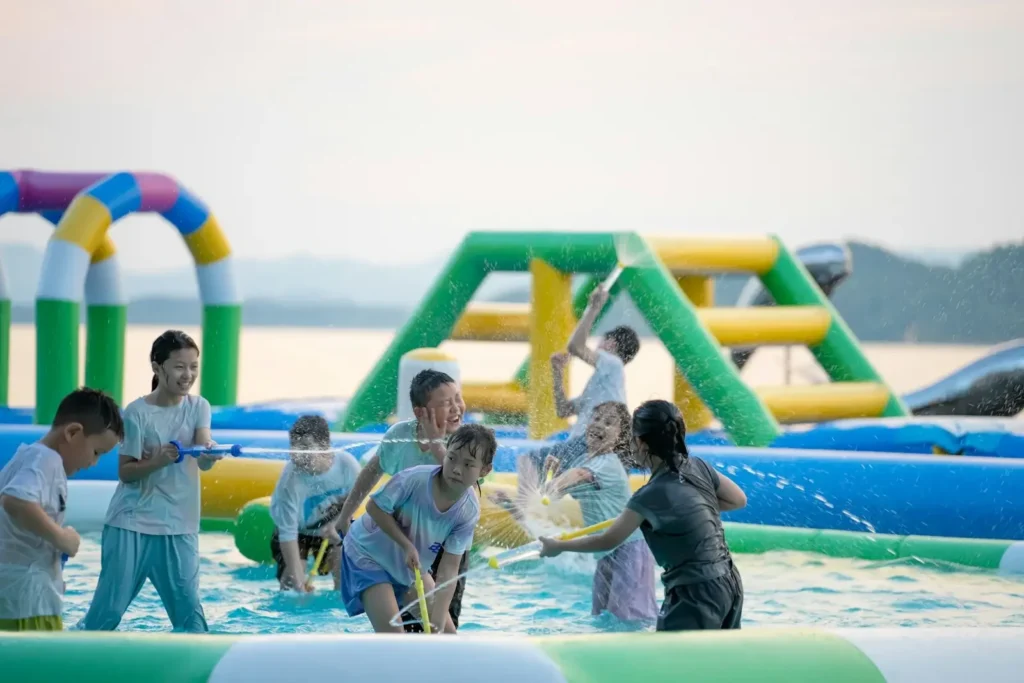
Commercial settings change the arithmetic. An inflatable water park built from slide towers and obstacle courses can pull crowds, and the format is genuinely popular. But daily operation means daily anchoring checks, daily inflation checks, supervision ratios, and a shutdown plan for gusts. When a bouncer or slide has to be packed down every evening, the labor adds up faster than most first-time operators expect. Anyone running an inflatable water park at summer peak also carries a replacement budget, because fabric under that much load does not last forever.
Rigid kid slides skip most of that list. They stay up, they drain, and they do not care whether the power is on.
Kid slide options compared
Permanent slides differ from inflatables less in the sliding surface and more in what holds them up, which is why age ratings, traffic tolerance, and paperwork all change once you leave fabric behind.
The four formats below cover nearly every request we see from parents, schools, and venue operators.
| Format | What holds it up | Best suited to | Main constraint |
|---|---|---|---|
| Inflatable water slide | Blower air pressure, anchored at the edges | Home weekends, rentals, one-off events | Wind sensitivity and blower dependence cannot stay out wet |
| Plastic combined outdoor slide | UV-stabilized engineering plastic or food-grade plastic on galvanized steel frames | Kindergartens, communities, housing estates | Needs a level base and a fixed footprint |
| Stainless steel slide | 304 stainless steel slide plates, hot-dip galvanized steel structure | Parks, resorts, coastal and high-traffic sites | Higher upfront cost and real design work |
| Indoor soft-play slide | EVA foam padding, plastic panels, galvanized steel frames | Malls, family entertainment centres, play cafés | Ceiling height and fall-zone space |
Two details separate the middle two rows in practice. First, an outdoor slide system is usually a combination unit, meaning the slide is one element inside a climbing tower with platforms, guardrails, and nets, so a single structure serves a wide age band instead of one child at a time. Second, the sliding surface matters more than the theme. Stainless steel plates are what keep a slide fast and smooth after ten thousand runs; the painted character on the tower is decoration.
Choosing a kid slide indoor or outdoor: the numbers that matter
Four specifications decide whether a slide fits its users, its site, and its maintenance budget: age and weight rating, deck height and lane count, material and finish, and anchoring.
Ask for each of them in writing. A quote that lists only a price and a photo is not yet a specification.
Age and weight ratings
Manufacturers rate equipment against a defined user range. ASTM F1487-25, the US consumer safety performance specification for public-use playground equipment, is written around the 5th percentile for two-year-olds through the 95th percentile for twelve-year-olds, which is why commercial equipment is rarely sold as one size for all ages. A slide aimed at a little kid audience of two-to-six-year-olds has lower platforms, gentler gradients, and tighter containment than a unit built for teenagers.
Where a single structure serves several age bands, good designs zone it. The best inflatable water slide for a 10-year-old keeps that rider on a run suited to their size; a permanent build can do the same thing structurally. JQK’s whale-shaped slide, for example, splits into three zones: a transparent spiral tunnel slide for ages six to fourteen, a straight slide with climbing nets for ages four to ten, and a low rotating play area for toddlers aged two to six. Children stay in the zone that matches their ability, and peak capacity rises because older riders are not queueing behind toddlers.
Deck height, slide length, and lane count
Deck height drives everything downstream: the length of the slide run, the fall height, and the depth of impact-absorbing surface required underneath. Lane count decides throughput. A single-lane straight slide handles one child at a time; a double parallel slide lets two children race and roughly doubles peak flow. On commercial sites, the entrance platform is usually the bottleneck, not the slide itself.
Height is also where age targeting gets practical. An outdoor slide for 5-year-old children needs a short run and a low platform so the climb-up is manageable, while a big kid slide can carry a taller tower and a longer tunnel without losing its appeal.
Material and finish
This is where outdoor kid slides separate into price tiers.
- Plastic bodies use UV-stabilized engineering plastic or food-grade plastic. The resin is what resists fading and cracking; the steel underneath carries the load.
- Frames are typically hot-dip galvanized steel with an anti-rust coating. Coastal sites and high-humidity regions punish anything less.
- Sliding surfaces in premium builds are stainless steel. One build from the Space Theme Outdoor Kids Combined Slide range combines a transparent tunnel slide, a straight slide, and a spiral slide on anti-UV engineering plastic with anti-rust metal supports, and every edge is rounded. A higher-specification unit uses 12 mm food-grade 304 stainless steel plates polished on both faces, hot-dip galvanized steel shells with a UV-resistant topcoat, transparent polycarbonate panels, and nylon climbing nets with standardized gaps.
Anchoring and drainage
A slide that moves is a slide that fails. Fixings should be rated for the load and the surface, and stainless hardware resists loosening better than mild steel under constant climbing. Drainage matters just as much in water play: standing water at the bottom of a run turns a slide exit into a slip hazard within a week.
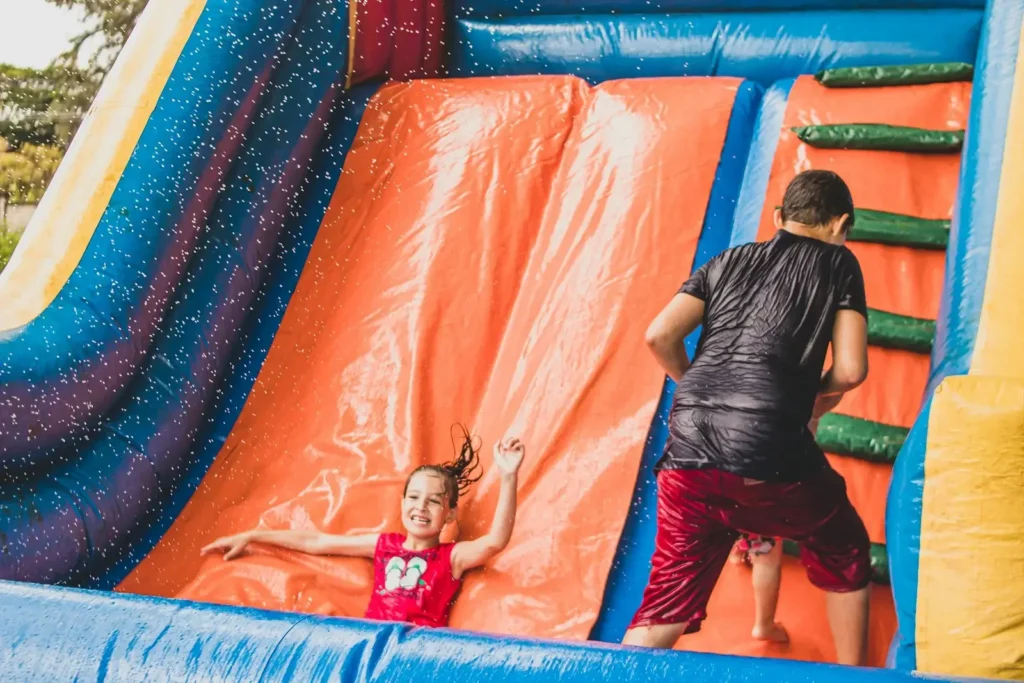
Safety checks for a big kid sliding in a backyard
Most playground injuries come from falls, not from equipment failure, so the surface under the slide and the guardrails around it deserve more attention than the slide itself.
The CPSC Public Playground Safety Handbook has treated falls to the surface as the leading cause of playground injury for decades, and the fix is unglamorous: adequate impact-attenuating material at the correct depth, matched to the fall height of the highest accessible platform.
A short pre-season check catches the rest. A big kid slide for backyard use is inspected by the people who own it, so the list has to stay short enough to actually happen twice a year.
- Walk the footprint and confirm the surface depth is still correct after winter.
- Check every fixing and anchor for movement or corrosion.
- Confirm guardrails and barriers are intact at all elevated platforms.
- Look for new entrapment gaps where parts have shifted.
- Test the exit run for standing water and debris.
- Re-read the capacity and age label, then enforce it.
For a kid slide for pool use, one more rule applies. A pool slide is not a playground slide with water nearby. Ratings, siting, and local pool codes all differ, and a slide that is legal in one jurisdiction may not be in the next. Check the local code before ordering, not after installation.
Why operators buy permanent kid slides instead of inflatables
Over a multi-year horizon the cheaper inflatable is usually the more expensive asset, because it has to be replaced, supervised, and packed away every single season.
Three costs sit outside the purchase price.
Replacement cycles and cost per season
Fabric, blowers, and seams all age. A rental-grade inflatable that runs daily will be patched and eventually retired, while a stainless steel slide with a galvanized frame keeps working past the point where three inflatables have been scrapped. Run the same numbers you would run on any asset: purchase price plus annual labour plus repairs, divided by seasons of service. The inflatable rarely wins once supervision and setup hours are counted.
Inspection paperwork and insurance
This is the part buyers underestimate. A commercial installation needs documentation: EN 1176 test reports for European projects, ASTM certification for US projects, domestic inspection reports such as GB/T 39222, plus material safety data sheets and factory production certificates for tender submissions and customs clearance. JQK supplies that documentation pack with custom builds, along with graded warranties covering steel frames, stainless steel slides, polycarbonate parts, and rope nets.
An inflatable can also be certified, and reputable suppliers of commercial inflatables do test against the relevant standards. The difference is that inflatable compliance leans on operating procedure, which sits with the operator, whereas a fixed structure’s compliance is largely settled at the factory and verified at installation.
Kid slide indoor: what changes when you move inside
Indoor play removes weather and wind from the equation and replaces them with ceiling height, floor loading, and a much wider user band from toddlers to twelve-year-olds.
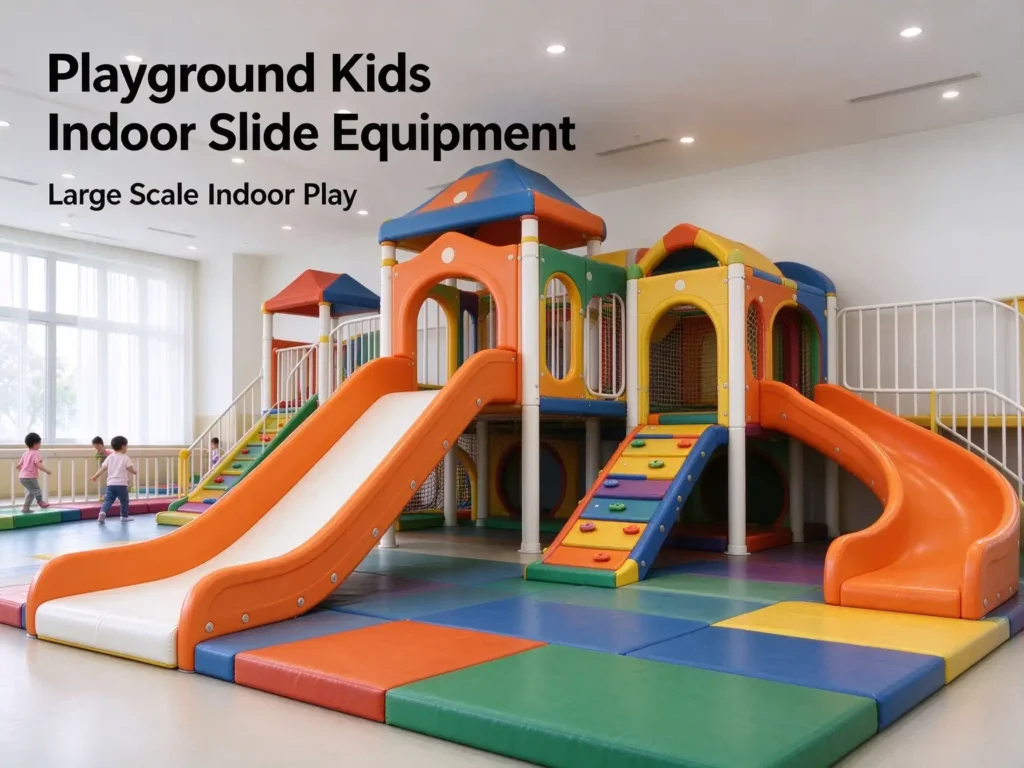
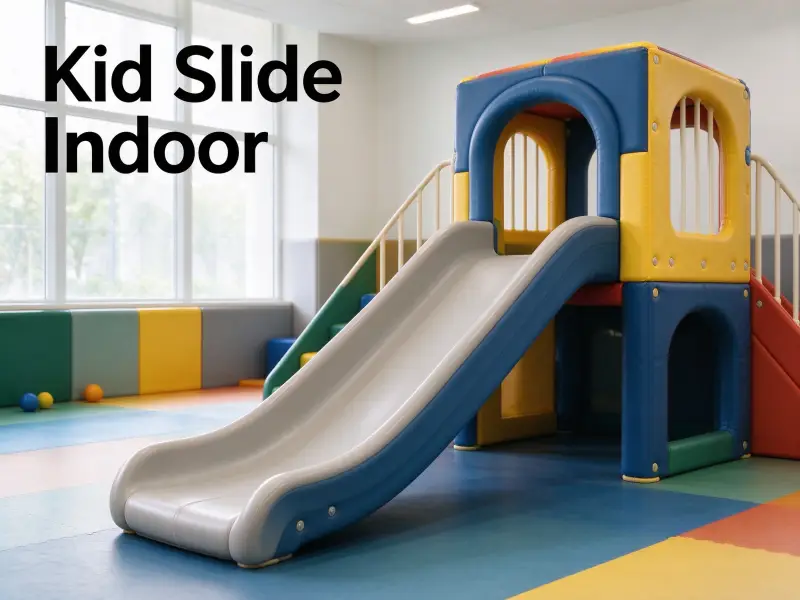
A kid slide indoor installation is usually part of a larger soft-play build. An indoor playground, sometimes called a naughty castle, is a soft-padded enclosure with slides, ball pits, climbing walls, and role-play areas designed for children from zero to twelve. The materials change accordingly: EVA foam and HDPE panels on galvanized steel frames, with everything rounded and padded.
Specifications differ too. Indoor slide sizes are quoted in centimeters and sold at low minimum order quantities, so a single unit is realistic for a small venue. Within the childhood fun series, for instance, individual units run from roughly L500 × W480 × H375 cm for the compact models up to L1750 × W1000 × H520 cm for the larger configurations, with a minimum order quantity of one.
Two planning numbers decide whether the layout works:
- Headroom. The highest platform plus the safety clearance above it has to fit under the ceiling with room for lighting and sprinklers.
- Fall zone. The padded area around the slide exit is part of the equipment footprint, not spare space, so it belongs in the layout from the first sketch.
Custom projects: how to plan a big kid slide for a park or venue
Custom work is mostly a sequencing problem, and the projects that run smoothly are the ones where the site survey happens before the design is committed.
JQK has been building themed playground equipment since 2016 from a 35,000 sqm workshop in Nanping, Fujian, and has supplied more than 10,000 kindergartens and communities. The projects that go well tend to follow the same order.
Site survey first
Collect these before any design review:
- Site dimensions, plus the position of drains, trees, and buried services.
- Surface type and its load-bearing capacity.
- Target age group and expected peak visitor numbers.
- Theme direction, if the venue already has one.
- Any certification requirements the tender or local authority demands.
Design, production, and installation
Layout, theme, and material specification follow from the survey. Because components ship as modular packages with construction drawings and bilingual installation manuals, the site work is shorter than most clients expect. Typical figures from the manufacturer’s own schedule:
| Stage | Typical duration |
|---|---|
| Layout suggestion and price list with the quote | Within 12 hours of receiving site details |
| Production, standard order | 15 to 30 days |
| Production, a large or highly customized project | 30 to 45 days |
| Installation, indoor playground of 50 to 100 sqm | 2 to 3 days |
| Installation, large multi-level or themed build | 1 to 2 weeks |
Themes can be developed from scratch as well as adapted. Space, cartoon, sci-fi, forest, castle, and IP-based directions are all handled in-house, which matters when a park wants the equipment to match an existing brand rather than sit beside it.
Maintenance that decides how many summers you get
A slide lasts as long as its inspection routine does, and the routine itself is short if it happens on schedule.
For an outdoor slide, the work is seasonal and quick: rinse the sliding surface, check fixings, clear drainage, and inspect the base. Stainless surfaces are forgiving, but they still want debris removed so grit does not score the plates. Outdoor kid slides left uncleaned through autumn, collecting leaf litter in the run, which is how a smooth surface turns abrasive.
For indoor playgrounds, the recommended rhythm is daily cleaning of high-touch surfaces, weekly inspection for loose parts and wear, and monthly deep cleaning of ball pits and soft components. Replacement parts and maintenance guides should come from the original manufacturer, because mismatched hardware on a climbing frame defeats the point of buying a rated structure.
Warranty terms tell you what the manufacturer expects to fail. Graded coverage on steel frames, stainless slides, clear panels, and rope nets, with longer terms on the structural components and shorter ones on the consumable parts, is a realistic split. A blanket lifetime promise is not.

Getting a real number
A slide quote is only as good as the details you send, because price depends on footprint, theme, material grade, and certification requirements, not on a catalogue entry.
Send the site size, the age group, whether the installation is indoor or outdoor, the theme direction, and any certification the project must satisfy. With that, a manufacturer can return a layout suggestion and a price list within about 12 hours, and the design team can revise the plan before you commit to anything. For project-specific pricing, contact us and include your park size, target audience, and budget range, and ask for the documentation pack alongside the quote so procurement and customs have what they need at the same time.
FAQ
How long will an inflatable water slide for kids last compared with a permanent slide?
It depends on the duty cycle. A home inflatable used on weekends and stored dry can serve several seasons with patching and careful storage. A rental unit running most days will need major repairs and eventual replacement well before a steel and stainless slide reaches the end of its working life. The fair comparison is cost per season, not purchase price.
Can a kid slide for pool use be installed at home?
Pool slides sit under a different set of rules from playground slides, and requirements vary by jurisdiction, so the local code governs what can be installed and where. Ratings and siting distances are specific to each model. Confirm the local requirement before ordering, and treat the manufacturer’s age and weight rating as the ceiling on who uses it.
Should a little kid slide and a big kid slide share the same structure?
They can, provided the structure zones them. Designs that separate a tunnel or spiral run for older children from low rotating and climbing play for toddlers keep different abilities apart while letting the whole family use one footprint. Mixing ages on the same run is where most queues and most collisions start. A venue that expects both a little kid slide crowd and older riders should plan the split at the design stage rather than adding a second unit later.