
Anyone visiting city parks, kindergarten yards or commercial parent‑child venues will spot modular combined play slides standing as the core play facility. Decades ago, playground slides were simple single‑function sliding chutes. Today they have evolved into multi‑activity tower sets integrating sliding, climbing, panel games and rest platforms.
This transformation is driven not only by market demand for more engaging play experiences, but also by updates to global safety standards, material iterations, risk‑control requirements, and rising demand for inclusive and expandable play solutions.
Modular combined slides never replaced standalone slides entirely. Instead they absorbed multiple play functions into one compact footprint. Early single‑function slides only offered a sliding experience with limited play value. Modern modular slide systems adopt a bolt‑together modular‑component design. Operators can add or remove climbing parts, game panels and swing attachments according to site space, target age groups and later‑stage renovation plans. Standards including EN 1176‑2 and ASTM F1487 have continuously revised clauses for combined play structures, setting strict rules for platform height, barrier protection, chute geometry and use zones.
It is worthwhile sorting out how simple sliding chutes evolved into today’s all‑in‑one modular combined play towers.
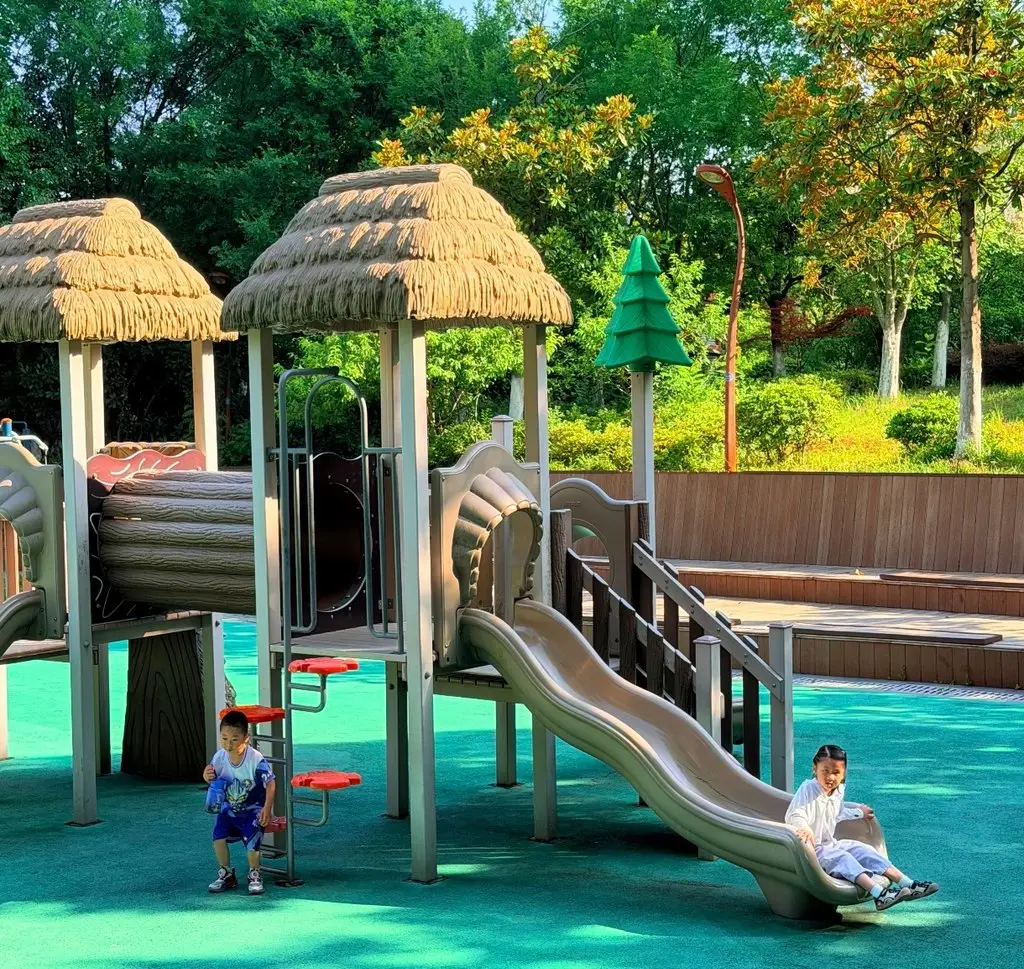
Were Traditional Single‑Unit Play Slides Phased Out Completely?
No. Neither European playground standards nor US federal safety regulations ban standalone single‑lane slides.
EN 1176‑2:2017+AC:2019 covers safety specifications for independent slide units. ASTM F1487 also sets performance test requirements for single‑function slides. The CPSC Public Playground Safety Handbook dedicates independent sections for both standalone slides and multi‑component combined play structures.
The impression that single slides “disappeared” comes mostly from local site‑level procurement choices, not legal prohibition. Since the 1990s, many park and kindergarten operators preferred modular combined sets, which deliver more play activities within a limited land space. The CPSC clearly classifies all its content as guidance rather than mandatory regulations. However, insurance institutions and local regulatory bodies often require projects to follow these guidelines. Choosing modular over single‑function slides represents risk‑management and space‑utilization judgment for each project site, not mandatory compliance.
Why Do Public Venues Favour Modular Combined Slides Over Old‑Style Single Slides?
Traditional single‑lane slides carry inherent drawbacks: limited play value, poor space‑utilization efficiency, and inflexible structures that cannot adapt to site‑renovation upgrades.
Back in the 1970s‑1980s, independent single slides were widely installed across countless public playgrounds. Gradually, site managers found three obvious practical bottlenecks restricting their application.
Risk liability & insurance assessment
A single‑function slide only provides sliding play. To satisfy children’s climbing needs, operators must install separate climbing ladders or climbing nets nearby. Multiple scattered facilities create more independent fall‑risk zones, expanding the safety use zone and raising the risk of potential injury claims. When safety specifications became stricter, maintaining multiple discrete play devices meant higher risk‑management costs. Integrating climbing, sliding and game areas into one unified tower helps concentrate risk‑control zones and lowers overall liability pressure for site owners.
Space planning & long‑term maintenance costs
Each separate play piece needs its own large safety buffer zone. If project planners place a slide, climbing net and play panel individually, these items occupy far more total ground space than a single modular combined unit. For densely‑built communities and compact kindergarten campuses, land resources are very precious. Meanwhile, scattered equipment means more independent support frames, more connecting hardware and more components needing routine inspection and replacement. Modular combined slides share unified main steel support frames, reducing the total quantity of metal frames and lowering the long‑term inspection and maintenance burden.
Age‑group adaptation and on‑site supervision pressure
Separate play facilities are seldom matched in height and difficulty. Toddlers and school‑age children can move freely among scattered devices, creating complex supervision challenges. Modular combined slides can be split into height zones: low‑elevation platforms for preschool‑aged children and taller towers for older kids. Designers can set different difficulty levels for ladders, slides and interactive panels on the same set, guiding kids of different ages to corresponding activity areas and easing the supervision burden for site staff.
What Safety Specifications Govern Today’s Modular Combined Play Slides?
Qualified modular combined slides must strictly control platform fall height, guardrail barrier height, slide gradient, anti‑entrapment gaps, landing run‑out area and shock‑absorbing surfacing within the whole use zone.
The 2025 CPSC Public Playground Safety Handbook lists detailed dimensional requirements for multi‑component combined playground structures. Although these documents serve as guidance rather than legal mandates, inspectors, underwriters and playground builders treat them as core reference criteria.
Two points are frequently ignored during purchasing. Fall height is measured from every accessible standing position of the whole combined tower, not merely the slide exit point, which determines the required thickness of protective ground surfacing. In addition, different play zones within one modular unit should be clearly differentiated by difficulty for distinct age groups.
Single‑Unit Slide VS Modular Combined Play Slide
Single‑unit slides keep simple sliding functions, while modular combined slides integrate diverse play modules on shared supporting frames. They both deliver sliding enjoyment but differ significantly in site adaptability.
| Attribute | Single‑Unit Independent Slide | Modular Combined Play Slide |
|---|---|---|
| Core play function | Only sliding experience | Sliding, climbing, panel games, multi‑user interaction |
| Space utilization | Large independent safety buffer zone required | Multiple functions share one overall use zone, saving site space |
| Structural expandability | Fixed structure, no space for adding accessories | Reserved mounting positions for swings, rockers and other attachments |
| Maintenance workload | Independent support frame, more separate components | Unified main steel frame, fewer frame parts for inspection |
| Age adaptability | Single difficulty level | Multi‑height platforms, customizable for mixed‑age users |
| Governing reference | CPSC & EN 1176 clauses for independent‑slide units | CPSC & EN 1176 combined multi‑play‑structure requirements |
For small‑size toddler‑only activity corners, single‑unit slides can still be a good option. For most public playgrounds, kindergarten projects and community projects serving mixed‑age groups, modular combined slides represent a more cost‑effective solution.
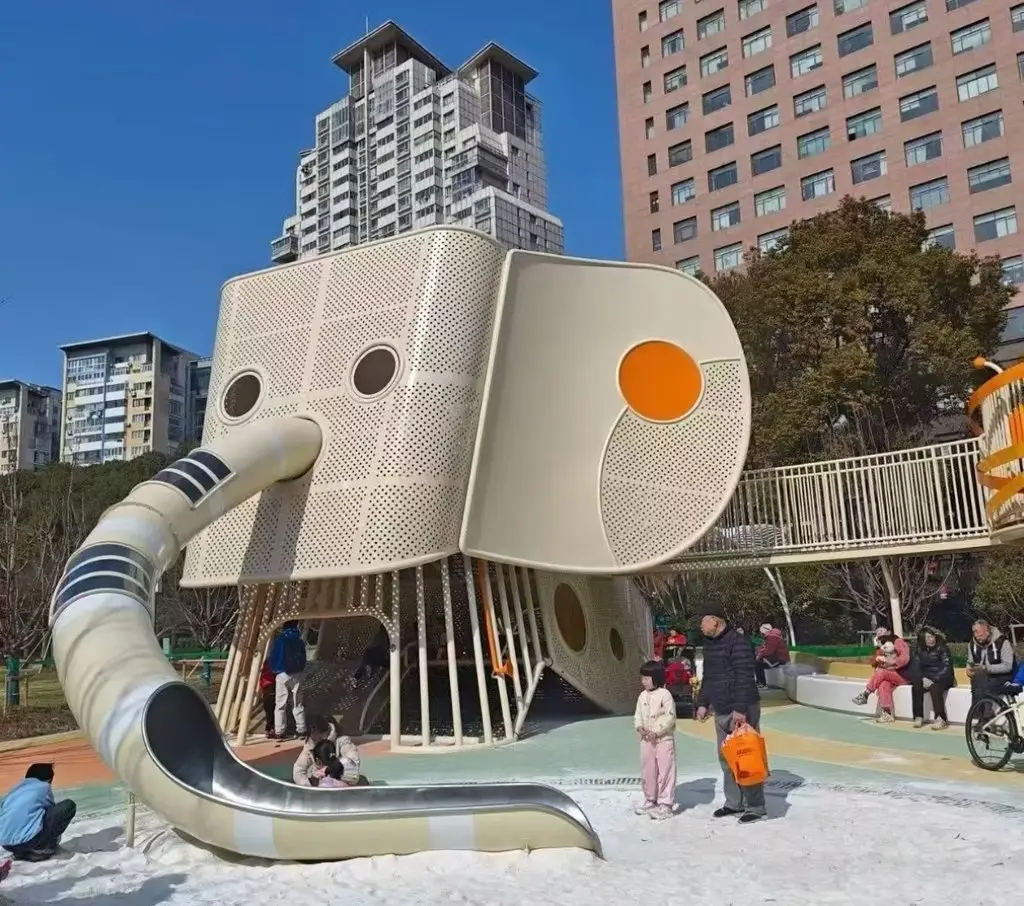
What Supporting Play Facilities Match With Modular Combined Slide Towers?
Spring rockers, spinning play units, crawl tunnels and ground‑level interactive panels can enrich play experiences without occupying excessive additional site space.
Modular slide towers serve as the main landmark facility. Auxiliary equipment complements play modes and improves site capacity:
Anti‑slip climbing ladders and climbing nets build upper‑body strength for children to reach slide platforms.
Ground‑mounted spring rockers offer low‑intensity bouncing fun for preschool‑age kids.
Rotating spinner devices provide vestibular stimulation for kids.
Crawl tunnels bring hide‑and‑seek and imaginative game scenarios.
Accessible transfer platforms help children with limited mobility get close to play components.
No auxiliary facility can fully replace combined slide towers. The unique downhill‑gliding sensation delivered by slides remains irreplaceable within outdoor children’s recreation.
Where Can We Still Find Widely‑Used Single‑Unit Slides?
Single‑unit slides are still commonly seen on the market, mostly deployed in small‑scale early‑education activity rooms, private backyard play sets and mini‑play corners inside shopping malls.
Surviving large‑size standalone public slides mainly fall into three scenarios: small‑scale community micro‑parks, retro‑theme custom playground projects and venues specially for toddler groups. Many of these legacy single‑slide products have been upgraded with modern LLDPE plastic chutes and galvanized steel frames to meet current safety standards.
Accessibility rules also change purchasing logic. The 2010 ADA Standards require accessible routes for ground‑level play components. Large modular combined slides can more easily integrate transfer platforms and wide entryways to satisfy accessibility requirements — a capability that is harder to achieve with basic single‑unit slides.
Before finalizing purchasing specifications for modular combined slides, buyers should verify five key points before comparing quotations:
- Target‑user age range, whether the venue includes exclusive preschool play zones.
- Maximum platform fall height, slide slope and exit run‑out dimension for calculating protective surfacing parameters.
- Plastic material performance: UV‑resistance, anti‑aging test reports for outdoor long‑term application.
- Guardrail height, gap anti‑entrapment compliance and specification of anti‑theft stainless‑steel fasteners.
- Complete use‑zone dimension matched with actual site layout instead of only referring to catalogue footprint data.
Why Have All‑Wood Combined Play Structures Lost Popularity?
Timber‑constructed combined slide sets declined for practical reasons: splinter hazards, ground‑contact rot, high‑frequency maintenance demands, and costly custom fabrication — prompting public purchasers to select solutions built from galvanized steel paired with rotationally‑molded LLDPE plastic.
Before 2004, CCA‑treated timber was widely used for outdoor play‑structure frames. Manufacturers voluntarily stopped supplying CCA‑treated wood for civilian use at the end of 2003. EPA guidance does not force removal of existing CCA‑wood facilities, yet penetrating surface coatings are recommended to reduce chemical leaching risks. This material shift removed the most cost‑effective durable timber choice for public playground bidding.
Real‑world operating problems accelerated this replacement. Timber easily generates splinters at hand‑holding positions. End‑grain wood absorbs water and rots where it touches soil. Every safety‑inspection cycle can uncover timber boards that require replacement. Powder‑coated galvanized steel posts paired with LLDPE plastic components achieve longer service cycles and greatly reduce day‑to‑day maintenance pressure for park‑management departments.
Custom‑made wooden combined slides still exist in high‑budget theme destination playgrounds, where unique appearance value justifies special‑purpose maintenance plans. They are not standard catalogue products for schools and public projects operating on fixed annual budgets.
FAQ
What special developmental values do modular combined slides bring for children?
Yes. Beyond balance, spatial perception and speed judgment gained from sliding itself, modular towers integrate climbing challenges and interactive panel games. Children build physical coordination while learning turn‑taking, queue‑waiting and peer‑communication skills.
Spinners and spring rockers offer vestibular stimulation, but they cannot replicate the comprehensive mixed play experience delivered by multi‑function combined slide towers. That is why playground designers regard modular combined slides as core facilities for most outdoor children‑oriented venues.
Can project teams install a new modular combined slide without replacing existing playground surfacing?
It is feasible in some cases, on condition that the maximum fall height of new equipment stays within the shock‑absorbing capacity of the original ground surfacing. Fall height is measured from every accessible standing platform position of the whole tower. Low‑height preschool‑grade modular units may adapt to existing engineered wood fiber or rubber surfacing. Tall multi‑layer combined towers usually need thicker protective surfacing material or full replacement. The complete safety use zone surrounding platforms, ladders and slide exits must always be covered by qualified shock‑absorbing ground material.
What creates the biggest cost when adding a modular combined slide?
The play‑set hardware itself is seldom the largest expenditure item. Modular combined slide catalogue prices may look acceptable, but surfacing upgrades, site ground preparation, foundation anchoring, delivery and on‑site installation labor costs often exceed the price of the playground equipment.


