
Anyone who has priced a play area has met the same small obstacle. Three suppliers send three quotations, and the same piece appears as a climber, a play panel, a play structure and a jungle gym, so the line items cannot be compared without a phone call. Buyers who maintain outdoor playground equipment across several sites meet a second version of the problem, because the name on the invoice rarely matches the name in the maintenance log or the name in the safety standard.
The names most people use fall into two groups. For the whole assembly, the common names are playground equipment, play structure, play system, playset, play apparatus and jungle gym, and the last two are regional or dated. For the parts, the common names follow the movement a child makes: climber, monkey bars, slide, swing, spinner, merry-go-round, seesaw, spring rider, balance beam and play panel.
Each of those names carries a different scope, and the differences matter most when a document has to be precise.

What Is Another Name for Playground Equipment?
The common alternatives are play structure, play system, playset, play apparatus and jungle gym, with playground equipment itself as the widest of the six. Play structure and play system are often used interchangeably for a unit with several activities, playset normally means one residential unit, and jungle gym is the older name for a climbing frame.
The differences are not decorative. A play structure can be a single climbing unit with no slide, while a play system implies several activities joined by decks and links. A playset belongs to one household and answers a retail question, which is why the word sounds wrong in a park tender. The table below sets out where each term is normally heard and what it usually covers.
| Term | Where it is heard | What it normally covers |
| Playground equipment | Standards, tenders, insurance schedules | Everything on the site, including surfacing and furniture |
| Play structure | Catalogs, designers | One built unit, connected or single |
| Play system | Manufacturers, modular ranges | A connected unit sold as a configurable kit |
| Playset | Retail, residential | One backyard unit for one household |
| Play apparatus | UK and Irish documents | Fixed climbing and balancing equipment |
| Jungle gym | Everyday speech, older documents | Climbing frame, often with overhead bars |
The widest of these terms is the one regulators use. The CPSC Public Playground Safety Handbook defines public playground equipment as equipment for children from 6 months through 12 years in parks, schools, childcare facilities, institutions, apartment grounds and comparable sites, then excludes amusement park equipment, fitness equipment for users over 12, soft contained play equipment, constant air inflatables, water play equipment and home playground equipment. That exclusion list is worth reading twice. It turns six other everyday uses of the word playground, from amusement rides to backyard sets, into separate product categories, each with its own standard and its own vocabulary.
What Are the Common Names for Children’s Playground Equipment?
Component names are grouped by the movement a child performs rather than by material or manufacturer, so the same slide is filed under sliding in a catalog and under a model code in a quotation. Seven groups cover almost every public playground: climbing, swinging, sliding, spinning, rocking, balancing and sensory play.
That grouping is why a buyer can describe a whole site without knowing a single model number, and also why two quotations for the same brief can disagree on scope. The table below maps the everyday name to the trade name for each group.
| Play movement | Everyday name | Trade or catalog name |
| Climbing | Climber, monkey bars | Climber, horizontal ladder, overhead ladder |
| Swinging | Swing, baby swing | Belt swing, bucket swing, glider, tire swing |
| Sliding | Slide | Straight, wave, spiral, tube slide |
| Spinning | Merry-go-round, spinner | Carousel, roundabout, spinner bowl |
| Rocking | Seesaw, spring rider | Teeter-totter, spring rocker |
| Balancing | Balance beam | Stepping pods, balance pods |
| Sensory | Activity panel | Music panel, sensory panel, play panel |
Climbing and Overhead Names
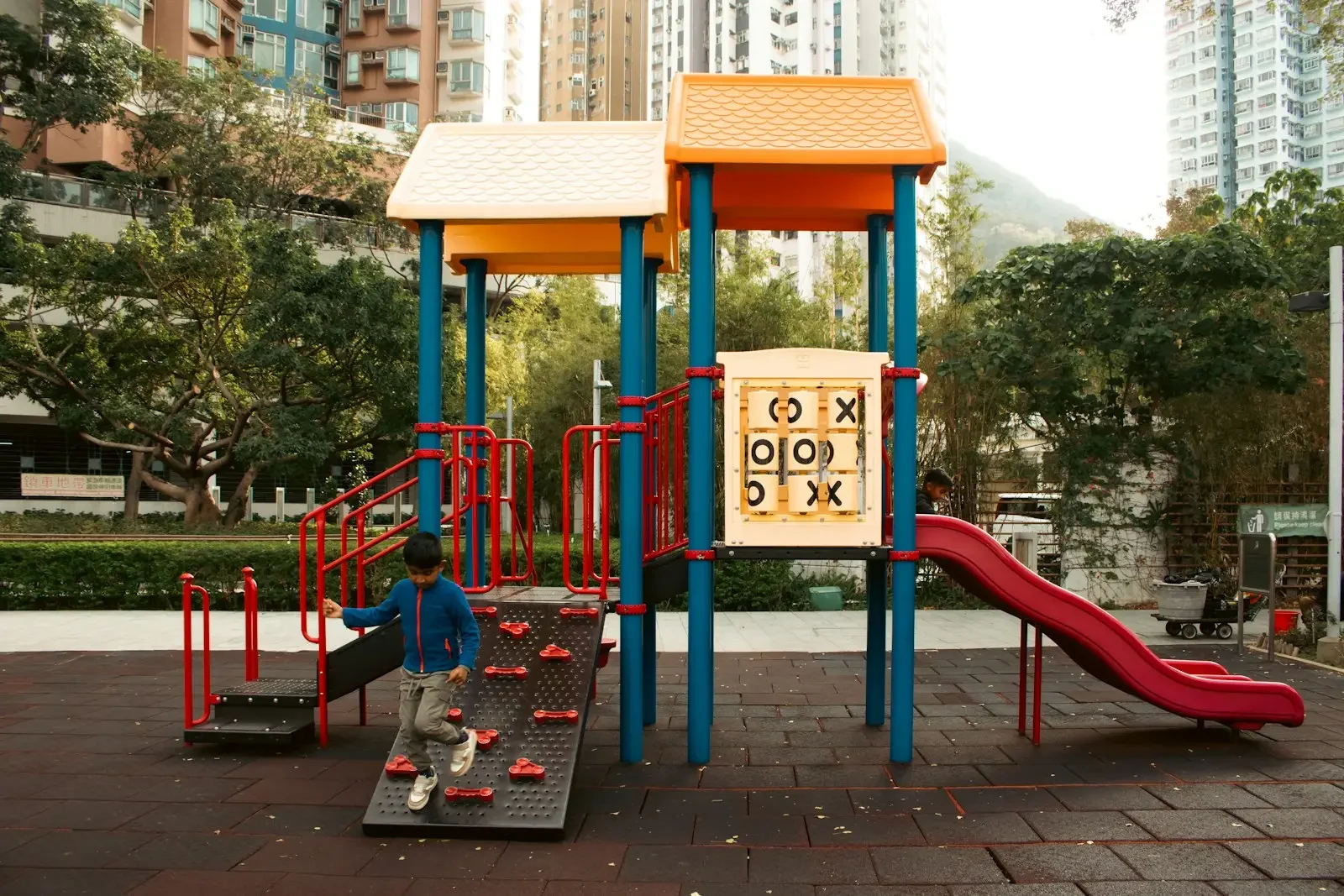
Climbing names carry the most history. Jungle gym survives from the steel frame that dominated schoolyards before modular systems, monkey bars remain the everyday term where catalogs print horizontal ladder or overhead ladder, and a geodesic climber is sold as a climbing dome. Cargo nets, rope ladders, rock walls and fire poles belong to the same group. On a modern multi-function play set several of these climbers hang off one deck, which is why the access route deserves the same attention as the name of each unit.
Swinging, Sliding, Spinning, and Rocking Names
Swinging splits by seat rather than by frame: belt swing, bucket swing for toddlers, glider for two riders facing each other, tire swing, and the large disc or net swing. Sliding splits by path: straight, wave, spiral, and the fully enclosed tube. Spinning is where names collide, since merry-go-round, carousel and roundabout describe the same rotating platform, a spinner is the smaller low-profile disc, and a spinner bowl is the seated version. Rocking covers the seesaw, also called a teeter-totter, and the spring rider that catalogs sometimes list as a spring rocker.

What Do You Call Playground Toys?
In everyday speech they are playground toys, and children will keep calling them that. In a purchase order the same objects are playground equipment or play components, and the shift is not cosmetic, because toy and equipment point to different safety standards.
A toy is judged as a toy, on small parts, sharp edges, material chemistry and age labeling. Fixed play equipment is judged on fall height, use zones, entrapment openings and the impact attenuation of the surface beneath it, none of which can be assessed for an object still in a box. A quotation that describes a commercial climber as a toy invites the wrong test report, and in some markets the wrong import category as well. The workable rule is to keep the word toy in conversation with parents and out of every document that a supplier will price from.
What Is the Most Common Playground Equipment?
The composite play structure is the most common single unit on a public playground, and the slide and the belt swing are the most common individual components. Which of those answers is correct depends on how the question is measured.
Three measures give three different answers, and each is legitimate:
- Installed base. One composite structure serves a whole age group, so it dominates by site count even where individual units are more numerous.
- Catalog range. Slides and swings outnumber every other component family in printed ranges, because both are sold separately and as parts of a kit.
- Specification rate in new projects. The default pairing is a composite structure plus a swing bay, with spinners added where space and budget allow.
The standard does not rank anything. ASTM F1487-25 is a consumer safety performance specification for playground equipment for public use, and that phrase does the work here: public use, not home use, so a home unit built to a different specification cannot be substituted for it in a park or school project no matter what the catalog calls it.
Why Does the Same Piece Have Several Names?
Four vocabularies describe the same object: everyday speech, manufacturer catalogs, safety standards and accessibility law. Regional usage adds a fifth layer, so one part can carry three or four legitimate names and still be misread in a quotation.
The systems evolved for different readers, which is why none of them is wrong. The table below shows the word each system prefers.
| Naming system | Word it prefers | Example |
| Everyday speech | Jungle gym, seesaw, roundabout | The spinny thing at the park |
| Manufacturer catalog | Play system, spinner, spring rocker | Trade name plus model code |
| Safety standards | Playground equipment, swing, slide, rocking equipment | Title of the standard or the part |
| Accessibility law | Play component | Ground-level and elevated component |
Regional drift is the fifth layer, and it is the reason two English-language quotations can look unrelated. The table below covers the pairs that cause the most confusion.
| Part | United States | United Kingdom | Australia |
| Pivoting board for two riders | Seesaw, teeter-totter | Seesaw | Seesaw |
| Rotating platform | Merry-go-round | Roundabout | Merry-go-round |
| Frame with overhead bars | Jungle gym | Climbing frame | Climbing frame |
| Fixed climbing equipment | Play structure | Play apparatus | Play equipment |
| Loose impact surfacing | Engineered wood fiber | Bark chippings | Soft fall |
The standards layer is the most formal of the four. The European series splits by equipment type instead of by activity, with separate parts for swings, slides, cableways, carousels and rocking equipment, so a European quotation names the part after the clause that governs it.
Accessibility Vocabulary: Play Components
Accessibility law uses the narrowest vocabulary of all. The 2010 ADA Standards count play components and divide them into ground-level and elevated components, then require a defined share of elevated components to sit on an accessible route, with ramps or transfer systems counted in components rather than in area. A schedule written in equipment names has to be converted into component counts before that check can be run, which is the single most common reason a compliant design fails review on paper.
Which Name Should Go into a Spec Sheet or RFQ?
Write three fields per line item: the type as the standard names it, the play function or position in plain words, and the standard or clause reference. That combination survives translation, substitution and a change of supplier.
The sequence below is short enough to run on a single site visit:
- Number each location on the site plan before opening any catalog.
- Name the type in the vocabulary of the standard: swing, slide, rocking equipment, composite structure.
- Add the plain function and position: two-bay swing for ages 5 to 12, embankment slide, cradle swing, elevated deck.
- Add the reference: standard edition plus age band.
- Keep the supplier model code in its own field, never inside the description.
Age bands change the standard, so they belong in the name. Equipment for children from 6 months through 23 months is covered by a separate specification from general public equipment for ages 2 to 12, and soft contained play is covered by a third. A line item that reads toddler unit, with no age band, can be quoted against any of the three, and the same gap exists on the European side, where the difference between ASTM F1487 and EN 1176 shows up first in what the parts are called.
Four terms cause most of the confusion in returned quotations: play unit, which sometimes means one deck and sometimes a full system; activity panel, which can be a single panel or a cluster; soft play, which is either an indoor padded area or loose surfacing depending on the reader; and toddler swing, which is either a bucket seat or a complete bay. When that argument needs settling, a plain list of playground equipment components helps more than another synonym.
FAQ
Three questions tend to arrive after the naming has been agreed.
Is a Play Structure Always One Connected Unit?
No. In catalogs a play structure can be a single climbing unit with no slide, and the connected version is usually called a play system or composite structure. Ask for the deck count and the number of link sections, which settles the question faster than any definition.
Does the Name on a Quote Change Which Safety Standard Applies?
Sometimes. Toy versus equipment changes the standard, and home versus public use changes it again, because home units and public units are judged against different specifications. Purely cosmetic synonyms do not: calling a spinner a merry-go-round has no effect on compliance, which is why the fit-for-purpose words are worth more attention than the marketing ones.
What Do Inspectors Call the Parts in a Report?
Inspection reports use the standard vocabulary, so a finding will name the composite structure, the component, the designated play surface and the use zone, then cite the edition of the standard applied. Use zone is the term that unsettles owners most often, because it describes the clear area around a unit and appears nowhere on the equipment itself.


