
A quotation, a tender document and an insurance form can all refer to “outdoor play equipment” and mean three slightly different things. That is why supplier comparisons of outdoor playground equipment so often fail to line up: one party is pricing a set of structures, another is pricing a whole site, and a third is pricing a category that a policy document defines. This guide settles the vocabulary first, then shows how the category is organised, how it is specified by age and by standard, and what a buyer should hold in hand before signing.
Outdoor play equipment is play infrastructure that is permanently sited outdoors, built from materials rated for year-round weather exposure, and designed so that the play value comes from the structure itself rather than from a toy, a screen or an adult leading an activity. The category covers climbing frames, slides, swings, spinning and balancing units, themed play structures and the surfacing inside the use zone, and it is defined by three tests applied together: it stays outside, it is fixed or anchored, and its primary purpose is play rather than exercise, sport or seating.
Those three tests explain most of the confusion that follows, so they are worth taking one at a time.
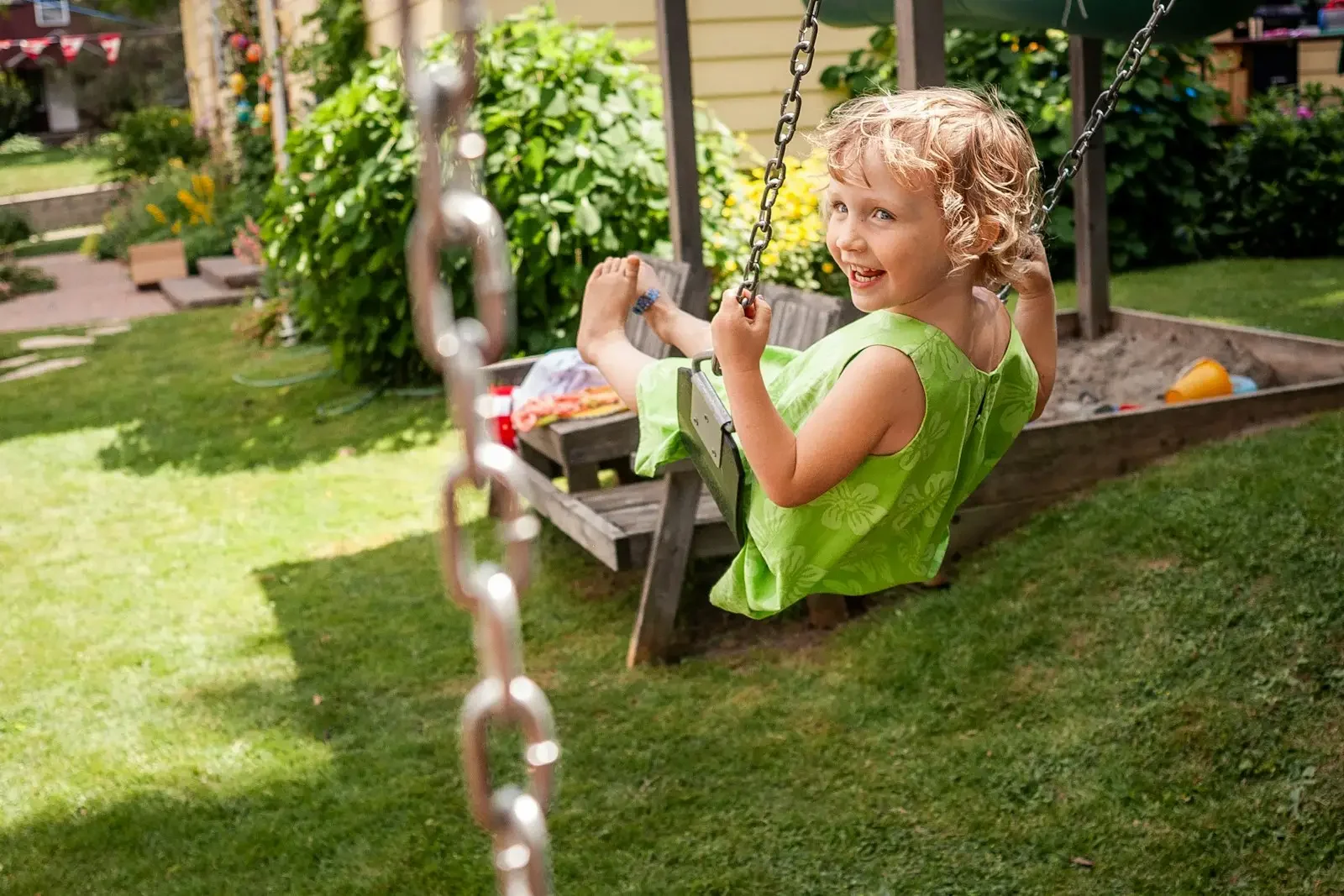
What Does Outdoor Play Equipment Mean in Practice?
In practice, whether a product counts as playground equipment is decided by all three tests at once: permanent outdoor siting, weather-rated construction and a primary purpose of play. Anything that fails one of them falls outside and is governed by a different set of rules, which is why inflatables, home swing sets and fitness stations are handled separately.
The siting test removes inflatable bouncers, temporary event rides and anything built to be packed away at the end of a season. The construction test removes indoor soft play, which is designed for a controlled climate and carries no allowance for UV or freeze-thaw. The purpose test removes sports courts, outdoor gym stations, benches and shading, which may sit on the same site but answer to different standards and different budgets.
For a buyer the boundary is not academic. Standards, test certificates, warranty terms and inspection duties attach to the equipment class rather than to how a product looks. A supplier quoting an inflatable against a fixed structure requirement is answering a different question, and the mismatch usually surfaces at the permit stage rather than at the quotation stage.
What Is Meant by Outdoor Play?
Outdoor play is the self-directed activity children choose to carry out in the open air, and equipment is only the infrastructure that makes that activity possible. The play is the behaviour; the equipment is the setting. A site can be fully equipped and still generate very little play if the layout leaves children nothing to decide for themselves.
Play of this kind is open-ended. Children set the pace, change the rules and stop when they are done, which is what separates it from a lesson, a drill or a game organised by an adult. Outdoors adds conditions a hall cannot reproduce: space to run, ground that slopes and changes, weather, noise, loose material that can be dug and piled, and permission to be loud.
That distinction matters because activity levels are measured, not assumed. The World Health Organization guideline for children under five recommends at least 180 minutes of physical activity a day for those aged three to four, including at least 60 minutes of moderate to vigorous activity, and treats being restrained for more than an hour at a stretch as something to avoid. A site that offers one route up and one route down cannot absorb that volume of movement. Layout can: loops rather than dead ends, several levels, and features that invite chasing, carrying and building.
The confusion worth clearing up is that outdoor play is an outcome and playground equipment is the infrastructure that produces it. Buying the second does not guarantee the first.
What Are the Common Types of Outdoor Play Equipment?
Six families cover almost everything sold as playground equipment: climbing and overhead travel, sliding, swinging, spinning and balancing, themed and imaginative structures, and ground-level sensory or nature play. Commercial sites usually combine three or more of them, because a single family holds attention for a short time only.
The table works at family level. Within each family the units differ in scale, fall height and capacity, so the family tells you what a site offers and the unit specification tells you what it costs.
| Family | Typical units | Main developmental target |
| Climbing and overhead travel | net towers, boulders, monkey bars, climbing walls | grip strength, route planning, risk judgement |
| Sliding | straight, spiral, tube and embankment slides | balance, postural control, speed tolerance |
| Swinging | belt, bucket, tyre, saucer and nest swings | vestibular input, rhythm, grip endurance |
| Spinning and balancing | rotation units, wobble decks, balance beams | vestibular calibration, core stability |
| Themed and imaginative | play castles, playhouses, towers, play panels | narrative play, language, cooperation |
| Ground-level and sensory | sand and water, music, planting, mounds | tactile exploration, early cause and effect |
Fixed Structures versus Free-Standing Units
Free-standing units need no foundation and can be moved or stored, which suits nurseries and rented sites. They also tip more easily, so they only work where supervision is continuous, and most permitting authorities will not count them toward fixed play provision. Fixed structures are anchored to a foundation and reserve a use zone for their whole service life.
Composite Systems and Themed Play Castles
Composite systems put several families on one frame with multiple entry and exit points, which raises throughput and keeps children circulating instead of queueing. A multi-function play set is the smallest version of that idea; a themed castle is the largest, and it trades some flexibility for a silhouette that can anchor an entire site.
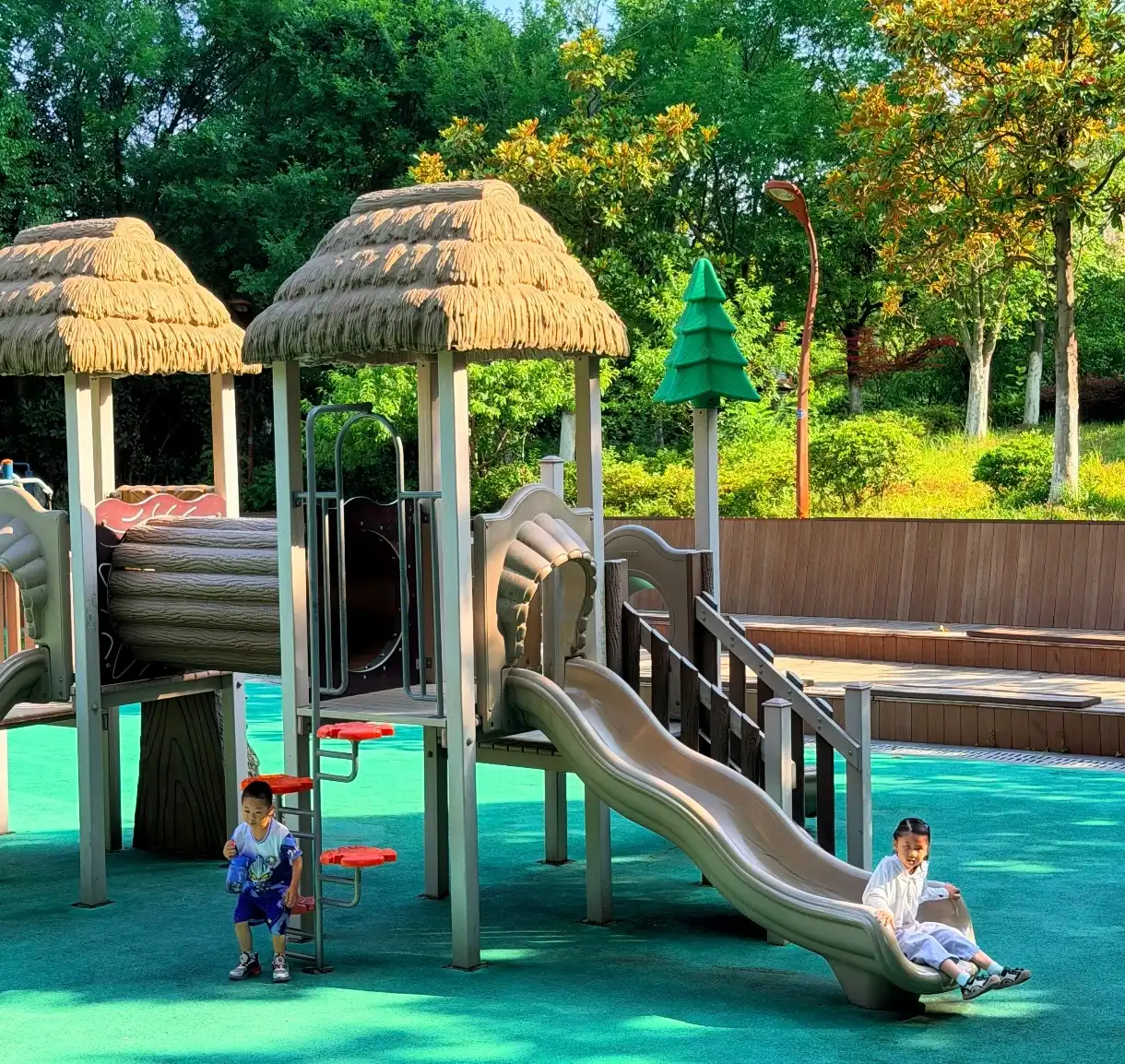
What Outdoor Play Equipment Is Available for Specific Age Groups?
The availability of playground equipment is set by age band rather than by catalogue section: children aged 6 to 23 months, 2 to 5 years and 5 to 12 years each have a defined list of suitable units and a different maximum fall height. Supplying equipment outside its band is the most common specification error on mixed-age sites.
The age bands in the CPSC public playground safety handbook are not marketing groupings. Each one pairs a set of permitted units with a fall height ceiling, so a structure that is acceptable in one band becomes a hazard in another.
| Age band | Suitable units | Max fall height |
| 6 to 23 months | low climbers under 32 in, ramps, single-file stepladders, short slides, spring rockers | 32 in |
| 2 to 5 years | climbers, ramps, horizontal ladders to 60 in, spiral slides to 360 degrees, belt and bucket swings | 48 in |
| 5 to 12 years | arch climbers, chain bridges, fulcrum seesaws, overhead and ring ladders, high spiral slides, sliding poles | 72 in |
Fall height is only one of the limits. Openings must be narrower than 3.5 in or wider than 9 in so that a head cannot pass through and a body cannot follow; guardrails and barriers scale with platform height; and platforms above 6 ft need an intermediate standing level. On a mixed site the practical answer is zoning: separate areas for the two younger bands, clear sightlines from the seating area, and a route between zones that never crosses the fall zone of the oldest group.
How Does Commercial Outdoor Play Equipment Differ from a Backyard Set?
Commercial and residential playground equipment are built to different standards and cannot be substituted in either direction. The commercial category assumes continuous public use by many children an hour, so it carries larger use zones, higher structural loads, documented testing and replaceable components, none of which a residential set is required to provide.
The dividing line is written into the standards. ASTM F1487, the commercial playground standard, covers users from the 5th percentile at age 2 to the 95th percentile at age 12 and assumes a public setting where nobody is counting heads. The residential standard assumes a family garden and a supervising adult, and it permits spans, anchors and finish schedules that would not survive a school yard.
The practical differences compound. A commercial structure is engineered for a stated number of users per hour, its use zone is calculated and drawn, its fixings carry a torque value, and its panels, ropes, bearings and swing seats are sold as service parts years after installation. A residential set offers none of that, and a grant-funded or publicly permitted site that installs one will usually be asked to replace it. Where both families of standard are being weighed, the comparison between ASTM F1487 and EN 1176 is the next question to settle.
Which Materials and Surfaces Define an Outdoor System?
Two decisions determine how outdoor playground equipment performs: the material schedule of the structure and the surfacing inside the use zone. The structure decides how long the equipment lasts, and the surfacing decides what happens in the first half second of a fall.
Structural Materials
The range of outdoor playground materials is smaller than it looks. Five families cover most commercial systems, and each fails in a characteristic way that a site manager should know before signing a maintenance contract.
| Material | Where it appears | Outdoor behaviour |
| LLDPE panel | decks, walls, roofs, slide bodies | UV-stabilised and colour-fast, does not splinter, expands in heat |
| Hot-dip galvanised steel | posts, frames, ladders | zinc layer sacrifices first, so coastal sites need heavier coating |
| Powder-coated aluminium | posts, rails, decorative parts | light and corrosion-resistant, coating chips at cut edges |
| Marine-grade rope and net | net towers, bridges, climbing | strong until UV degrades it, then fails at the terminations |
| Composite timber | decking, cladding, edging | stable and splinter-free, needs no annual sealing |
Coating and hardware matter as much as the substrate. A galvanised post cut on site loses its protection at the cut, and a zinc-plated bolt on a coastal installation will show rust before the coating does.
Safety Surfacing
Surfacing is part of the system, not a finishing item. It is specified by critical fall height, which must meet or exceed the highest fall height on the structure, and it has to extend across the whole use zone, typically 6 ft in every direction and twice the pivot height in front of and behind a swing. Unitary surfaces are poured or tiled and need no topping up but cost more. Loose fill such as engineered wood fibre, bark or rubber chip needs about 9 in of depth and loses height with use, so it has to be replenished on a schedule.
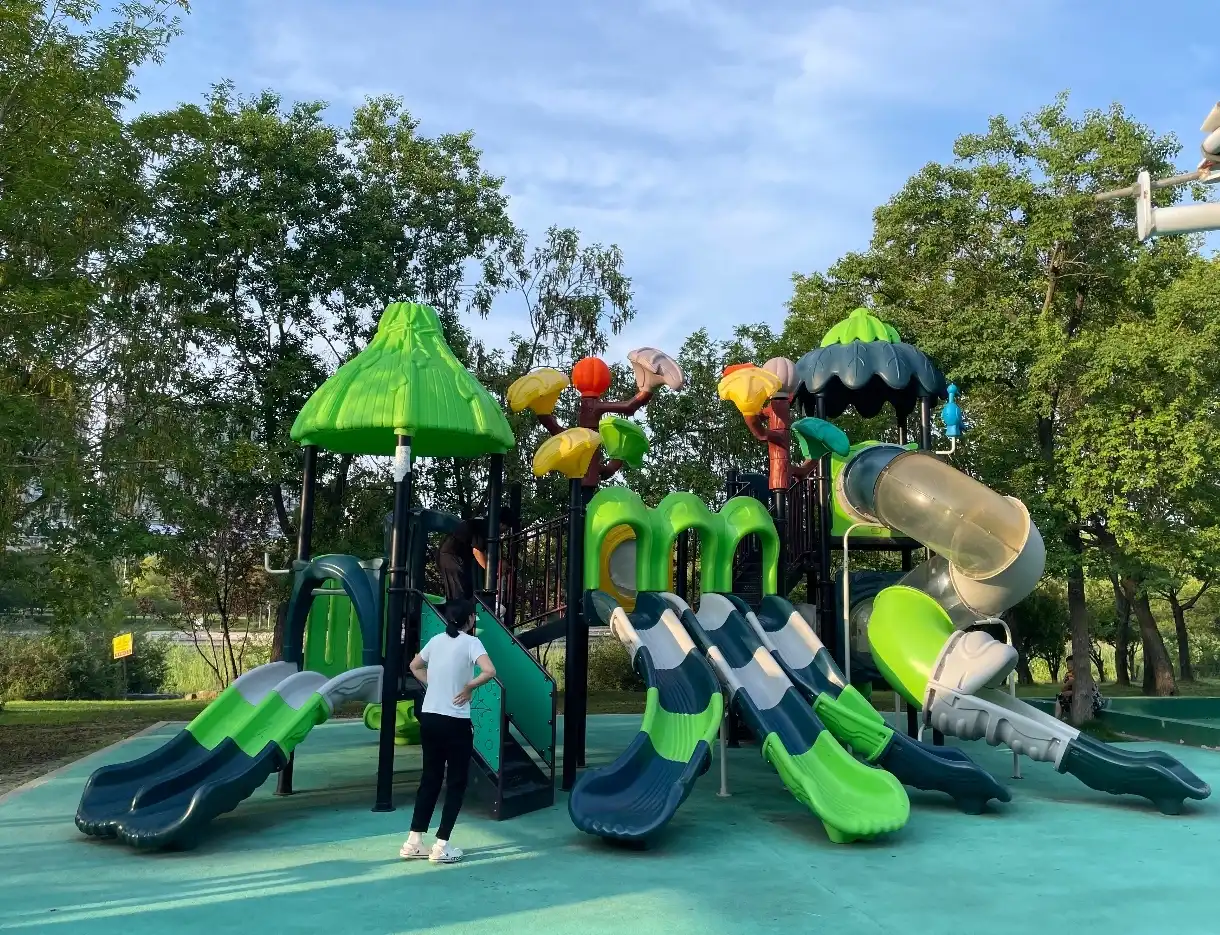
What Should Buyers Verify Before Ordering Outdoor Play Equipment?
Six documents settle most of the risk before a purchase order for outdoor playground equipment is raised: a standard reference with a test certificate, a use-zone drawing, a fall height schedule matched to the proposed surfacing, an accessible route drawing, an installation and anchoring method, and a spare parts and inspection list.
- Standard and certificate: the unit is tested to the standard named in the specification, not merely described as compliant.
- Use-zone drawing: scaled, with the fall zones of adjacent units overlaid so that overlaps are visible.
- Fall height schedule: highest fall height per unit, set against the surfacing depth or thickness proposed.
- Accessible route: the path to the play area, its gradient and its width, drawn rather than implied.
- Installation method: foundation type, anchor specification and the compaction or torque values that go with them.
- Service parts: panels, bearings, swing seats, rope terminations and the inspection interval for each.
Price comparisons go wrong when only the first column is compared. A landed cost that includes surfacing, freight, installation and a first spares allowance often runs 30 to 50 percent above the equipment value alone, and the two quotes that look furthest apart are frequently the two that are closest once the perimeter is drawn.
FAQ
Three questions come up after the specification is settled, and each one sits just outside the definition rather than inside it.
Is a Trampoline Classed as Outdoor Play Equipment?
Usually not. A trampoline court is a separate equipment class with its own standard, its own inspection regime and, in several states, its own registration requirement. It is outdoor recreation rather than playground equipment, and a site that lists it under the wrong heading will find the two categories handled differently at permitting.
How Long Does Commercial Outdoor Play Equipment Last?
A realistic service life is 15 to 20 years for a galvanised steel structure, 10 to 12 years for panel and slide bodies, 5 to 8 years for rope nets and moving bearings, and 5 to 8 years for loose fill surfacing including top-ups. Coastal exposure, heavy use and skipped inspections shorten each figure.
Who Should Inspect Outdoor Play Equipment, and How Often?
Day-to-day checks belong to site staff and should be recorded daily or weekly. A detailed inspection by a certified playground inspector once a year is the common benchmark, with an immediate inspection after any incident, storm or act of vandalism. Maintenance records are the first thing an insurer or a grant auditor asks for.


