
Most people meet the phrase before they meet the building. A parent reads it on a birthday invitation, a teacher finds it on a trip consent form, a first-time operator pricing trampoline park equipment hears it in a supplier meeting, and each of them pictures something slightly different: a room of small trampolines, an amusement ride, a warehouse with a foam pit, or a soft play center with a bouncy floor. That spread of images is why the question keeps coming up, and why a short definition is worth more than a long description.
A trampoline park is a ticketed indoor venue whose main attraction is one large, connected commercial trampoline court, staffed and operated under a written set of jumping rules. The term describes an operating model, not a piece of equipment. A trampoline in a backyard is not a park, and a room of separate trampolines with no supervision, no timed admission and no controlled entry is not one either.
The definition holds together once the three parts are separated, because almost every confusion about the term comes from mixing them up.
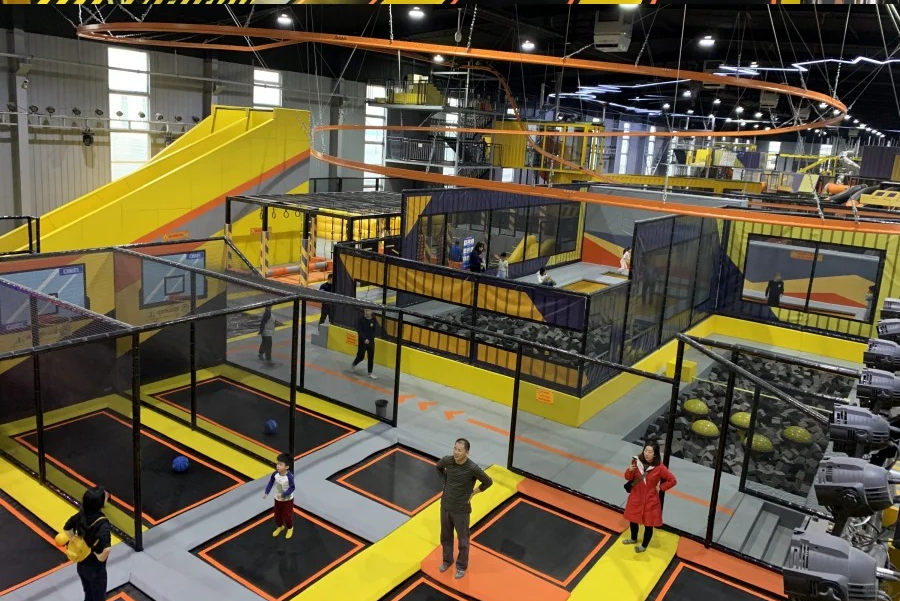
What Does the Term Trampoline Park Actually Mean?
The term means three things at once: a commercial trampoline court, a venue built around that court, and a time-based session that admits the public into it. Remove any one of the three and you no longer have a trampoline park, whatever the signage says.
A Commercial Trampoline Court
A court is not a row of household trampolines. It is a continuous jumping surface assembled from many beds, each stretched on its own springs inside a shared steel frame, with padding over every frame member and spring and a containment system around the perimeter. Because the beds are joined, a jumper can travel from one to the next, and that is what makes group games and continuous play possible. The court is the defining object, which is why safety standards are written around it rather than around the building.
A Ticketed Venue Around It
Around the court sits everything that turns jumping into a business: a reception and payment point, shoe storage, toilets, a viewing area for adults who are not jumping, first aid, staff positions with sightlines over the floor, and usually one or more party rooms. None of these is an attraction in itself, yet a venue without them cannot process a crowd, and a crowd is the point.
A Session, Not an Open Floor
Admission is sold in blocks, commonly 60, 90 or 120 minutes, and the floor is cleared between blocks. The session is the unit of capacity, the unit of pricing and the unit of supervision. An indoor playground with a bouncy floor and open-ended admission is a different product, even when the two look similar from the parking lot.
Why Is It Called a Trampoline?
The word comes from the Spanish “trampolin”, meaning a diving board, and it was attached to the apparatus in the 1930s. “Park” arrived decades later, when the device turned into a place that sells admission rather than a product you buy once.
| Word | Where it came from |
| Trampolin | Spanish for a diving board; older Italian forms point to a springboard, from stilts |
| Trampoline | The anglicized form adopted for the apparatus in the 1930s |
| Park | Added when the apparatus became a commercial venue with timed entry |
The apparatus itself is usually credited to an American gymnast and a diving coach who built an early prototype in 1934 from a canvas sheet, coiled springs and a steel frame, after watching circus performers use a safety net to break a fall and bounce back up. The name is reported to have reached them on a demonstration tour in Mexico, where the Spanish word for a springboard was already in use. It began as a trade name and drifted into ordinary language, which is why dictionaries now list it in lower case and why the sport is called trampolining while the object is called a trampoline.
What Is Inside a Trampoline Park?
Inside the shell there are one or more jumping zones built on the same court system, plus the support spaces that let a crowd move through in waves. The zones are the attraction; the support spaces are what make the attraction runnable at scale.
The boundary between the two matters because safety standards attach to it. ASTM F2970-25 covers the design, manufacture, installation, operation, maintenance, inspection and major modification of trampoline courts, and it does not automatically cover a slide, climbing wall or obstacle rig standing in the same hall. Those are separate items with separate rules, suppliers and maintenance schedules.
| Zone | What it is for |
| Open jump court | Free bouncing across connected beds |
| Dodgeball court | Team game inside padded dividers |
| Dunk or hoop lane | Jump-assisted basketball |
| Foam pit or airbag | Soft landing for aerial tricks |
| Ninja or obstacle line | Balance, grip and upper-body course |
| Toddler area | Smaller beds, lower fall height, closer supervision |
A small venue may hold only the open court and a toddler corner. A large one may run six or seven zones, and the mix is chosen by the operator from the building’s clear height, the target age group and the staffing budget rather than from a fixed list.
What Happens Between the Door and the Court?
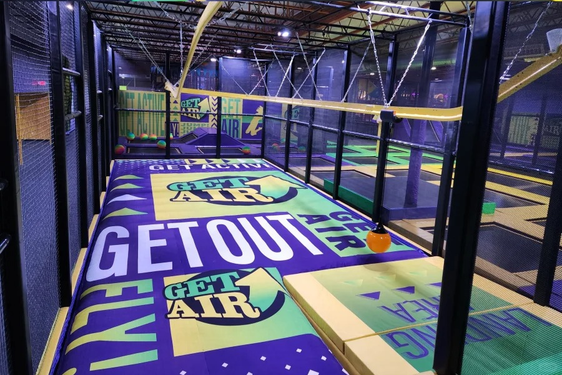
Every visit follows a fixed sequence, and that sequence is part of the definition rather than a detail of customer service: a signed waiver, a pair of grip socks, a short briefing, a wristband or slot check, then entry in a group that starts and ends together.
- Sign the waiver, which a guardian must complete for a minor.
- Buy or present the session booking for the chosen time block.
- Change into grip socks with a rubberized sole, usually sold at reception.
- Watch or listen to the safety briefing covering one jumper per bed, no double bouncing, and the exit routes.
- Receive a wristband or color code that matches the session start time.
- Enter the floor with the group and leave when the block is called.
Grip socks are not a merchandising gimmick. They give traction on the bed surface, they keep street dirt off the fabric, and the color coding tells staff at a glance who belongs in the current block. The waiver is the operator’s record that the risks were disclosed, which is why it is signed before payment in most venues and why a parent cannot sign it on the day for a child who arrives without them.
What Is a Trampoline Park Considered?
In everyday terms it is considered an indoor recreation venue built around a trampoline court. In formal terms the answer depends on who is asking: state safety rules may treat the court as an amusement device, industry bodies treat the business as a family entertainment center, and a venue that runs coached sessions can legitimately call itself a sports facility.
| Framework | What it calls the venue |
| State amusement device rules | A regulated device, registered and inspected |
| Industry classification | A family entertainment center or location-based attraction |
| Programming and coaching | A sports or fitness facility |
| Everyday speech | An indoor playground, or simply the trampoline place |
The labels are not cosmetic. Registration brings inspection cycles and insurance conditions, an entertainment center label shapes the lease and the licensing, and a sports facility label changes how sessions are staffed and priced. The full breakdown of how each framework classifies the venue, and what that changes in practice, sits in a separate guide to what a trampoline park is considered.
Is It Normal for Adults to Go to Trampoline Parks?
Yes, and in many venues it is deliberately programmed. Adult-only evening blocks, trampoline fitness classes, corporate bookings and team events are standard parts of the weekly schedule, not an afterthought.
The format was marketed to families because that is where the volume is, but the activity itself does not have an age ceiling. A trampoline session is vigorous, intermittent exercise: short bursts of high effort with recovery in between, which is close to the pattern recommended for adults who cannot commit to long continuous training. The WHO physical activity guidance puts the weekly target at 150 to 300 minutes of moderate activity or 75 to 150 minutes of vigorous activity, so 20 to 30 minutes of jumping contributes a meaningful share rather than a token amount.
Two practical notes for adults. Fatigue changes landing mechanics faster than most people expect, so a 60-minute block is usually a better first booking than a two-hour one. And the most common adult injuries are ankle and lower-leg injuries from landing off axis or landing while another jumper is still moving, which is why the one-jumper-per-bed rule is enforced hardest during adult sessions.
Should I Let My Kid Go to a Trampoline Park?
There is no single answer, but the decision should rest on the child’s age, the supervision ratio in the room, and what the operator will confirm in writing. Park admission policy and pediatric guidance do not fully agree, and that gap is where parents get surprised.
Pediatric guidance is cautious. The American Academy of Pediatrics states that children under six should never use a trampoline, recommends that children of all ages avoid them, and links trampolines to roughly 110,000 emergency department visits a year in the United States. Park policy usually admits children from two or three years old, with a paid adult on the floor and access limited to a toddler zone. Both positions are real, and the venue’s rules are the ones that will actually be applied on the day.
Four questions are worth asking before booking, because the answers separate a well-run floor from a crowded one:
- What is the minimum age and weight, in writing, and what does the toddler zone allow?
- How many staff are on the floor at peak, and are they positioned rather than patrolling?
- How many jumpers share the court in one block, and is that number capped?
- Can you see the last inspection record and the incident log summary?
If the venue answers all four plainly, the risk is at least being managed by someone who has thought about it. If the answers are vague, the age of the child matters less than the fact that nobody is counting. A longer discussion of age bands, session types and what to check before a first visit is in this guide to can kids go to a trampoline park.

What Does the Definition Change for Buyers?
For a buyer, the definition sets the unit of purchase. You are buying courts, session slots and supervision positions, not floor area. A quote that prices square feet without stating court count, jumpers per session and which zones fall under which standard cannot be compared with another quote.
Three consequences follow. First, capacity is calculated per session, so the revenue question is how many blocks a day the floor can run, not how many people fit in the hall at once. Second, each zone has its own wear pattern, inspection interval and spare-part list, so a mixed venue should be specified as a set of separate items rather than one lump. Third, the containment, padding and landing surfaces are the parts that fail first, and they are also the parts that determine whether the court can be re-bedded without rebuilding the frame. Operators who want the commercial arithmetic behind those three points will find it in this guide to opening a trampoline park, while the equipment side of the same decision is covered in the trampoline park series pages.
FAQ
Three questions tend to surface once the definition is settled, and none of them are about the jumping itself.
Is a trampoline park the same as a trampoline arena?
Largely yes, with a difference in emphasis. Arena is a marketing word used by some operators to suggest a larger or more competition-oriented floor, and park is the broader term that covers toddler zones, party rooms and mixed attractions. No standard or regulator distinguishes the two, so a venue called an arena is judged by the same court, supervision and inspection criteria as one called a park.
Can parents watch without buying a ticket?
At most venues, yes. A viewing area, cafe or mezzanine is normally open to non-jumpers at no charge, while the paid adult requirement applies only when an adult has to be on the floor to supervise a young child. Ask when booking, because a venue with a small reception and no seating may charge for spectating or restrict it to one adult per group.
Do trampoline parks have a weight limit?
Yes, and it is usually stated per jumper rather than per court. Common published limits sit between 250 and 300 lb per jumper, with lower limits on toddler beds, foam pit entries and some obstacle elements. The limit exists because spring and bed loading is designed around a maximum user mass, so a court rated for a lighter population should not be sold as one that suits everyone.


