Land rent for outdoor play areas must be paid every month regardless of visitor flow. Playground facilities also continue to depreciate whether the site is packed with children or nearly empty. This forces commercial site operators to face one core question: which outdoor playground structures can deliver solid return‑on‑investment, and which ones only look attractive on product catalogues. Most buying guides target large theme parks with huge one‑off tourist traffic, but commercial outdoor venues operate under totally different constraints.
For most commercial playground sites, usable ground space is limited to hundreds of square meters. Primary visitors are local families and children aged 4‑12, and revenue mainly comes from repeat local guests instead of one‑time tourists. Common site configurations include combined slide structures, swing sets, climbing frames, trampoline zones and toddler soft‑play corners.
The most profitable outdoor playground facilities are not always those with the highest purchase price. Winning assets deliver high revenue per square meter during opening hours and encourage families to keep coming back. Modular combined slides, swing sets, climbing play structures, trampoline zones and toddler play zones each fulfill unique venue functions. A well‑balanced mix of these play items will drive stable profit for your commercial playground.
This article explains how operators can evaluate playground equipment based on real‑world operational data rather than visual appeal seen at exhibition fairs.
What makes an outdoor playground structure profitable
Profitability of outdoor play equipment depends on four core factors: number of participating children per operating hour, occupied ground footprint, required maintenance labor and equipment downtime. Purchase cost matters, yet it ranks behind these four metrics. A cheap play structure with low child throughput and high maintenance labor will keep losing money month after month.
Two playground units with similar buying prices can generate completely different earnings. A medium‑size modular combined slide with dual‑slide lanes completes one full play cycle in around 3 minutes and allows multiple children to play simultaneously. At 70% realistic weekend occupancy, it can handle dozens of users each hour. In contrast, a small standalone spring rider only serves one child each 4‑minute cycle. The multi‑user slide wins on visitor throughput, while spring riders take very little floor space. No single piece of equipment is universally superior. Profitability for playground facilities is a calculated ratio instead of an inherent product feature.
Four key metrics to evaluate before placing purchase orders
- Children per operating hour. Number of users per play cycle × cycles per hour × realistic occupancy rate. Apply 60‑75% occupancy for weekends and holidays; use 25‑40% occupancy for weekdays. Manufacturers usually quote peak theoretical capacity which rarely reflects real‑site income.
- Admission or per‑play fee. Refer to pricing of nearby competing playground venues, adjusted according to local household disposable income.
- Effective operating hours. Total opening hours minus time lost to breakdown repairs, cleaning and equipment inspection. Playground features that require frequent mechanic visits will lose considerable productive running time.
- Labor & maintenance input. Multiple adjacent play structures can share one maintenance attendant. Assigning one full‑time staff member for only one small play feature will heavily squeeze profit margins.
Basic operational calculation formula:
- Hourly gross revenue = children per hour × average play charge
- Monthly gross revenue = hourly gross revenue × monthly effective operating hours
- Monthly net contribution = monthly gross revenue − labor expense, power consumption, maintenance work and spare‑part replacement costs
Revenue per square meter decides whether your playground pays the land rent
Land rental expense normally represents the biggest fixed cost for outdoor commercial playgrounds. Revenue per square meter becomes the critical KPI to judge whether one play structure deserves your limited site space. A play feature occupying 80 square meters must generate enough income to justify its footprint, compared against alternative uses such as wider walking zones, rest seating or party activity corners. When two playground options deliver similar hourly revenue, the compact‑footprint solution is preferred, and it also reserves extra space for visitor queuing which protects peak‑hour user throughput.
| Metric | Calculation Method | Impact on Project Profit |
|---|---|---|
| Children per hour | Users per cycle × cycles per hour × practical occupancy | Sets upper limit of peak‑time income |
| Play fee benchmark | Local market competitor pricing | Defines maximum possible income per guest |
| Effective operating hours | Scheduled opening hours × real‑world uptime | Unplanned downtime creates hidden revenue loss |
| Total footprint | Equipment area plus fall‑safety zone, queue space and access passages | Land rent is charged by every square meter |
| Maintenance & Labor Intensity | Attendant headcount × working wage × service hours | Excess assigned staff will erase profit |
| Repeat‑visit factor | Percentage of guests willing to revisit your site | Separates short‑lived novelties from long‑term profit generators |
Five playground categories that support commercial‑venue revenue
Modular combined slides, swing assemblies, climbing play frames, outdoor trampoline zones and dedicated toddler play zones cover five core business functions for commercial playground venues: landmark attraction, multi‑age group engagement, high‑throughput play, time‑based charging model and repeat‑visit driving. A venue operating three categories properly will normally out‑perform sites that poorly maintain six different play types.
These categories differ more in their operational roles than pure earning potential, as we will break down below.
Modular combined slides: venue visual landmark
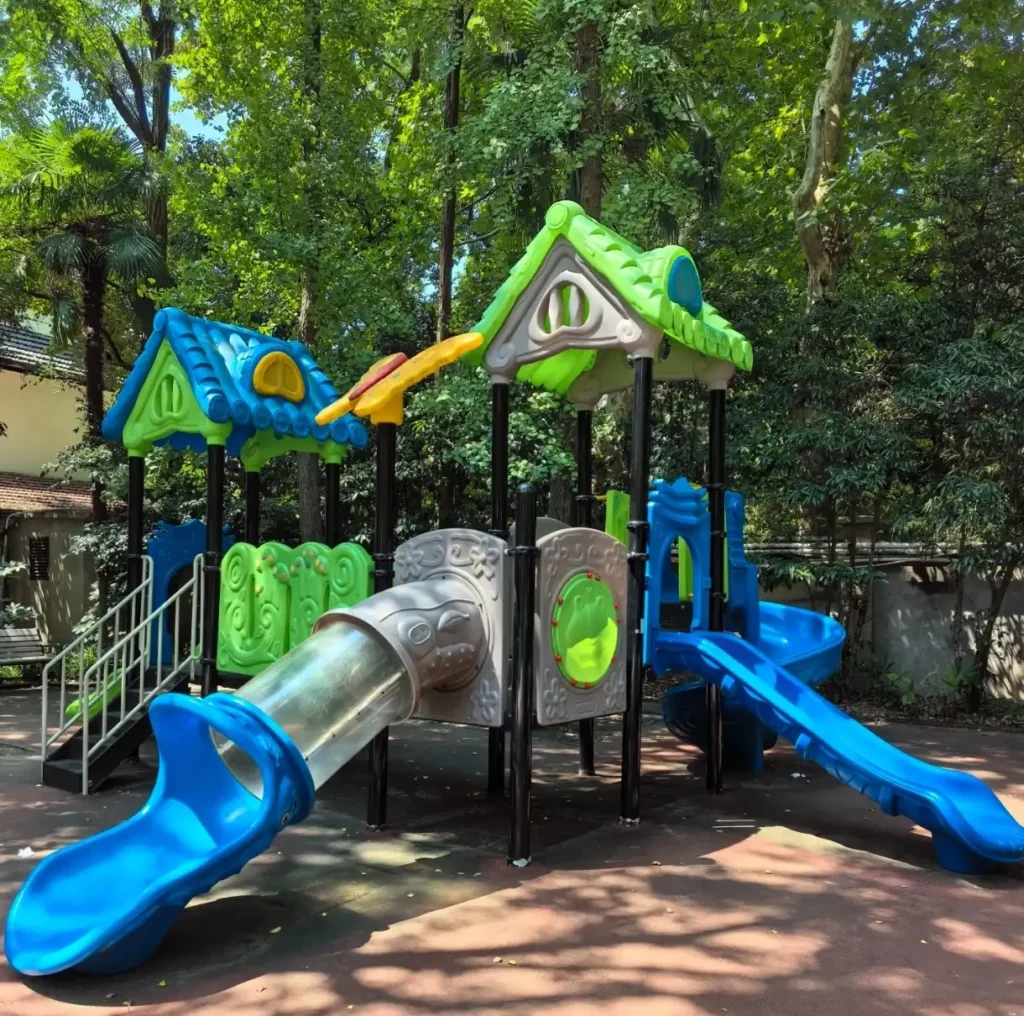
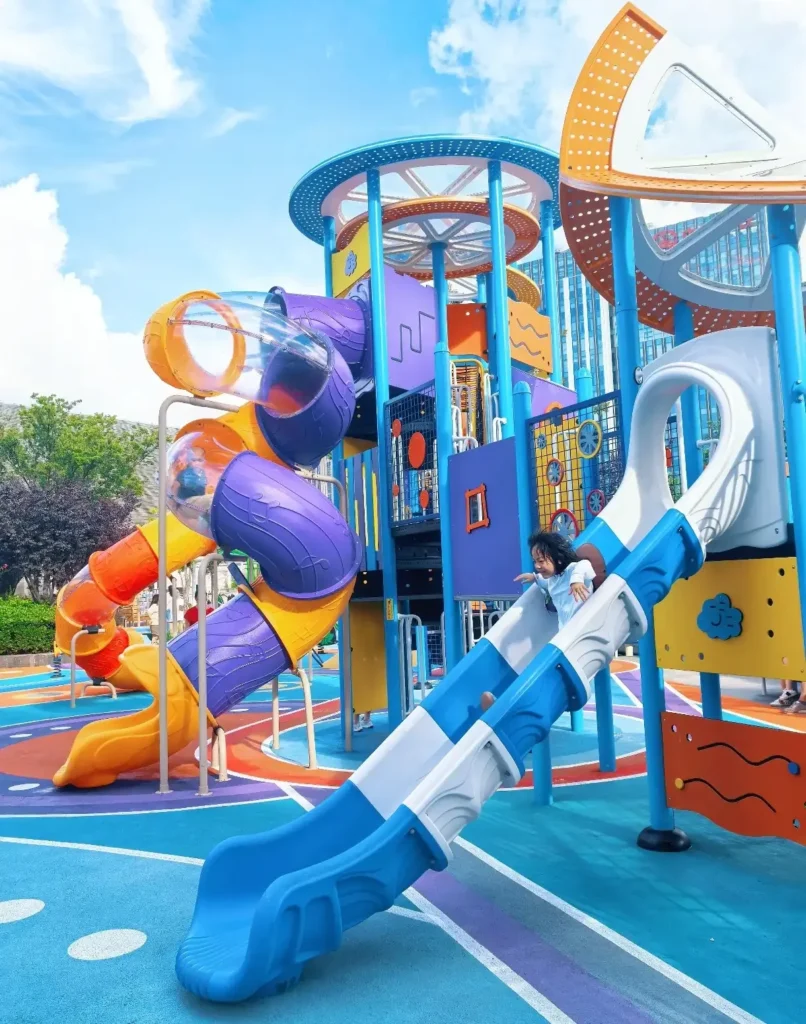
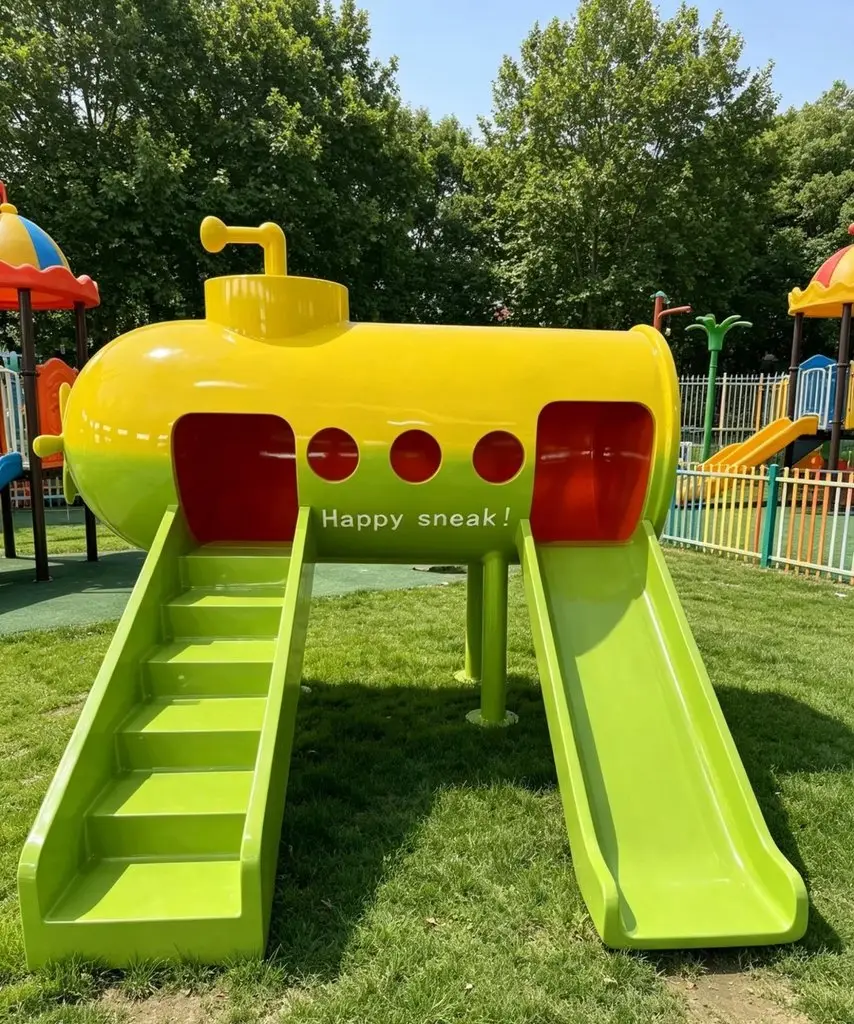
Modular combined slide structures are suitable for children across different age brackets, from preschool toddlers up to pre‑teen children, making them ideal landmark attractions rather than secondary supplementary facilities. Operators can select compact or large‑scale models to match available site dimensions. Small‑sized units fit limited‑space community playgrounds, while large multi‑function sets can serve as core landmarks for park and scenic‑spot zones. Two practical operational tips outweigh decorative appearance: keep play‑cycle flow smooth to process weekend visitor queues; install the playground where incoming guests can easily observe it from site entrances. Visible landmark play equipment helps attract foot traffic before visitors buy tickets.
Swing assemblies: Multi‑Age‑Group Engagement Tool
Swing sets draw interest from toddlers, school‑age children and even accompanying parents. They improve dwell time on‑site without demanding complex operation work. Swing units work well in both residential‑community playgrounds and scenic‑spot play areas. One attendant can supervise several swing bays at the same time. When planning layout, operators must reserve adequate safety fall‑clearance zones behind and in front of swing seats; narrow clearance will create collision hazards and restrict actual visitor capacity.
Climbing play frames: high‑engagement impulse‑play equipment
Climbing walls, climbing nets and obstacle‑course frames bring high‑physical‑activity play experiences for school‑age children. Their compact unit footprint allows arranging multiple climbing elements within limited ground space. Play sessions keep short, helping rotate visitor queues efficiently. Revenue performance depends on quantity of climbing positions instead of single‑unit size. Several small climbing posts, when deployed together, normally out‑earn one oversized climbing frame that occupies the same site space. Remember inspection schedules: climbing net and rope components suffer heavy abrasion and require regular checks and spare‑part replacement.
Outdoor trampoline zones: time‑slot charging & repeat‑visit driver
Outdoor trampoline zones sell play time instead of single‑ride tickets, which reshapes the venue revenue model. One‑hour timed sessions allow operators to reuse the same ground area for multiple batches of children each day. Trampoline play retains appeal for older kids who lose interest in simple slides. Main costs come from on‑site supervision and periodic component replacement: trampoline pads, springs and safety nets wear following predictable timelines, and staffing ratios must meet peak‑holiday safety requirements instead of average‑day visitor volume. Commercial trampoline layouts with central monitoring sightlines can cut down required supervision‑staff numbers.
Dedicated toddler play zones: birthday‑event & family‑stay engine
Toddler‑oriented low‑height play structures bring less income for each individual child, yet they raise revenue from bundled party bookings. Birthday‑party packages combine site admission, snack service, host service and exclusive activity zones, creating higher‑value invoices than single‑play tickets. These party bookings also fill idle weekday afternoons. Slides, ball pits and low climbing elements keep families staying far longer than short‑cycle amusement rides. Layout design must separate toddler play zones physically from equipment for older children; otherwise older kids will drive younger visitors away.
Side‑by‑side comparison for main outdoor playground categories
Different playground categories vary more in their venue business role than raw earning potential. Operators should compare functional positioning and maintenance workload instead of only checking purchase price. One landmark‑style core attraction, one dwell‑time booster and one high‑throughput play item should be prioritized before adding second landmark‑type facilities.
Buying commercial playground equipment is fundamentally a site‑layout decision first, and a purchasing decision second. Placing two high‑throughput play zones next to each other will split the same visitor pool and compete against each other.
| Category | Typical Footprint | Traffic‑driving Factor | Revenue Mode | Labor Requirement | Role In Venue |
|---|---|---|---|---|---|
| Modular combined slide | medium‑large | visual landmark, multi‑age appeal | single‑play or site admission | shared attendant | core landmark attraction |
| Swing assemblies | medium | multi‑generational appeal | site admission | shared attendant | dwell‑time improvement |
| Climbing play frames | compact‑medium | physical‑activity attraction | site admission / per‑play fee | shared attendant | high‑throughput impulse play |
| Outdoor trampoline zone | large | active play for older children | timed‑session passes | fixed supervision ratio | time‑based revenue generator |
| Toddler play zone | medium‑large | family & birthday‑party demand | admission plus party packages | attendants & cleaners | family‑stay & booking driver |
Calculating payback period before you purchase
There exists no universal fixed payback period for playground projects. Any supplier quoting guaranteed payback without knowing your actual site data is only guessing. Payback equals total turnkey installation cost divided by annual net operating contribution after subtracting labor, energy consumption and maintenance expense. All variables are tied to your local situation, and results shift with city location, ticket pricing and opening schedules.
Total turnkey project cost covers far more than equipment invoice value: sea or land freight, import customs duty, ground‑surface preparation, safety surfacing material, on‑site installation labor, spare‑parts stock and staff training. Many operators only budget for playground hardware and ignore these extra expenses; this pushes total investment far above initial budget before opening.
| Input Data You Need | How It Influences Final Calculation |
|---|---|
| Annual opening days & daily opening hours | Sets theoretical revenue ceiling |
| Weekend versus weekday visitor proportion | Decides realistic occupancy assumptions |
| Local play‑fee level & common discount rules | Defines income from each visiting child |
| Staff‑arrangement plan per shift | Largest controllable operating expense |
| Power‑supply consumption & local utility tariff | Small per‑hour cost, accumulates greatly each year |
| Maintenance budget & spare‑part delivery lead‑time | Guarantees equipment uptime and avoids unexpected shutdown |
Carry out payback calculation twice: one calculation applying weekday occupancy data and one applying weekend‑holiday occupancy. If your playground feature only achieves payback under weekend‑peak assumptions, it is not reliably profitable equipment — it is only profitable on busy Saturdays and holidays.
Lessons large‑scale playground parks teach small‑commercial venues
The world’s highest‑profit public playground parks enjoy both huge visitor attendance and diversified non‑ticket income. Visitor volume sets upper revenue boundaries, yet per‑guest consumption determines real profit margin. Top‑performing playground parks keep investing in play facilities suitable for whole‑family participation.
Practical takeaways for smaller‑scale commercial sites:
- Pre‑plan non‑ticket income. Food‑and‑beverage service, retail merchandise and birthday‑party packages should be considered in initial site layout instead of squeezed into leftover empty corners.
- Build repeat‑visit mechanisms. Season passes and family memberships convert one‑off visits into stable regular consumption and improve weekday‑period revenue predictability.
- Schedule regular attraction refreshes. Partial updating of play elements on fixed cycles gives returning families new content to experience. A playground receiving zero updates for 5 years loses its appeal for repeat guests.
Five common mistakes making operators lose money even with good playground facilities
Most playground‑business losses do not stem from selecting bad equipment. They result from poor operation of good‑quality play structures: equipment capacity mismatching real‑site traffic, inflexible pricing rules, and postponed maintenance until sudden shutdown occurs.
- Design equipment only for peak‑holiday flow. Playground hardware sized for maximum Saturday‑holiday crowds sits under‑utilized for most weekdays. Choose capacity matching normal‑weekend visitor numbers, and manage peak‑holiday pressure via timed‑session visiting rules.
- Make buying decisions purely based on low purchase price. Cheaper playground products without accessible spare‑part support generate higher total cost across 2‑3‑year operation. Weekend‑day shutdown due to broken components equals permanently lost revenue.
- Apply one‑price‑for‑all charging strategy. Bundle packages, off‑peak discounted tickets and birthday‑party packages lift per‑guest income without raising single‑play price directly.
- Neglect venue internal sight‑lines and visitor flow paths. If guests cannot view secondary play zones after finishing one attraction, they will leave early. Clear sight‑lines directly improve total‑site revenue.
- Skip scheduled maintenance calendar. Planned cleaning, fastener tightening and component inspection cost far less than emergency breakdown during school‑holiday peak season.
Matching playground equipment to your site layout
Product‑supplier communication should start with your site drawing, usable ground dimension, fall‑safety zone limits, power‑supply condition and expected visitor volume — not browsing product catalogues. A moderately‑sized playground solution fitting your site condition and local price point will out‑perform oversized spectacular play hardware your venue cannot fully support.
JQK supplies the above‑mentioned full playground categories: modular combined slide sets in multiple sizes, swing assemblies of different themes, diversified climbing‑frame series, outdoor trampoline systems and customized toddler‑play structures. As a commercial playground manufacturer, JQK supports custom‑tailored themes, color schemes, capacity adjustment and layout modification. Customization capability is critical when playground hardware needs to adapt existing building pillars or height‑restricted sites.
If you are planning a new playground project, share your site floor‑plan, maximum allowed installation height, expected play‑fee standard and estimated weekend visitor volume. With this information our team can recommend suitable configurations and complete payback‑period calculation using your real‑world parameters instead of hypothetical factory data. Discuss with JQK technical team before finalizing your venue layout. Adjusting layout on drawing documents costs nothing. Moving already‑installed playground equipment will cost you an entire operating season.
FAQ
How large of ground space does a profitable commercial outdoor playground unit require?
Space demand differs for each category. As practical reference for medium‑size commercial venues: modular combined slides plus fall‑safety clearance usually occupy 60‑100 square meters; each swing bay group requires a minimum 25‑40‑square‑meter safety clearance zone; climbing‑frame clusters take 30‑60 square meters. Outdoor trampoline zones and comprehensive toddler‑play areas belong to larger‑scale solutions, normally requiring at least 150‑200 square meters to justify supervision‑staff cost.
Does every playground play unit need its own dedicated attendant?
Not necessary. Multiple adjacent play structures within one visual supervision range can share one attendant. Trampoline zones need dedicated supervisors following safety standards. Large combined‑slide landmarks also need periodic on‑site patrol inspection instead of permanent one‑to‑one staffing.
How frequently should commercial playground venues refresh play equipment?
Most experienced playground operators arrange partial visible updates every 2‑3 years, and carry out comprehensive equipment review every 5 years. Refreshing does not always mean full replacement. Re‑theming surface decorations, adding extra play components or shifting to timed‑session visiting mode can restore visitor interest at much lower investment than buying brand‑new large‑scale structures.