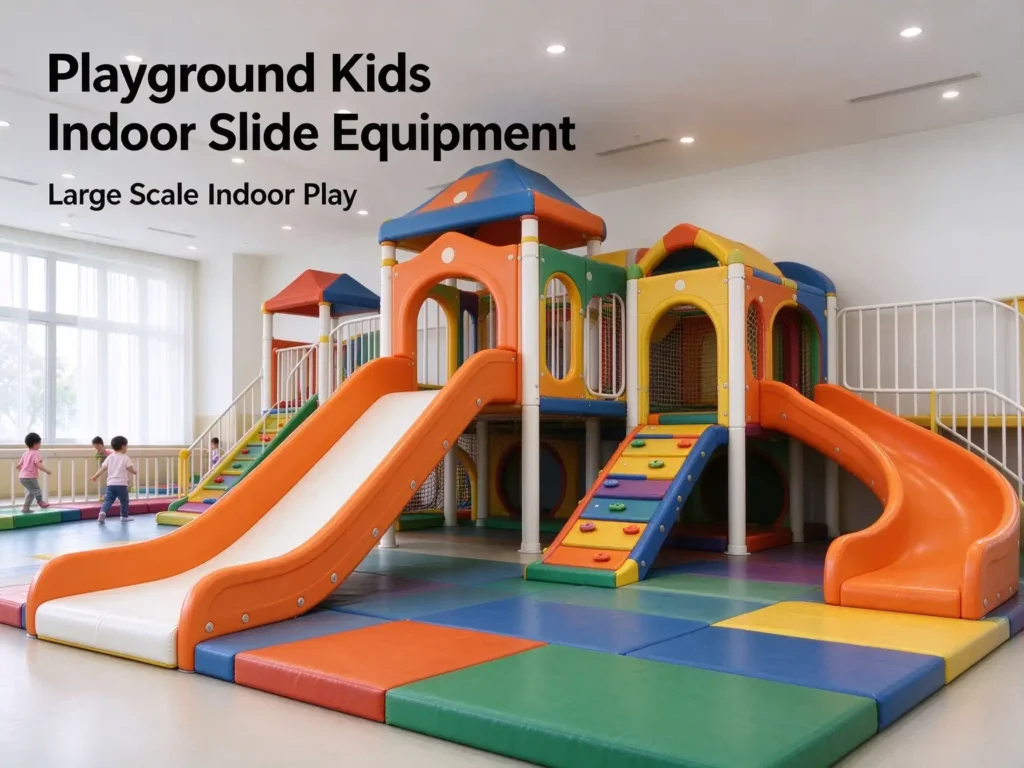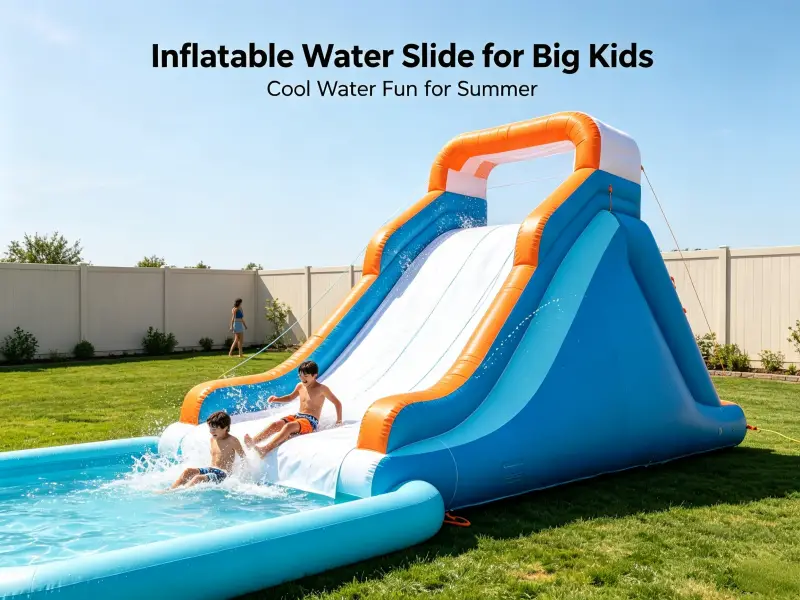
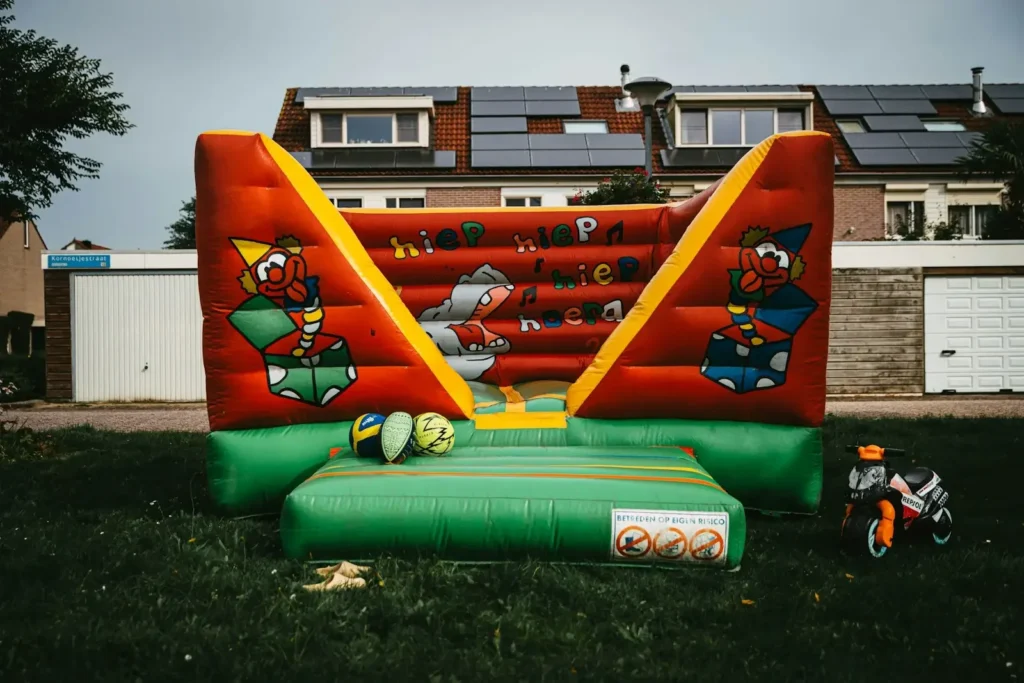
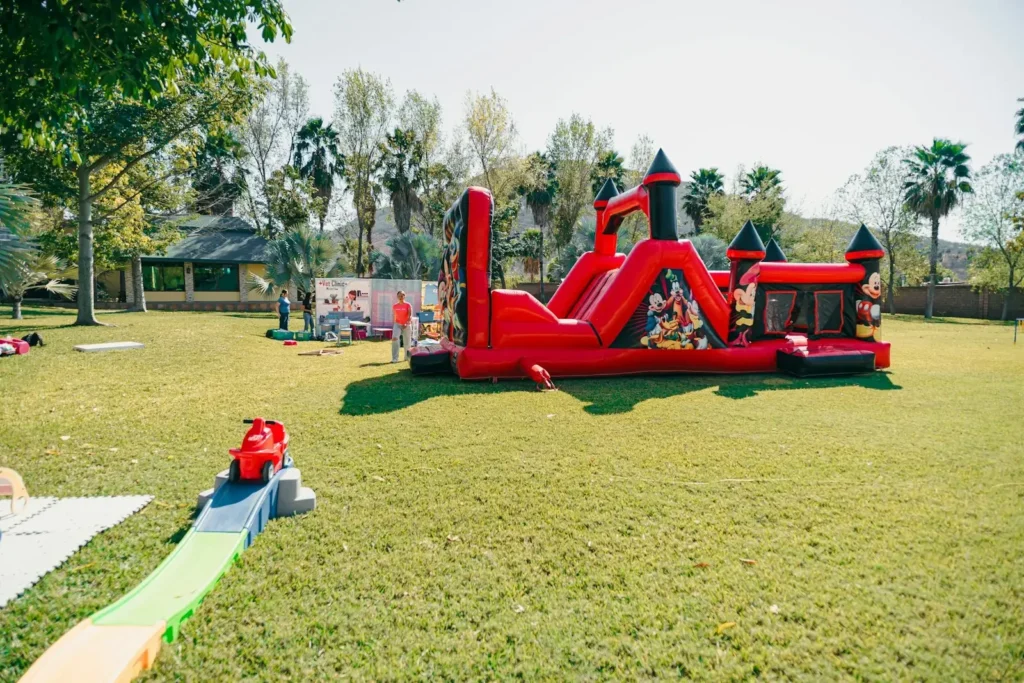
The appeal of a backyard kids’ inflatable bounce house with a slide is easy to see. It arrives flat, inflates in minutes, and folds into a bag when the party ends. For one birthday, that is enough. Then the seams start weeping air, the blower gets louder, and you spend the second summer patching vinyl instead of watching your kids play. That is roughly the moment families, kindergartens, and small venue operators start pricing outdoor playground equipment instead.
For occasional weekends in a private yard, a backyard bounce house with a slide does the job. For anything that has to sit outside through four seasons, hold a queue of children, or pass a safety inspection, a fixed kid slide costs less over its life.
This guide compares the two, then walks through the details that decide whether a kid slide is still standing straight in year three.
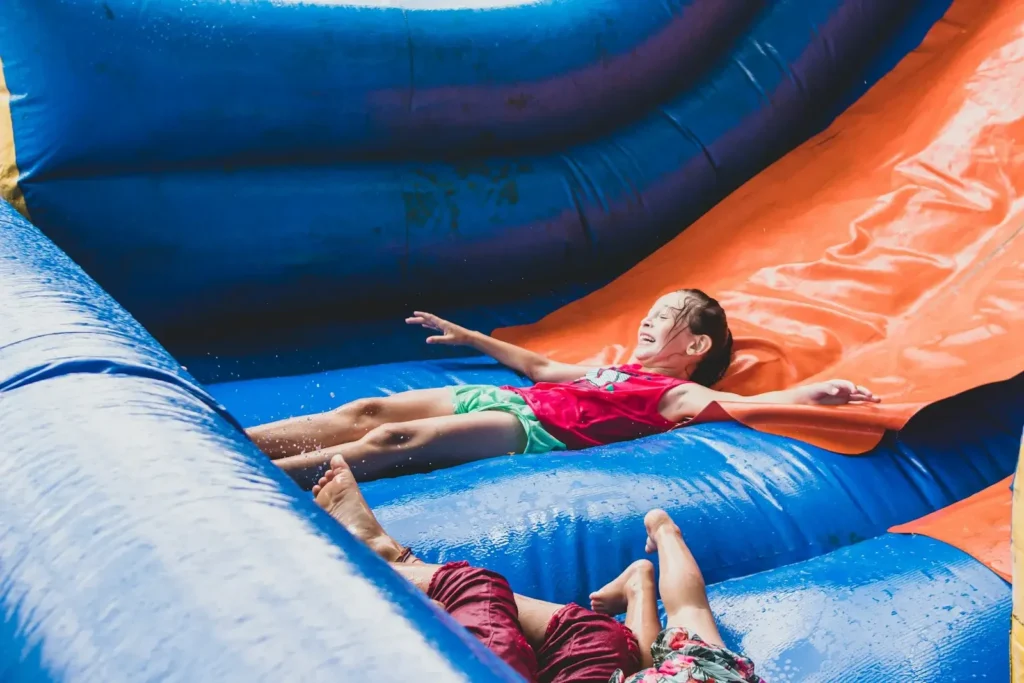
Are backyard inflatable bounce houses with slides worth it?
They are worth it as seasonal garden toys and a poor fit as play equipment. The gap shows up in how the thing is built, not in what you pay for it.
What you actually get with a backyard inflatable
An inflatable is an air-supported structure. The vinyl or TPU body holds no shape of its own, the blower keeps it pressurized while children are on it, and the whole unit comes down the moment you switch the power off. Setup is quick on flat, dry ground, and a normal household circuit runs the blower.
That design is why backyard inflatables are cheap and light. It is also why everything about them is temporary. The play surface shifts underfoot. The walls give way. Nothing is anchored beyond stakes or sandbags, so wind is a hard stop rather than an inconvenience, and most operators pull an inflatable well before the weather would stop a fixed slide.
Where the inflatable setup starts to cost you
Inflatables fail in predictable ways, and every one of them carries a price.
- Seams and baffles leak, so the unit needs patching and eventually re-stitching.
- The blower runs continuously, which means noise and power draw for as long as children play.
- UV exposure degrades the fabric. Stored wet, the same fabric grows mildew.
- Storage takes real space, and a folded inflatable has to be bone dry before it goes away.
- Rain and wind force a shutdown, so a backyard inflatable is unavailable exactly when a wet or breezy weekend would otherwise be useful.
Marketing language does not change any of this. A “heavy duty bounce house” in inflatable catalogs usually means thicker vinyl, reinforced seams and a commercial-grade blower. Thicker vinyl is a durability claim. It is not a statement that the structure meets playground standards.
The standards picture is more telling. ASTM F1148, the US consumer safety specification for home playground equipment, covers products for children from over 18 months through 10 years and defines that equipment as something whose support structure remains stationary while the activity happens. Within the same scope, the standard exempts electrically operated constant air inflatable devices, and it states plainly that it is not intended for equipment used in places of public assembly such as schools, nurseries, day-care centers, and parks.
Read that twice. A backyard inflatable bounce house with a slide sits outside the home playground standard by design, and it was never meant to carry the traffic of a kindergarten or a mall play zone.
Who they suit, and who should look elsewhere
A backyard inflatable suits a private yard, one or two children, and a handful of weekends a year. It is the wrong purchase for anyone who needs the structure to stay where they put it: kindergartens, residential communities, family entertainment centers, shopping mall play zones, farm resorts, and equipment rental operators.
| Factor | Backyard inflatable bounce house with slide | Fixed kid slide |
|---|---|---|
| Structure | Air-supported, needs a running blower | Rigid frame anchored to the ground |
| Standards coverage | Constant air inflatables are exempt from the home playground specification | Equipment built to EN 1176, ASTM and GB/T requirements |
| Weather | Cannot stay up in wind or rain | Designed for year-round outdoor exposure |
| Materials | Vinyl or TPU, blower, patch kit | Anti-UV food-grade plastic, galvanized steel with anti-rust coating |
| Ground work | Flat, dry surface plus power | Level surface and an installation plan |
| Throughput | One soft chamber, children take turns | Multi-track slides let several children slide at once |
| Public venues | Not intended for public assembly | Built for kindergartens, communities, malls and parks |
| Maintenance | Patching, blower service, dry storage | Checking joints, wiping surfaces, replacing wear parts |
What makes a kid slide safe enough to buy?
Stationary structure, age-matched height and gradient, and documented standard compliance. Everything else is decoration.
The standards that actually apply
ASTM F1148 covers home playground equipment, and its scope runs from over 18 months through 10 years. It is the standard a fixed backyard slide should be measured against, and it is the standard an inflatable is exempt from.
For anything public, the bar moves up. EN 1176 is the European standard for playground equipment, and GB/T covers the domestic Chinese market. Jinqikai states that its playground systems comply with EN 1176, ASTM, and GB/T requirements and provides compliance certificates on request. That is the sentence to ask for in writing when you are buying for a kindergarten, a community compound or a mall.
Materials that survive outdoor weather
Weather is where cheap slides die, and the failure modes are boring and consistent: faded plastic, cracked panels, rusted joints, and wobbling decks.
Jinqikai builds its outdoor slides around two materials. Plastic parts use anti-UV food-grade plastic that tolerates long sun exposure, rain, and temperature swings without fading, cracking, or deforming. The supporting frames use thickened galvanized steel pipe with a rust-proof coating, which carries the load and keeps the structure stable outdoors. Indoor lines use EVA foam and HDPE plastic on the same kind of metal frame.
Details buyers forget to check
The features that prevent injuries are rarely the ones in the marketing photo. Walk through this list before you sign anything:
- Anti-slip textured stair treads, so climbing shoes do not slide off.
- Full-surround railings on every elevated platform, not just the open side.
- Rounded, polished edges and corners on every exposed part.
- Joints that lock tightly, so the unit stays firm when several children play hard.
- A widened standing platform with buffer space to queue and turn around.
- A matte anti-slip sliding surface, which controls speed without killing the slide.
- Height and gradient matched to the age group, not to the tallest child who might use it.
Choosing a big kid slide for backyard use
Pick the slide by age and slide count first, then let height, gradient and footprint follow.
Height, gradient and the age question
A big kid slide for backyard use is not simply a taller version of a preschool slide. Height and gradient move together, and both should track the age band the equipment is designed for.
Jinqikai’s product pages describe gradient as matched to the age group rather than quoting one universal number, and the indoor range deliberately reduces height and gradient to suit toddlers aged two to eight. That is the right way to read any spec sheet: ask which age band the design was drawn for, then ask for the drawing and confirm the numbers against your own site.
Spiral, double parallel and tunnel slides
Slide form changes how a structure gets used. Running one loop of the same slide for twenty minutes is a different experience from choosing between three of them.
| Slide form | What it does | Works best for | Trade-off |
|---|---|---|---|
| Spiral curved slide | Adds a turning descent and more play time per climb | Big kid slide installations with space above | Needs head clearance around the spiral |
| Double parallel slide | Two lanes, so children race side by side | Siblings, kindergartens, busy play zones | Takes more deck width |
| Tunnel tube slide | Enclosed descent with a crawl-in entry | Shy children, themed structures | Harder to see into during supervision |
| Combined straight slide | Straight run plus climbing and swinging in one unit | Smaller footprints and mixed ages | Fewer slide options per structure |
A combined outdoor kids’ play slide solves the usual backyard problem of buying three separate items. Jinqikai’s all-in-one outdoor range pairs spiral curved slides, wide double parallel lanes, and tunnel tube slides on one frame, and some models add hanging swing seats, so sliding, climbing, tunnel crawling, and swinging all happen without children moving between structures.
Ground space and the fall zone
Inflatables ask for flat, dry ground and an outlet. Fixed slides ask for more planning and give back more. You need a level surface, space for the fall zone around each slide exit, room for installation equipment to reach the site, and a footprint that leaves the structure stable once it is anchored.
This is the stage where a site survey earns its cost, and it is the stage where most buyers discover that the corner they had in mind is two meters short.
When an indoor kid slide is the better buy
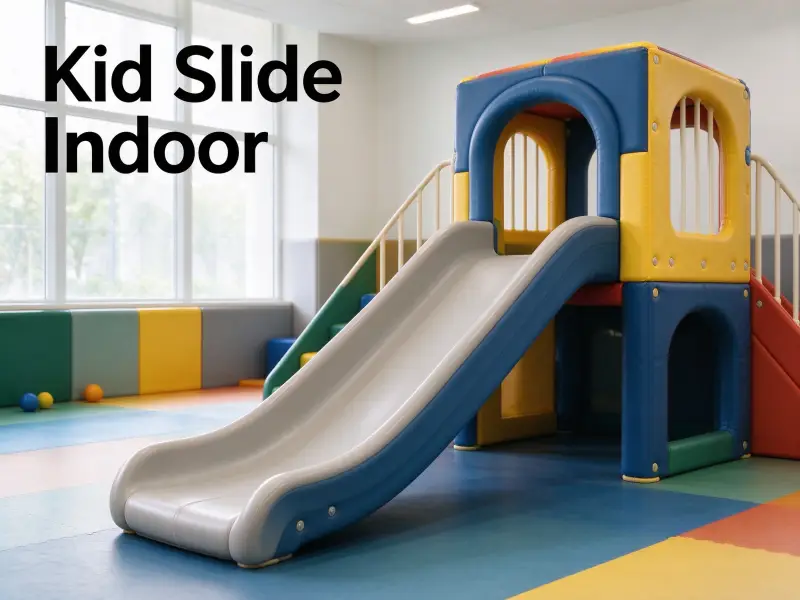
Choose an indoor kid slide when weather, floor area, or venue rules make an outdoor structure impractical. Indoor models are not outdoor models moved inside.
What changes when the slide moves indoors
An indoor slide drops the weather variable completely. No rain shutdowns, no UV exposure, no seasonal storage, and stable use all year. That comes with design changes, not just a shorter frame.
Jinqikai’s dual-lane indoor range reduces height and gradient according to indoor safety standards, matching toddlers aged two to eight, and uses a compact footprint that fits a floor plan instead of a yard. It also removes the need for outdoor foundation construction, which cuts labor and setup time for a venue. The sliding surface gets a matte anti-slip treatment, and the side frame carries a mini basketball hoop and a toy football, so children who finish sliding have somewhere to go next.
Venue types that choose indoor every time
An indoor kids play slide earns its place in kindergarten activity rooms, shopping mall parent-child play areas, community indoor activity rooms, restaurant kid zones and early education centers. All five share the same constraints: a fixed ceiling, a rented floor, a landlord who wants the space back in a defined condition, and no control over the weather.
Slides for five-year-olds versus a big kid slide
Five-year-olds need a short, slow slide with enclosed access. A big kid slide is for children who have the coordination and the height to use it unsupervised.
What an outdoor slide for a 5-year-old needs
A five-year-old is in the awkward middle of the playground market. Tall enough to want the big slide, not yet steady enough to use it safely without a railing. For an outdoor slide for a 5-year-old, the priorities are a lower deck height, a fully enclosed staircase, railings at hand height for a small child, a gentle gradient, and a run-out long enough that the child stops before their feet do the stopping. Supervision is still required. Nothing in the equipment replaces it.
Matching the slide to the child
| Age band | Play behaviour | What to prioritise | Slide forms that work |
|---|---|---|---|
| 18 months to 3 years | Exploring, climbing one or two steps | Lowest access height, padded edges, constant supervision | Short little kid slide runs |
| 3 to 5 years | Repeated climbing, parallel play | Enclosed stairs, full railings, gentle gradient | Double parallel lane, short tunnel |
| 5 to 8 years | Racing, social play, longer sessions | Wider deck, queue space, several slide options | Spiral plus parallel lanes |
| 8 to 10 years | Faster descents, showing off | Structural stability, tight joints, firm anchoring | Spiral, longer straight run |
Notice where the two ranges overlap. Jinqikai’s outdoor all-in-one slides are drawn for children aged three to ten, while the indoor and dual-lane models target two to eight. That overlap is intentional: a fixed structure with several slide options keeps a five-year-old and an eight-year-old busy at the same time, which is the whole point of buying equipment instead of a one-off garden toy.
What about kid slides for pool areas?
A kid slide for pool areas is a separate product class. Pool slides are built around water and drainage, and playground slides are built around fall protection.
Why an inflatable pool slide is a different animal
An inflatable water slide is an air-supported structure fed by a hose. Water keeps the surface slick, so the descent depends on flow rate as much as on gradient, and the whole unit drains, dries, and gets stored after each session. That is a water-play product with its own failure points: seams, valves, wet fabric, and mildew.
It is also not playground equipment. Treating an inflatable pool slide as a fall-protected kid slide is how people end up with a bruised child and a damaged retaining wall, because there is no fixed structure, no anchored frame, and no railing to catch anybody.
Water-adjacent options worth pricing
If the slide is going next to water rather than into it, the material question shifts to corrosion and standing water. Jinqikai builds custom stainless steel slides within its outdoor range, and stainless steel is the sensible starting point for a pool deck, a splash area or a coastal site where painted steel will not hold up.
Ask any supplier four questions before quoting: which material handles permanent moisture, how the deck drains, what the surface does when it is wet, and which local code governs water-play areas on your site.
How a custom kid slide gets quoted
A custom slide is quoted from a site survey and a written design, not from a catalog price.
The one-stop process
Jinqikai has run the same sequence since 2016: site survey, themed design, production, installation guidance, and after-sales. The company designs and builds themed indoor and outdoor play solutions for shopping malls, kindergartens, communities, family entertainment centers, and theme parks, and it keeps the theming in-house across IP, space, cartoon, sci-fi, forest, and castle concepts.
Production runs out of a 35,000-square-meter workshop on a site covering over 200 mu, and the company has supplied more than 10,000 kindergartens and communities worldwide. After-sales covers 24/7 online consultation, replacement parts and technical guidance for maintenance and repairs, and shipping support includes the export documents needed for customs clearance.
Lead time and what drives it
Jinqikai publishes its own numbers, which makes planning easier than guessing. Standard orders take 15 to 30 days for production. Large or highly customized projects run 30 to 45 days. Where a project lands inside that window depends on how far the theming departs from the standard design, the quantity of units, site constraints that affect how the structure arrives and assembles, and shipping distance. Confirm the exact lead time once the design is locked, not before.
What to send for an accurate quote
Give a supplier these eight items and you will get a real number instead of a range:
- Site dimensions and photos of the ground surface.
- Indoor, outdoor, or both.
- Age group the slide is for.
- Peak number of children using it at once.
- Preferred theme or an existing design language to match.
- Ground surface and drainage conditions.
- Access route for delivery and installation.
- Budget range and target opening date.
Send that to Jinqikai, and the team replies with a free layout suggestion and a price list within 12 hours, no obligation. If the project is a kindergarten, a community compound, or a mall play zone, ask for the compliance certificate alongside the drawing. You should not have to chase it.
FAQ
How long does a backyard inflatable bounce house with a slide last compared with a fixed slide?
There is no single number, and anyone quoting one is guessing. Inflatable life depends on UV hours, how carefully it is dried and stored, how many sessions it runs per season, and whether the blower is serviced. A fixed kid slide has a different profile: the plastic and the frame coating set the ceiling, and maintenance decides how close you get to it. Ask both suppliers what wears out first, then price the replacement part.
Can I put a kid slide indoors if the room is small?
Yes, and that is what the indoor range is designed for. Dual-lane indoor models use a compact footprint, drop the height and gradient to suit toddlers aged two to eight, and skip outdoor foundation work entirely. Measure the floor area, the ceiling height, and the door width first, then send those numbers with your enquiry.
Do I need a different slide for a five-year-old and an eight-year-old?
You can run both on one structure if the equipment carries several slide options, which is why combined slides outsell single-lane models. Set the access stairs and railings to suit the younger child, then use the spiral or longer straight run for the older one. If your group is mostly under five, buy the smaller slide and accept that it will be outgrown.