
Walk through any showroom and the structures aimed at toddlers look nearly identical: a small deck, one slide, a swing or two. The differences that decide whether a two-year-old can actually use the set are dimensional, and they sit in spec sheets rather than on the display floor. Parents run into the same wall each season, because most combination sets are rated from age three upward, while the sets that do start at 18 months are often sold as toys rather than as outdoor playground equipment.
The best outdoor playset for a 2 year old is a low, compact combination structure rated from 18 months: a platform no higher than 32 inches, a slide with a 3 to 5 foot drop, one or two high-back bucket swings, and openings that are either narrower than 3.5 inches or wider than 9 inches, standing on 9 inches of loose-fill surfacing inside a full use zone.
The rest of this guide converts that sentence into numbers you can check before you pay a deposit.
What Makes an Outdoor Playset Right for a Two-Year-Old?
Fit is decided by three measurements rather than by the feature count: how far a child can fall, how the slide delivers them to the ground, and whether any gap in the frame can trap a head, a limb or a hand.
At 24 months most children run, kick a ball and walk up a few stairs with or without help, and jumping with both feet usually appears around 30 months, according to the CDC milestones for 2-year-olds. That profile sets the layout priority: a wide base, a short vertical distance, and handholds at chest height. A two-year-old climbs up far more confidently than they descend, which is why ladder access with wide treads and a continuous handrail matters more at this age than the height of the tower behind it.

The Three Numbers That Decide Fit
Platform height first. For a child unsteady on stairs, keep the highest standing surface at 32 inches or below. Decks 30 to 48 inches high need a guardrail at least 25 inches tall; anything over 48 inches needs a barrier, not a guardrail, at least 27 inches tall. Slide drop next: 3 to 5 feet, gentle slope and open sides so an adult can reach a child before the runout, spirals at or under 270 degrees. Gap width third: any opening 3.5 to 9 inches wide risks head or neck entrapment, including spaces between ladder rungs, rail and post, and swing chain and frame.
| Measurement | Target for a 2-year-old | Why it binds |
| Platform height | 32 inches or lower | Short fall distance for an unsteady climber |
| Slide drop | 3 to 5 feet, gentle slope | Speed a toddler can control on landing |
| Gap width | Under 3.5 inches or over 9 inches | Prevents head and neck entrapment |
| Swing seat | High-back bucket with restraint | Holds the torso upright |
Why Age Ratings Are Not Interchangeable
Home equipment and public equipment answer to different standards. ASTM F1148 covers home playground equipment for children from over 18 months through 10 years and adds separate requirements for swings built for toddlers; it expressly excludes equipment for schools, nurseries, daycare centers and parks, which fall under a public-playground standard instead. The practical consequence cuts both ways. A set built to a public standard is heavier, needs a deeper use zone and is not automatically safer in a backyard, while a home set installed in a daycare sits outside the scope of its own certification.
Which Layout Suits a Two-Year-Old Best?
For a two-year-old, the best outdoor playset layout is a compact combination: a low deck, one short slide, one or two bucket swings and something to do at ground level. A tall tower with monkey bars adds height a 24-month-old cannot use and risk they cannot judge.
Three layouts cover most backyards, and each solves a different problem rather than a different budget.
- Slide-and-swing combo. A covered deck at 3 to 4 feet, one straight or gently waved slide and a bucket seat. This is the most complete first structure, provided the slide exit sits clear of the swing arc so a child landing does not walk into a moving seat.
- Freestanding swing beam. An A-frame with two or three hanging positions. It is the cheapest way to get swinging right and the easiest to extend later, but it must be anchored, because a light frame with two moving children tips in wind.
- Ground-level station. A playhouse, sandbox or water table with no fall height at all. This is what keeps a toddler outdoors on days when climbing is too much, and it is the part of a set that gets used longest.
A modular frame with interchangeable panels lets a family start with two of these and add the third without buying a second structure, which is how a multi-function play set is usually specified when the buyer intends to keep it past preschool.
Plastic, Wood, or Metal for a Toddler?
For a child under three, a molded plastic outdoor playset is usually the right call: it stays cooler in sun, has no splinters or exposed grain, sits lower to the ground and wipes clean. Wood or vinyl-clad wood earns its price only if the set has to survive eight years or more.
| Material | Surface in sun | Edges and splinters | Upkeep | Realistic life |
| Molded plastic | Warm, rarely burning | Rounded, none | Wipe down | 5 to 10 years, fades |
| Cedar or redwood | Hot to touch | Yes, sanding needed | Seal annually | 10 to 20 years |
| Vinyl-clad wood | Moderate | None | Wash | 10 to 15 years |
| Coated steel frame | Hottest | Weld and bolt ends | Touch-up paint | 15 years and up |
Whatever the material, ask what the timber is treated with. Residential pressure-treated lumber sold in the United States after the end of 2003 no longer uses chromated copper arsenate, so a secondhand wooden set built before that date is worth identifying before a toddler starts mouthing the rails. Fasteners should be corrosion-resistant, flush rather than protruding, and any cut tube end should carry a cap that needs a tool to remove.
Material choice affects more than appearance, and the trade-offs between outdoor playground materials behave the same way at domestic scale as they do on a public site.
What Should Go Under the Playset?
Nine inches of loose fill under and around the outdoor playset, carried 6 feet beyond the equipment and twice the beam height in front of and behind the swings. Grass, packed dirt, concrete, carpet and thin mats are not protective surfacing at any depth.
The CPSC Outdoor Home Playground Safety Handbook sets the working numbers. Nine inches of wood mulch, engineered wood fiber or shredded rubber protects a fall from equipment up to 8 feet high; the same depth of sand or pea gravel covers only 5 feet. Loose fill also settles, so 12 inches installed compacts to roughly 9, which is why the handbook recommends marking the correct depth on the support posts where a refill is visible at a glance.
| Surfacing | Depth | Fall height covered |
| Wood chips, mulch, engineered wood fiber | 9 inches | Up to 8 feet |
| Shredded or recycled rubber | 9 inches | Up to 8 feet |
| Sand or pea gravel | 9 inches | Up to 5 feet |
| Rubber tiles or poured-in-place | Per test report | Rated height, often 5 to 10 feet |
Buy tiles or a poured surface only with a test report that names the height it protects. A set with a 5 foot deck needs surfacing rated to at least 5 feet, not a product described as heavy duty. Edging keeps loose fill where it belongs and doubles as drainage control, and the comparison of which material holds up best under daily use is set out in this guide to the safest playground surface.
How Much Space Does a Toddler Playset Need?
Count the use zone, not the footprint. A compact plastic outdoor playset needs about 8 by 8 feet of clear ground, while a wooden set with a swing beam commonly needs 15 by 20 feet once the swing arcs and surfacing are included.
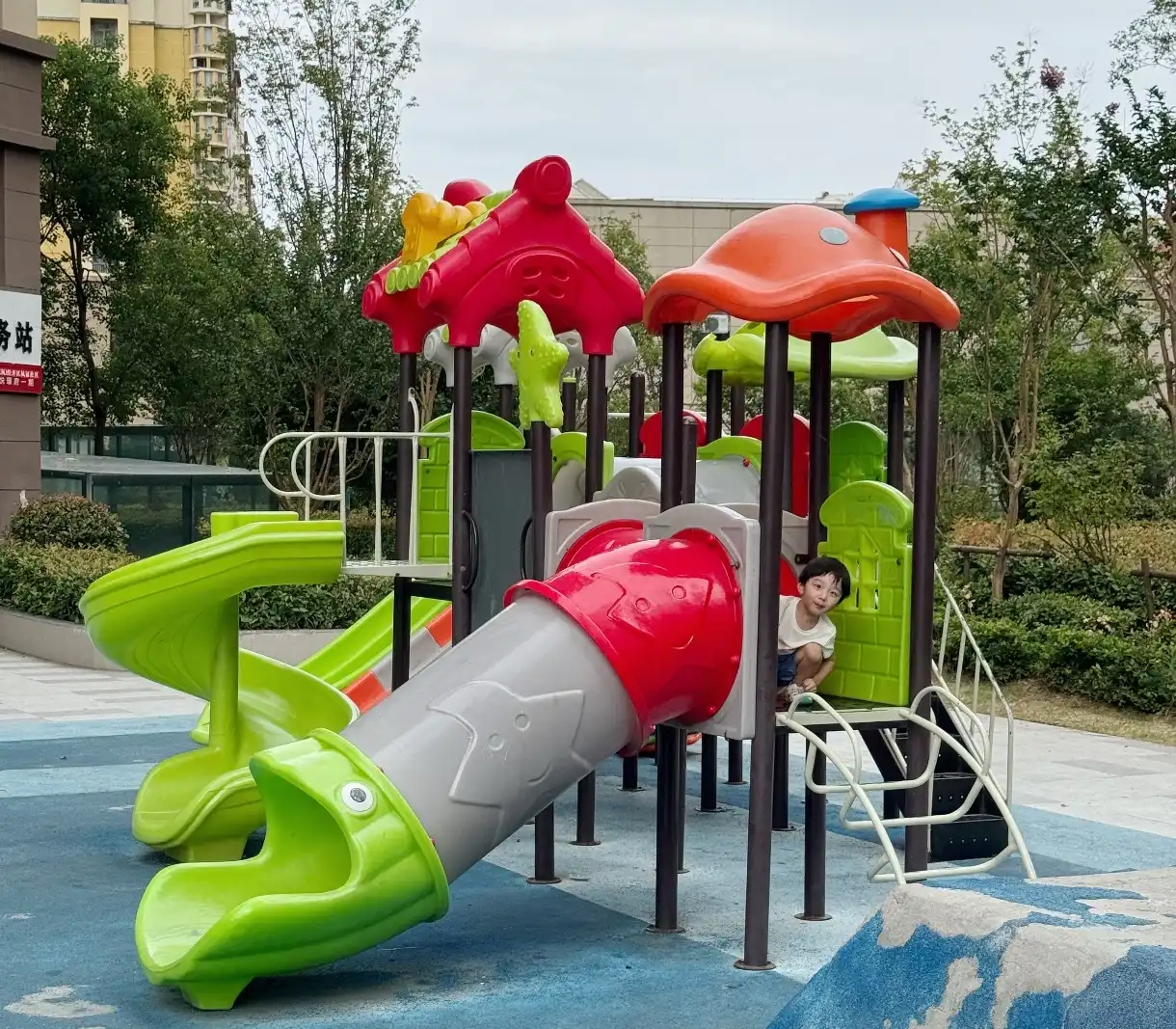
The arithmetic is simple enough to run before delivery. Take a 4 by 4 foot deck with an 8 foot beam whose top sits 7 feet above grade. Surfacing has to extend twice the beam height in front of and behind the swings, so 2 times 7 equals 14 feet, and total depth becomes 4 plus 14, or 18 feet. Width is the 8 foot beam plus 6 feet of surfacing on each side, or 20 feet. A buyer who measures only the 4 by 4 footprint will discover the shortfall after the boxes arrive.
Site the set at least 6 feet from a house, fence, shed, tree or pole, on ground that is level and drains well. On a slope, regrade rather than blocking the posts up on pavers, since a raised frame loses its anchorage. Leave a clear route to the site as well, because a wooden set arrives as long beams rather than as a kit that fits through a side gate.
Which Safety Details Should You Check Before You Buy?
Five details separate toddler-grade hardware from adult hardware: an ASTM F1148 label, closed hooks whose gaps are thinner than a dime, guardrails or barriers matched to the deck height, a ground-anchor kit in the box, and a bucket seat whose restraint cannot be slipped.
| Check | Target | Why it matters |
| Certification label | ASTM F1148 | Scope begins above 18 months |
| “S” hooks and open hooks | Gap thinner than a dime | Clothing entanglement and strangulation |
| Rails | 25 inch guardrail at 30 to 48 inch decks; 27 inch barrier above 48 | Falls drive the largest share of injuries |
| Anchoring | Stakes or augers included | An unanchored frame tips in wind |
| Swing seat | High-back bucket with restraint | Torso support and head control |
ASTM F1148 is a consumer safety performance specification rather than a licensing scheme, so compliance is declared by the manufacturer and supported by a test report rather than issued by an agency. Ask the seller for that report, and read the label on the carton rather than the badge on the website. Two further checks belong on the same list: no loose ropes anywhere on the frame, since a rope that can untwist forms a loop, and no bolt protruding more than its own diameter past the nut.
Assembly time is a safety variable too. A wooden set runs 8 to 15 hours with two adults, a molded plastic set under two hours, and the step most often skipped is the re-torque of every fastener after the first month of use, once the timber has settled.
Will the Playset Still Work When the Child Turns Four?
Only a modular outdoor playset frame survives the transition. Adjustable chain heights, swappable seats and open attachment points turn a two-year purchase into a ten-year one; a fixed toddler shell is usually abandoned by four.
The progression is predictable. At two, a bucket seat, a 3 to 4 foot deck and a gentle slide. At three and four, a belt seat, a low rock wall and a wider ladder with a handrail. From five, rings, a trapeze bar or monkey bars, but only where the frame was designed to carry them, since the 2009 revision of the home equipment standard barred hanging swings and trapeze bars from monkey bars after a run of falls onto moving seats. Maintenance follows the same calendar: swing hardware and seats checked monthly, timber resealed annually, loose fill topped back to the marked line, and the whole frame inspected each spring before the season starts.
FAQ
Three questions come up after the specifications are settled, and none of them is answered by the box.
Can a 2-year-old use a playset rated for ages 3 and up?
Not safely as a first structure. A set rated from three typically carries a higher deck, a steeper slide and a belt seat, and a 24-month-old lacks the trunk control to use any of the three unsupervised. The exception is a set with a low toddler configuration and an adult willing to stay within arm’s reach, which in practice means paying for features the child cannot use for another year.
Does a backyard playset need a permit or a professional installer?
Most jurisdictions treat a residential outdoor playset as an accessory structure and require nothing, but height thresholds, setback rules and homeowner association covenants vary, and a set placed on a shared boundary can breach both. Check before delivery rather than after assembly. Professional installation is worth the cost mainly on wooden sets, where the anchor and fastener sequence decides whether the frame stays square.
How do you stop a toddler from climbing the outside of the frame?
Remove the invitation rather than the child. Keep the deck clear of stored toys that double as steps, avoid placing the set beside a fence, bin or bench that offers a leg-up, and specify guardrails that are not designed to be climbed. Teaching one rule, climb down rather than jump, and repeating it on every visit does more than any single piece of hardware.


