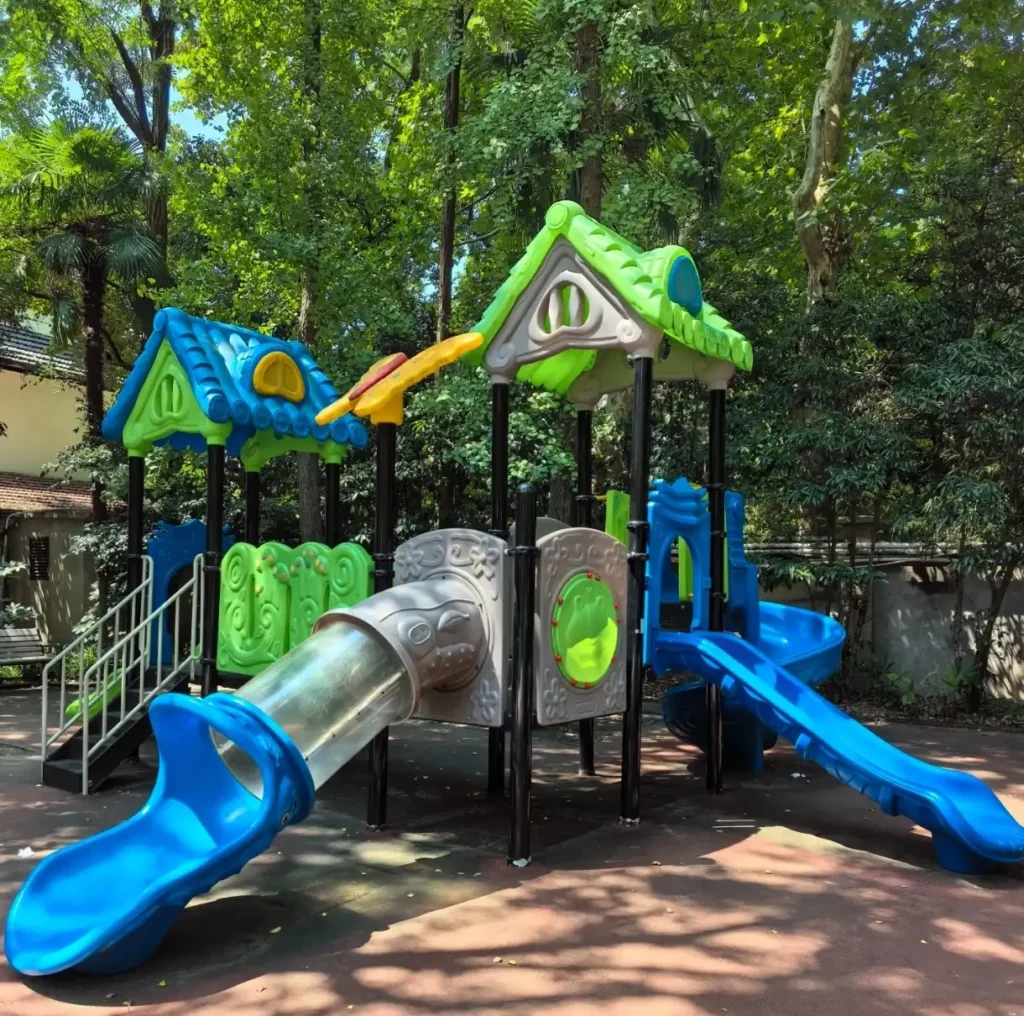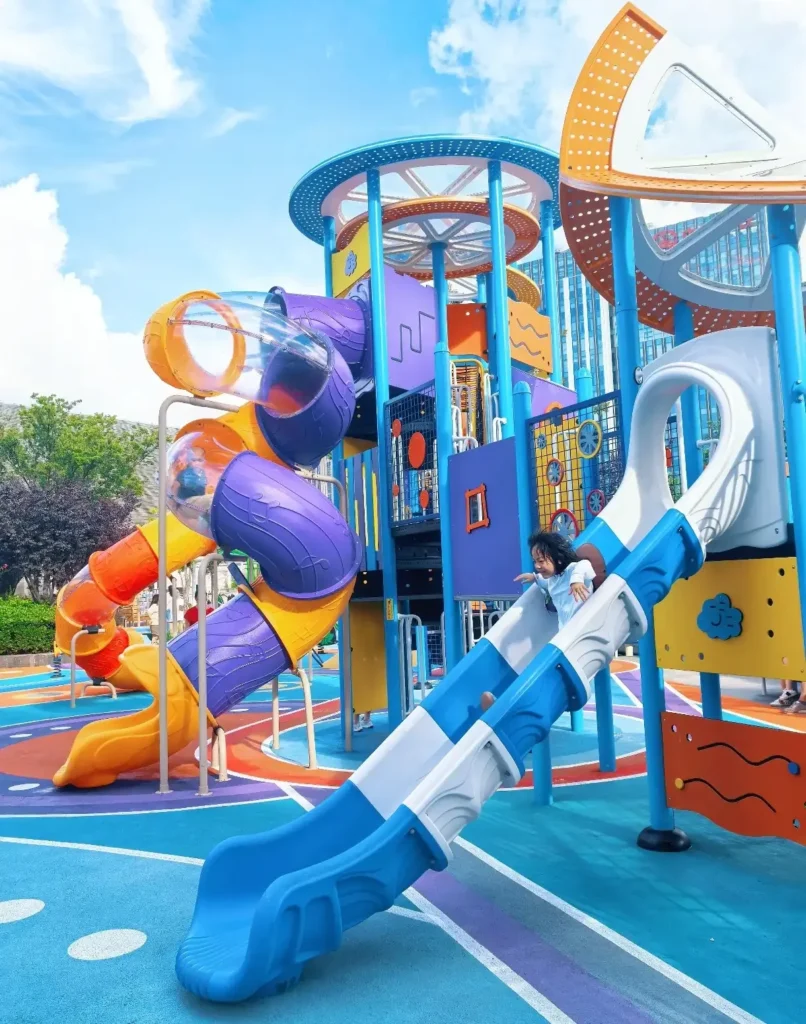
Every outdoor playground project starts as a material decision, and it usually gets made before anyone has walked the site. A specifier inherits a budget, a climate, a maintenance team of unknown size, and a drawing someone else approved.
There is no single best material. Galvanized steel carries the load, LLDPE plastic takes contact and impact, and wood earns its place only where upkeep is funded and the design is nature-themed. Almost every durable set sold today is a mix of all three, chosen component by component rather than as one blanket decision.
The sections below take each material on its own terms, then show where a typical outdoor playground equipment specification breaks down.
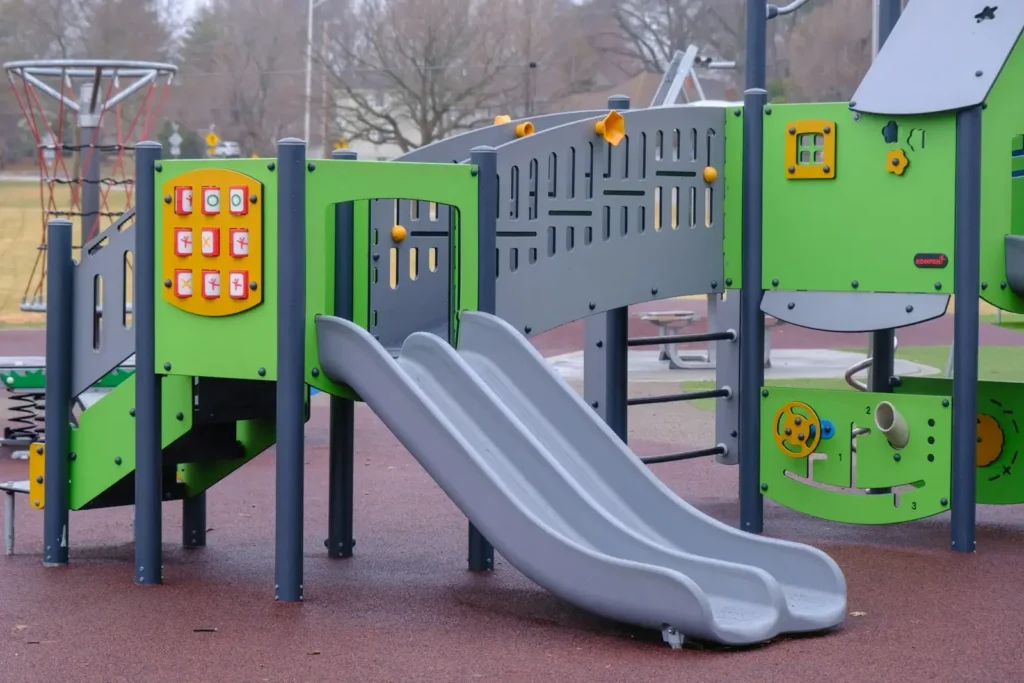
How the three materials compare at a glance
No material wins every row. Steel lasts longest but costs most at the frame. LLDPE is the cheapest route to safe, colourful contact surfaces, yet it can’t span a platform. Wood looks best and needs the most upkeep.
Read the table as a filter, not a specification for an outdoor playground structure. Service life moves with wall thickness, coating weight, traffic and drainage.
| Measure | LLDPE plastic | Galvanized steel | Wood |
|---|---|---|---|
| Role | Panels, slides, guardrails | Posts, trusses, platform frames | Posts, decks, themed towers |
| Service life | Medium; driven by UV and wall thickness | Longest, if coating weight is right | Shortest, and treatment-dependent |
| UV behaviour | Fades first, embrittles if unstabilised | Zinc dulls; steel unaffected | Greys and checks; coatings peel |
| Surface heat | Warm to hot on dark colours | Very hot; shade handrails | Coolest of the three |
| Maintenance | Wash and inspect | Inspect fasteners, touch up coating | Sand, seal, check for rot |
| Weak point | Long unsupported spans | Cut ends and drilled holes | Moisture at ground contact |
UV fading hurts appearance; embrittlement hurts safety. A pale panel that still flexes is doing its job, while one that cracks under a child is not. Wood’s weak point isn’t the board either. It’s the ground contact, where rot starts where nobody can inspect.
LLDPE plastic: the panel and slide-bed material
LLDPE suits anything a child touches, lands on or slides down. It’s the wrong choice for anything that carries load across a distance.
Linear low-density polyethylene sits between HDPE and LDPE on the stiffness curve. HDPE is harder and resists scratching, which suits flat panels. LLDPE is tougher and stays flexible in cold, which is why it dominates slide beds, curved tunnels and guardrail infill on outdoor playground climbing structures.
What rotational molding gives you
Powder goes into a hollow mold that turns on two axes through an oven, and the plastic fuses against the wall. The result is seamless shapes with no weld line down a slide bed, rounded corners by default, and double-wall sections joined by a molded rib. Wall thickness is where buyers get caught: a thicker wall resists impact and holds shape in summer heat, and it’s the first thing a cheap quote gives up.
UV stabilisation and colour retention
Sunlight breaks polymer chains at the surface, and each season takes the damage deeper. A UV absorber and a hindered amine stabiliser slow that down, but you can’t check either by looking at a sample. Ask for the resin grade in writing, and compare a reference panel you kept indoors after two summers.
Where LLDPE stops working
Platforms wider than about a metre need a steel frame underneath, because plastic creeps under load and a sagging deck is a trip hazard. Dark panels get hot in full sun. Anything a child reads as structural, like a handrail at the top of a climbing wall, should be steel cored.
Galvanized steel: what actually carries the load
Steel belongs in the frame. Posts, trusses, platform beams and slide supports should all be steel, and the real question is not steel versus plastic but how the steel is protected.
The zinc does the corrosion work. It’s a sacrificial layer, so when moisture arrives the zinc corrodes first and the steel underneath stays intact. A scratch isn’t automatically a problem on galvanized tube, while the same scratch on painted mild steel is the start of a rust bloom.
Hot-dip versus pre-galvanized tube
Hot-dip galvanizing immerses the finished tube in molten zinc. The coating bonds metallurgically, covers the inside as well as the outside, and protects cut ends through the same sacrificial action. Pre-galvanized tube is coated as flat coil before forming: cheaper, thinner, often bare inside, and every cut and weld is exposed steel. Look at a cut post and see whether the zinc continues around the end.
Why powder coating sits on top of zinc
Powder coating adds colour and hides the knocks a bare zinc surface shows. It doesn’t replace the zinc. Once a bolt hole breaches a coating with no galvanising under it, corrosion runs under the film and the coating lifts in sheets.
Coastal and high-humidity sites
Three details matter more than the material choice: higher zinc coating weight, specified in grams per square metre rather than “standard galvanised”; stainless fasteners; and drainage at the low point of every closed tube, because trapped water is how posts fail from the inside out.
Wood: when it still makes sense
Wood works in three situations: nature-themed designs where timber is the point, low-traffic sites with a funded maintenance programme, and covered areas where rain doesn’t sit on the deck.
Timber is the coolest surface of the three in direct sun and it can be repaired on site with hand tools. It also has the shortest realistic service life and the highest annual labour cost, and both show up in year four.
Species and treatment choices
Naturally durable species such as cedar and redwood resist rot without treatment and age to a silver-grey. Pressure-treated softwood is cheaper but depends entirely on the preservative system. Confirm the chemistry, then confirm the hardware, because copper-based treatments corrode zinc-plated brackets faster than the old arsenic formulations did.
The maintenance bill nobody budgets for
Timber needs an annual cycle of inspection, sanding of worn edges and reapplication of finish. Film-forming finishes peel, take the surface with them and trap moisture underneath. The real cost isn’t the sealer, it’s the closure days.
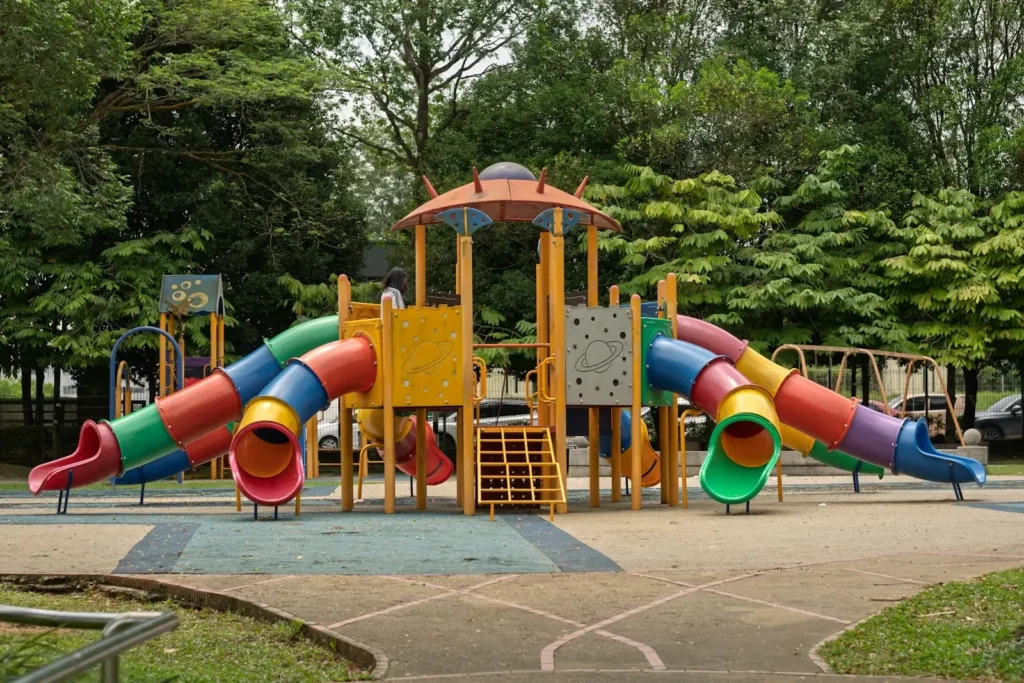
Why wooden playgrounds largely disappeared from public parks
Two things pushed timber out of public play areas, and neither was a sudden dislike of wood. The first was the withdrawal of arsenic-based pressure treatment from playground use. The second was the operating cost of a structure that needs annual refinishing and inspection.
The regulatory part is documented. Chromated copper arsenate was the standard preservative for outdoor timber for decades, and the Consumer Product Safety Commission’s Public Playground Safety Handbook records that CCA-treated wood has not been processed for playground applications since 31 December 2003. Arsenic could migrate to the wood surface, and children put their hands in their mouths. Existing structures weren’t ordered removed, but new ones stopped being built that way.
The replacements resist rot without arsenic, but the copper-based formulations are more corrosive to fasteners, and they look identical to untreated timber, so an inspector can’t tell them apart by eye.
The operating side killed the category in parks. Wooden structures take unsupervised traffic from children of every age, in every weather, all year. Timber checks, splinters, grows mould in shade and rots at ground contact. Public agencies answer to inspection logs, accessibility rules and insurers, and a material that generates annual defects in a signed document gets value-engineered out. Wood has retreated to themed resorts, farm parks and covered courtyards.
Matching material to component, not to the whole structure
Specify material by component. That’s the biggest gap between a drawing that performs and one that looks fine on paper.
| Component | Usual material | Reason |
|---|---|---|
| Posts and trusses | Hot-dip galvanized steel | Dynamic load, vandal resistance |
| Platform decks | LLDPE over a steel frame | Slip resistance, replaceable |
| Slide beds | LLDPE, or 304/316 stainless | Low friction, impact tolerance |
| Guardrails and infill | LLDPE | No sharp edges, cheap to swap |
| Fasteners | Stainless or zinc-flake coated | Must outlive the joint |
Multi-slide structures and slide beds
Multi-slide structures put the material question under pressure, because several slides share one tower and each exit creates its own impact zone. Keep the slide beds in one material family. Mixing a stainless flume with an LLDPE flume on the same deck produces two friction profiles, two exit speeds and two maintenance routines. The tower should stay steel, since it carries combined loads. Where a design uses paired or helical runs, as on these double spiral slides, specify entry and exit sections separately from the run.
Fasteners, footings and the parts nobody specs
What fails first is rarely what’s in the render. Check for anti-tamper fastener heads on public sites, footings sized to soil and wind load rather than copied from another project, isolating washers at every metal-to-metal contact, and a drawn transition piece at every material change. A steel frame with plastic panels has a joint every 600 mm, and each is where two expansion rates fight. If the interface isn’t drawn, the installer invents it on site.
Climate and lifecycle cost decide more than material alone
Climate changes the ranking more than the material does. The LLDPE panel that lasts a decade in a shaded courtyard can fail in four years on a sun-baked rooftop, and a frame that survives inland can corrode early within sight of the sea.
On coastal and monsoon sites, prioritise coating weight, drainage and fastener grade, since standing water at the base of a post defeats every other line on the drawing. In high-UV sites, prioritise stabilised resin, light colours and shade over dark plastic and metal handrails. In cold-winter sites, watch the thin-walled parts with tight radii.
Build the lifecycle comparison yourself instead of accepting a number from a supplier:
Total cost of ownership = purchase price + installation + annual maintenance hours × labour rate × years in service + replacement parts + access lost on closure days
Then ask every bidder for the same inputs: annual maintenance hours, which components they expect to replace and when, coating or wall thickness data, and warranty terms including what voids them. A quote that won’t put maintenance hours in writing expects you to fund them.
What surface belongs under an outdoor structure for kids
Surfacing is specified from the fall height down, never from a material preference up. The tallest designated play surface sets the requirement, and the material must be tested to that height at the depth it will actually be maintained.
The same CPSC handbook gives the working figures for loose fill: a minimum uncompressed depth of 9 inches for equipment with a fall height up to 7 feet, and 12 inches up to 10 feet, with shredded rubber at 6 inches. Those are floors, not targets. Testing runs under ASTM F1292, which measures impact attenuation through peak deceleration and the Head Injury Criterion, typically capped at a HIC of 1000. A product carries a critical fall height, meaning the tallest drop it still passes at the installed depth.
| Surface | Strength | Trade-off |
|---|---|---|
| Engineered wood fibre | Cost-effective, good absorption | Compacts; monthly depth checks |
| Sand | Cheap, sensory play value | Poor impact per inch; hygiene |
| Rubber tiles | Consistent, accessible | Costs more; must match fall height |
| Poured-in-place rubber | Seamless, accessible | Needs a drained sub-base |
The use zone extends at least 6 feet beyond stationary equipment, further at slide exits on taller slides, and the surfacing must cover the ground under the swing arc where fill gets kicked out fastest.
What to send in an RFQ before you approve a spec
Write the spec as measurable parameters. “Heavy duty” and “premium quality” have no place in an RFQ, because neither can be inspected on delivery.
Put these on the enquiry and require a written answer against each line:
- Tube wall thickness, and zinc coating weight in grams per square metre.
- LLDPE wall thickness, resin grade and UV stabiliser package.
- Colour reference and the fade expected over the warranty period.
- Fastener material, head type and corrosion class.
- The standard built and tested to, such as EN 1176 or ASTM F1487.
- Third-party test reports for strength, toxicity and weathering.
Then verify. A colour swatch, a cut tube section showing coating on the inside, a salt-spray report and three wall-thickness measurements on a sample panel tell you more than a factory tour.
JQK builds outdoor playground structures to project requirements, including themed multi-slide towers, stainless and timber-look slide options, and mixed steel-and-LLDPE configurations. Material data, drawings and inspection documents go out with the quotation, so the spec can be checked line by line instead of taken on trust. Send the site dimensions, target age group, climate and surfacing plan, and the material breakdown comes back as a document you can put next to other bids.
FAQ
How often should slide bed panels be replaced?
Judge by condition, not calendar. Check the exit section quarterly for scratches deep enough to catch a fingernail, chalked surfaces that leave residue on clothing, and any flex that stays after the child leaves the panel.
In a mixed-material structure, who is responsible when a joint fails?
Whoever specified the interface. If the transition between steel frame and plastic panel is drawn with a part number and an isolating washer, responsibility sits with the designer. If the installer improvised it, the argument goes to the installer.
Can a custom project be validated with a single module first?
Yes. Commission one tower or one slide run, install it, and check what drawings can’t show: how the surface heats at midday, whether exit speed suits the age group, and whether the maintenance routine is realistic for your team.