A structure that looks correct on a specification sheet can fail in three summers on a site with hard ultraviolet light and 45°C afternoons. Plastic chalks to a pale surface, a slide bed blisters, a bolt seizes inside a coastal frame, water sits in a post and splits the coating at the first freeze. None of it is visible in the catalogue, which is why buyers specifying outdoor playground equipment for deserts, monsoon belts or salt-heavy coastlines ask different questions than buyers in a mild climate.
Choose from the site’s climate loads first, then match materials and coating systems to those loads, then confirm the safety standard your destination market enforces, and write each requirement into the RFQ as a document you expect back. Price decides between options only after a structure can survive the site.
The rest of this guide follows that sequence, from climate loads to the acceptance checks at delivery.
Start with the climate load, not the catalogue
Every weather failure traces back to one of six loads: ultraviolet radiation, sustained heat, freeze-thaw cycling, salt air, snow and wind. Name which dominate your site before comparing a product page, because each one changes a different part of the specification.
Design loads work on extremes and cycles, not averages. A site at -15 °C for two weeks takes less damage than one that crosses freezing forty times, because the damage comes from water expanding inside a joint. Fading is a cumulative dose in the same way. Two outdoor playground structures can look identical in a brochure and share almost no components.
| Climate load | What fails first | What to specify |
|---|---|---|
| Ultraviolet radiation | Resin chalking, colour loss, embrittlement | UV-stabilised resin tested to ISO 4892 or ASTM G154 |
| Sustained heat | Slide bed temperature, thermal movement | Light touch surfaces, heat-stable resin, expansion allowance |
| Freeze-thaw cycling | Water in hollow sections, coating splits | Low-point drains, footings below frost depth |
| Salt air and spray | Zinc consumption, white rust | Stated galvanising thickness, stainless fixings |
| Snow accumulation | Platform deflection, blocked exits | Local design load plus a clearing procedure |
| Wind exposure | Uplift at footings, racking | Anchorage for site wind speed, bracing |
A claim of outdoor suitability is not a climate specification. One unit may use a UV-stabilised compound throughout while another relies on a surface additive that washes off in two seasons. The difference shows up in year three, when most buyers stop checking.
The standards that decide whether a structure survives its climate
Safety standards set the floor for fall protection, entrapment and structural integrity. They do not set your climate specification. ASTM F1487 governs public playground equipment in the US, EN 1176 is the European series, and each has a separate surfacing standard. Use them for the baseline, then add climate requirements.
What ASTM F1487 covers, and where its limits sit
ASTM F1487 is the Standard Consumer Safety Performance Specification for Playground Equipment for Public Use. It covers children from roughly two to twelve and sets requirements for use zones, entrapment, protrusions and structural integrity. The CPSC Public Playground Safety Handbook restates the same logic in plain language, which makes it the reference most US buyers keep open at a layout review.
What it leaves out matters as much. It is a product performance standard, not a site structural design, so it will not give you the snow load for your region or the corrosivity category of your coastline. It also sits in a family: ASTM F1292 covers surfacing impact attenuation, ASTM F1951 covers surfacing accessibility, and ASTM F2373 covers equipment for six to twenty-three months.
What EN 1176 adds for exposed sites
EN 1176 is the European series from CEN. Part 1 holds the general safety requirements and test methods, with later parts covering swings, slides, cableways, carousels, rocking equipment and spatial networks. Surfacing is handled separately under EN 1177.
The part worth reading on a harsh site is EN 1176-7, which covers installation, inspection and maintenance. It puts the maintenance regime into the standard rather than leaving it to the operator, so a site that freezes needs a pre-winter and a post-thaw check rather than one annual visit.
Where the two standards pull a specification apart
| Requirement | ASTM F1487 (US) | EN 1176 (Europe) |
|---|---|---|
| Use zone | Minimum 6 ft (1.8 m) beyond the perimeter | Calculated from fall height and equipment type |
| Merged use zones | Zones merge within 9 ft (2.7 m) | No directly equivalent rule |
| Slide geometry | Chute angle limited to 50° over age five | Exit height limited to 1000 mm, with a 300 mm run |
| Surfacing | ASTM F1292, HIC 1000 and g-max 200 | EN 1177, same limits, different conditioning |
| Accessibility | Provisions tied to the ADA framework | Not directly specified |
The destination market picks the standard, and the layout follows it. Use zone drives the area of surfacing, which is often the largest installed cost on a project, and climate then decides whether that surface still performs in February.
Material choices that hold up under UV, heat and salt
For ultraviolet and salt exposure, the resin grade and the coating system matter more than the shape of the part. Specify a material class with a test method attached, not a label, because the same label covers products with very different service lives.
Plastic: colour fastness and embrittlement
Rotomoulded parts are usually LLDPE or HDPE. Both need stabilisers to survive outdoor exposure, and the difference between grades is mostly the stabiliser package and whether it is compounded into the resin or applied as a surface treatment. Compounded stabilisation lasts. A surface additive does not.
Ask which weathering method was used and for how many hours, whether colour was measured by grey scale or by ΔE, and whether the sample was a production part. Colour is a separate decision: dark parts absorb more solar gain, so the same multi-slide structures run hotter in dark green than in sand.
Steel: coating systems and coastal corrosion
Three systems dominate and they fail differently. Hot-dip galvanising protects by sacrificial action, so it keeps working at a scratch. Powder coating is a barrier, and once the film is breached, corrosion travels under it well beyond the visible damage. Stainless avoids the mechanism but costs more near salt water.
Two frameworks help. ISO 9223 classifies atmospheric corrosivity from C1 to CX, and it describes the site, not the product. ISO 9227 salt spray gives hours to red rust, useful for comparing systems but not a service-life prediction. One detail gets missed: stainless fasteners in aluminium or plain steel create a galvanic couple, and the less noble metal corrodes faster than it would alone.
Slide beds and hot-weather contact burns
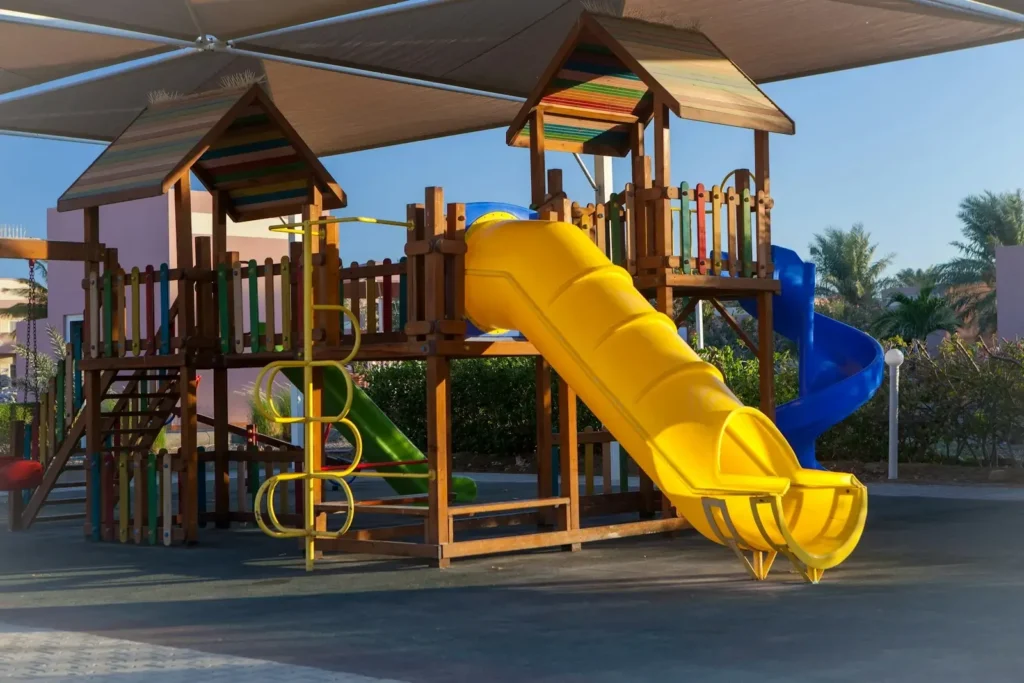
Metal conducts heat well, and a steel chute in strong sun can reach a temperature that is painful through thin clothing. Plastic heats less, though dark colours still get uncomfortable. What reduces risk is a combination: a light or non-metallic chute, orientation away from the afternoon sun, airflow across the bed, and shade as an addition rather than a substitute. Surface temperature is measurable, so measure it on a comparable outdoor structure for kids at peak hour.
Structural detailing for wind, snow and freeze-thaw
Three details decide whether a sound structure survives a hard winter: where the water goes, how deep the footings sit, and how much the frame is allowed to move. None of them shows up in a product photo, all of them are cheap at the factory and expensive to fix on site.
Water comes first. Every hollow section needs a low-point drain and every platform needs a fall so it does not pond. Water inside a post will split the coating at the first freeze, and the corrosion clock then starts where nobody can see it.
Footings come second. Depth follows the local frost line, because a footing that heaves distorts a frame that was square at installation, and anchor material should suit the soil chemistry as well as the frame.
Movement is third. Long steel runs expand daily, so slotted holes and specified clearances let that movement happen without loading the welds. Rigid frames look stronger and crack sooner.
Then the design loads. Snow load comes from the local code, whether ASCE 7 or the EN 1991 series, and it needs a clearing procedure for canopies; a structure designed for the load still fails if someone climbs onto a loaded roof. Wind governs uplift on open sites, which usually means the footing rather than the tube gauge. On outdoor playground climbing structures, bracing matters more than wall thickness.
Layout and surfacing decisions that change with climate
Impact-attenuating surfacing is tested under defined laboratory conditions, and heat, water and frost all move performance away from those conditions. Treat surfacing as part of the climate specification, not as a finishing item chosen at the end.
The limits are the same on both continents: a head injury criterion of 1000 and a peak deceleration of 200 g, under ASTM F1292 and EN 1177. What differs in the field is the state of the material on the day of the fall.
Loose fill freezes into a hard matrix. Rubber tiles stiffen as temperature drops, lowering the critical fall height they absorb, then soften in heat. Artificial turf holds frost in shade and runs well above air temperature in sun.
Three layout decisions follow. Drainage should fall away from the equipment, and in a freeze-thaw climate the surfacing edge needs a restraint that survives heave. A slide facing the winter wind holds snow on the chute and ice at the exit. And a structure placed to catch afternoon sun runs hotter than one placed to catch morning sun.
What to put in the RFQ and how to accept the delivery
Put the climate requirements in the RFQ as a list of documents you expect back, and make acceptance conditional on those documents matching the goods delivered. Verbal assurances about weather resistance do not survive the first claim.
| Document | What it should show | Why it matters |
|---|---|---|
| Weathering report | Resin or coating tested to a named method | Separates compounded stabilisation from a surface treatment |
| Coating specification | System, thickness, standard referenced | Sets coastal service life |
| Structural calculation | Site wind and snow loads, footing design | Proves the frame was checked for your site |
| Hardware schedule | Fastener grade, material, isolation | Prevents galvanic corrosion at joints |
| Surfacing certificate | Critical fall height against your fall heights | Ties the surface to the equipment |
For a site with real exposure, send conditions rather than pick from a photo gallery. JQK builds outdoor play structures from UV-resistant LLDPE and engineering plastic on anti-rust treated steel frames, with rounded edges and modular layouts, and its engineers review site dimensions, age group and exposure before quoting. The multi-slide outdoor play structure range is the usual starting point for parks, kindergartens and resorts that want several slide types in one footprint. Send climate data with the enquiry and ask for the material grade and coating system in writing.
Commissioning, inspection and the maintenance cycle
Harsh climates shorten every inspection interval. A structure that needs one annual audit in a mild climate may need a pre-winter and a post-thaw check in a cold one, and a coastal site needs its fixings inspected far more often than a generic schedule assumes.
Handover is where the record starts. Check anchor torque, look for transport damage, confirm every drain is open, and measure surfacing depth against the certificate. Photograph the joints; those are what you compare against in year two.
A workable routine for an exposed site:
- Before the hard season: torque check on anchors and clamps, touch-up of coating damage, drains cleared, surfacing depth restored.
- After the hard season: corrosion at welds and ground level, fasteners checked for seizing, plastic checked at fixing holes and stress points.
- After any extreme event: inspect before reopening, not after the first complaint.
- Once a year: a full audit against the standard in force in your market, written down and dated.
That record also turns a corrosion complaint into a warranty repair instead of an argument.
FAQ
Is plastic or metal safer in extreme cold?
Neither is unsafe when it is specified for the temperature. Plastic loses impact strength as it gets colder, so a grade chosen for a temperate market can crack at -25°C, while a cold-adapted grade will not. Metal conducts heat instead, so bare skin can stick to it. What matters is the low-temperature impact rating of the resin and whether water can sit inside the steel at all.
How often should fixings be replaced on a coastal site?
There is no universal interval, and a supplier who gives you one in years is guessing. Coastal corrosion depends on distance from the surf line, onshore wind, salt deposition and fastener material. Classify the site, inspect at a fixed frequency, then replace on condition: rust at the thread, seized nuts, or staining from a joint.
Can shade alone solve hot-weather burn risk on slides?
Shade lowers surface temperature but does not remove the risk. A shaded metal chute still absorbs radiant heat from surrounding surfaces and holds warmth after the sun has moved, and shade cloth itself degrades under ultraviolet light. The dependable combination is a light or non-metallic chute, orientation away from the afternoon sun, and shade added on top.