
A trampoline park looks self-explanatory to a visitor and ambiguous to almost everyone else. Two people can stand in the same hall and disagree about what the business is: a play venue, an amusement attraction, a fitness studio, a sports facility, or simply a building full of equipment. The disagreement is not academic. Operators shopping for trampoline park equipment meet it at the first quote, because suppliers, insurers, and inspectors each start from a different definition of the same room.
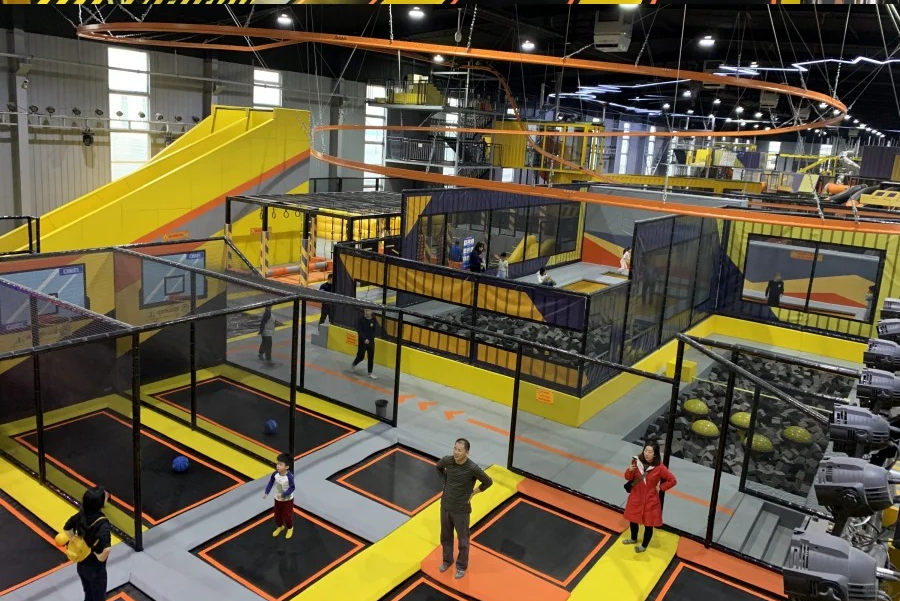
A trampoline park is considered an indoor commercial recreation venue built around connected trampoline courts, and it is classified as an amusement attraction or a family entertainment center rather than as a gym, a sports facility, a school playground, or a single piece of play equipment.
The sections below follow that answer through each system that classifies these venues, because the label changes what a buyer has to specify and what an operator has to prove.
So What Is a Trampoline Park Considered?
In short, it is considered an amusement or recreation business whose product is access to a supervised trampoline court, and nearly every official definition places it on the entertainment side of that line rather than the sport or education side.
No single body issues “the” classification. Five separate systems label the same building, and the labels do not automatically transfer between them.
| Lens | What the park is considered | Who relies on the label |
| Everyday speech | An indoor jump venue | Visitors, mall leasing agents |
| Industry statistics | Amusement and recreation business | Analysts, lenders, franchise filings |
| Regulation | An amusement device or attraction, or an exempt premises | State safety and labor departments |
| Insurance and law | A commercial recreation premises with inherent risk | Underwriters, courts |
| Planning and zoning | An indoor commercial recreation use | Planners, fire marshals |
The practical consequence is that a permit from one system proves nothing to another. A state device permit does not satisfy a zoning officer, and a certificate of occupancy does not satisfy an insurance questionnaire. Each document answers a different question about the same address.
What Is Meant by Trampoline Park in Operating Terms?
Operationally, a trampoline park is a building whose main floor is a continuous matrix of connected trampoline beds, run as a ticketed venue with timed sessions, zone supervision, and one admission gate rather than as a room containing individual trampolines.
That distinction is what separates a park from a gymnasium with equipment in it. One ticket, one waiver, one safety briefing, and one monitor team cover every bed on the floor, so the unit of design and the unit of liability are both the court rather than the trampoline.
What Counts as the Trampoline Court
A court is the installed system: beds, suspension, frame padding, dividing nets, and the landing zones at the edges. Landing zones are usually foam pits or airbags, and that choice changes both maintenance load and inspection routine. The term of art in the technical literature is trampoline court, and ASTM F2970-25 is the practice governing its design, manufacture, installation, operation, maintenance, inspection, and major modification. The document also assigns duties by role, with separate sections for manufacturer responsibilities, owner and operator responsibilities, patron education, and patron responsibilities, and it does not apply to any device that does not incorporate a court bed.
What Sits Around the Court
Most parks add dodgeball courts, slam-dunk lanes, obstacle or ninja courses, climbing walls, party rooms, a cafe, and a viewing mezzanine. Each addition raises revenue per visit and lengthens dwell time, and each one also pushes the venue toward the family entertainment center label, which is a different insurance and staffing conversation from a single-court park.

How Do Industry Statistics Classify a Trampoline Park?
Statistically, a trampoline park belongs to the amusement, gambling, and recreation industries, and the two codes that appear most often in filings are amusement and theme parks and all other amusement and recreation industries, depending on how much revenue comes from fixed attractions rather than open recreation.
| Code | Title | What it covers |
| NAICS 71 | Arts, entertainment, and recreation | Sector level |
| NAICS 713 | Amusement, gambling, and recreation industries | Subsector |
| NAICS 713110 | Amusement and theme parks | Fixed-attraction parks |
| NAICS 713990 | All other amusement and recreation industries | Recreation centers and open recreation |
The code an operator picks follows the business plan more than the floor plan. A park that sells itself as an attraction with rides, shows, and packaged birthdays reads closer to 713110, while one that sells open jump time and fitness sessions reads closer to 713990. The choice is not cosmetic: it sets the benchmark group a lender or franchise disclosure compares the site against, and it decides which set of comparable sales a valuer will use. Selecting the code carelessly is one of several avoidable errors that surface years later, when the site is refinanced or compared with the figures in this guide to opening a trampoline park.
How Do Regulators Classify a Trampoline Park?
There is no federal certification for trampoline parks in the United States. Whether a park counts as an amusement device is decided state by state, and the range runs from annual permitting and inspection of every court to an explicit exemption from ride regulation.
| State | How the venue is treated | What follows for the operator |
| Tennessee | Named among the devices the state regulates, in the same list as inflatables and trackless trains | Annual device permit |
| Oklahoma | Registered as an amusement ride under the state trampoline guidelines, with each court counted as a separate device | Annual registration, inspection, and 1,000,000 USD liability cover |
| Illinois | Brought under the Amusement Ride and Attraction Safety Act in 2021, with dedicated gymnastics training facilities excluded | Permit and inspection before operation |
| Utah | Named among the amusement ride exemptions from state permitting | No ride permit required |
The technical content behind those rules comes from a voluntary consensus standard rather than a regulation. The scope of F2970 lists the settings it was written for, and that list is a fair summary of how the industry is classified in practice: trampoline parks, amusement parks, theme parks, water parks, family entertainment centers, fitness centers, gyms, gymnastics facilities, sports facilities, skate parks, camps, shopping malls, temporary special events, carnivals, and municipal parks. The standard therefore classifies the venue by its equipment, while the state classifies it by its business, and a park has to satisfy both at once. No federal agency licenses a park, inspects a court, or keeps a register of compliant operators; that work sits with state device units and the third-party inspectors they approve. That dual obligation also explains why incident reporting differs so much between states, a pattern covered in this review of the trampoline park safety record.
What Else Is a Trampoline Place Called?
The same venue is sold as a jump park, a trampoline arena, an indoor trampoline park, a bounce park, or an adventure park, and each label points to a different attraction mix, capital profile, and contract vocabulary.
| Term | What it usually signals | Where it shows up |
| Trampoline park | Court-based venue with ticketed sessions | Search, leases, standards |
| Jump park | The same format, shorter and family-facing | Consumer marketing |
| Trampoline arena | One large hall, competition or fitness angle | Event contracts, Europe |
| Bounce park | Inflatable-led, lower capital | Family venues |
| Adventure park | Multi-attraction site | Zoning, insurance |
The label matters most in writing. A lease, a supplier quote, and an insurance questionnaire will each use one of these terms, and a mismatch between them is enough to produce a quote for the wrong scope of work.
What Is the Actual Term for a Trampoline?
The word itself comes from trampolino, an Italian term for a springboard or diving board, which is a useful reminder that the device began as gymnasium apparatus. Three terms then do different jobs. Trampoline refers to the device. Trampoline bed refers to the fabric surface that returns the energy. Trampoline court refers to the installed commercial system, and it is the term used in standards, permits, and inspection reports. A purchase order that asks for trampolines gets devices; one that asks for a court gets a designed, inspected system.
Is a Bounce House a Trampoline?
No. A bounce house is an inflatable whose shape is held by air pressure, while a trampoline returns energy through a tensioned bed suspended on springs or rods. Different structure, different failure mode, different standard, and usually a different regulatory category.
| Attribute | Bounce house | Trampoline court |
| Structure | Fabric chamber held by air pressure | Tensioned bed on a rigid frame |
| Energy return | Low and heavily damped | High and repeated |
| Commercial standard | ASTM F2374 | ASTM F2970 |
| Common device category | Inflatable device | Amusement device |
| Typical setting | Rented or seasonal | Permanent indoor building |
The two do meet in one place, and that is where most of the confusion starts. A state statute can put both under the same act while listing them as separate device categories, so sharing a law is not the same as sharing a definition. A park that adds an inflatable zone therefore adds a second compliance track rather than extending the first.
How Does It Compare With Other Indoor Play Venues?
Physically, a trampoline park is closest to an indoor playground and a family entertainment center, but its surface returns energy instead of absorbing it, so supervision ratios, session flow, and inspection routines follow amusement-device practice more closely than playground practice.
| Venue | Core surface | Supervision model | Standard anchor |
| Trampoline park | Tensioned beds | Zone monitors | ASTM F2970 |
| Indoor playground | Padded structure, slides, ball pits | Roaming staff | ASTM F1918 |
| Family entertainment center | Mixed rides and arcade | Attendant per attraction | Mixed |
| Inflatable park | Air-supported devices | Attendant per device | ASTM F2374 |
The comparison is not only technical. These formats compete for the same mall unit, the same birthday party spend, and often the same landlord, yet they are not interchangeable in a lease negotiation. Insurance terms, ceiling height, and the indoor playground floor area required per visitor all differ, which is why a landlord may accept one tenant and decline the other for the same space.

What Does the Classification Change in Practice?
The label decides four things at once: which standard revision goes into the specification, which permit the building needs, which insurance class the policy is written against, and how many trained monitors must be on the floor at peak.
Work through the checks in this order, because each one constrains the next.
- Confirm with the state device authority whether a trampoline court is a regulated device, and whether registration is per court or per building.
- Write the standard revision into the purchase order explicitly, as F2970-25 rather than “latest version”, so the delivered equipment and the inspection report refer to the same document.
- Answer the insurance questionnaire using the classification the business actually registered under, not the one used in marketing material.
- Set the monitor ratio in the operations manual, then staff and train to that number rather than to the roster.
- Keep the evidence chain intact: manufacturer certificates, installation records, inspection reports, and training logs in one file per court.
Mismatches rarely surface at opening. They surface at a claim, a renewal, or an acquisition, when someone asks which standard the equipment was built to and the answer is a brochure instead of a document.
FAQ
Three questions tend to follow once the labels are settled.
Is a trampoline park considered a sports facility?
Not in the regulatory sense. Competitive trampoline training takes place in gymnastics facilities under federation rules, while a commercial park is treated as an amusement or recreation venue. Hosting fitness classes does not reclassify the building, because the classification follows the equipment and the admission model rather than the class schedule.
Does a trampoline park count as an indoor playground?
Only in casual speech. Indoor playground standards address padded play structures and their fall zones, while trampoline courts have a separate practice covering design, operation, and inspection. Where a venue contains both, the two areas are specified, inspected, and staffed separately.
Is a trampoline court an amusement ride?
It depends on the state. Several states define it as an amusement device and require annual permitting, while at least one names trampoline parks among explicit exemptions. The useful question is narrower than the general one: does this state’s device list include trampoline courts, and does it count each court or the whole building.


