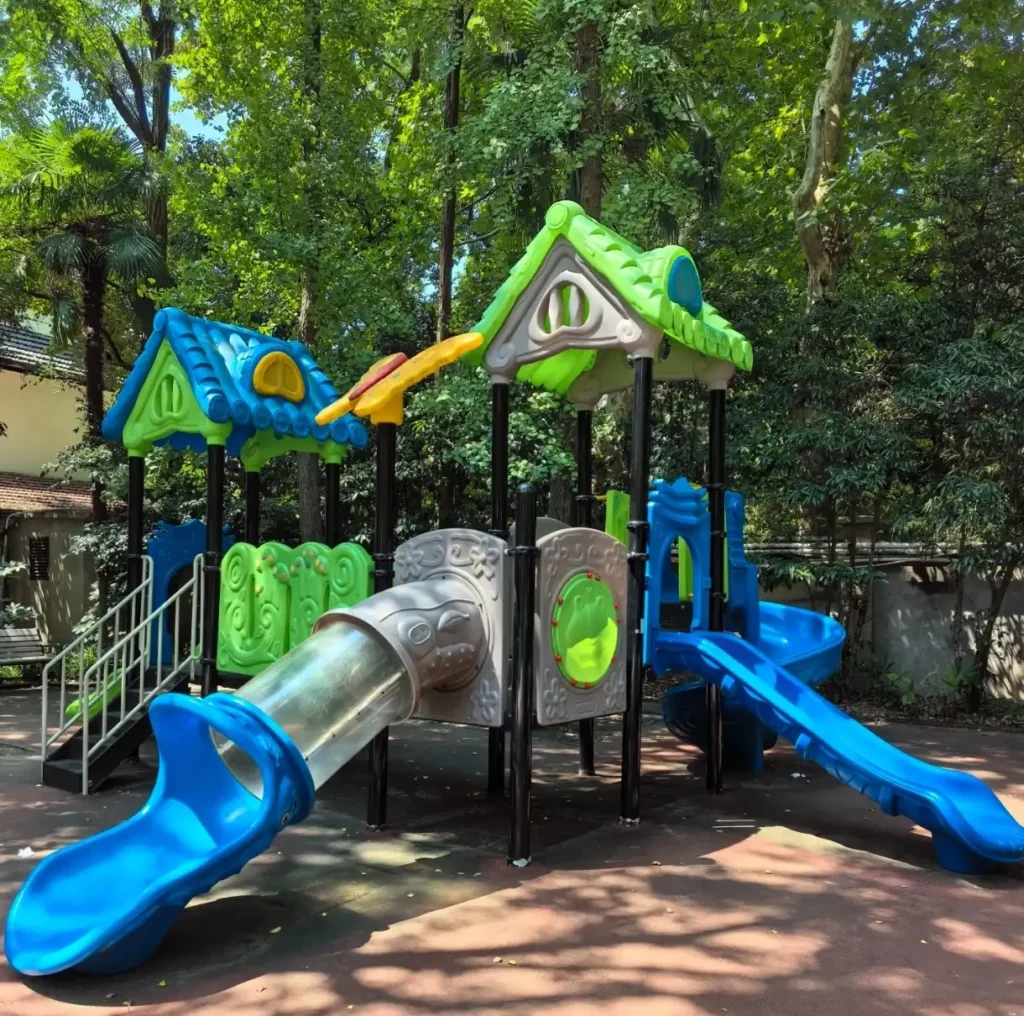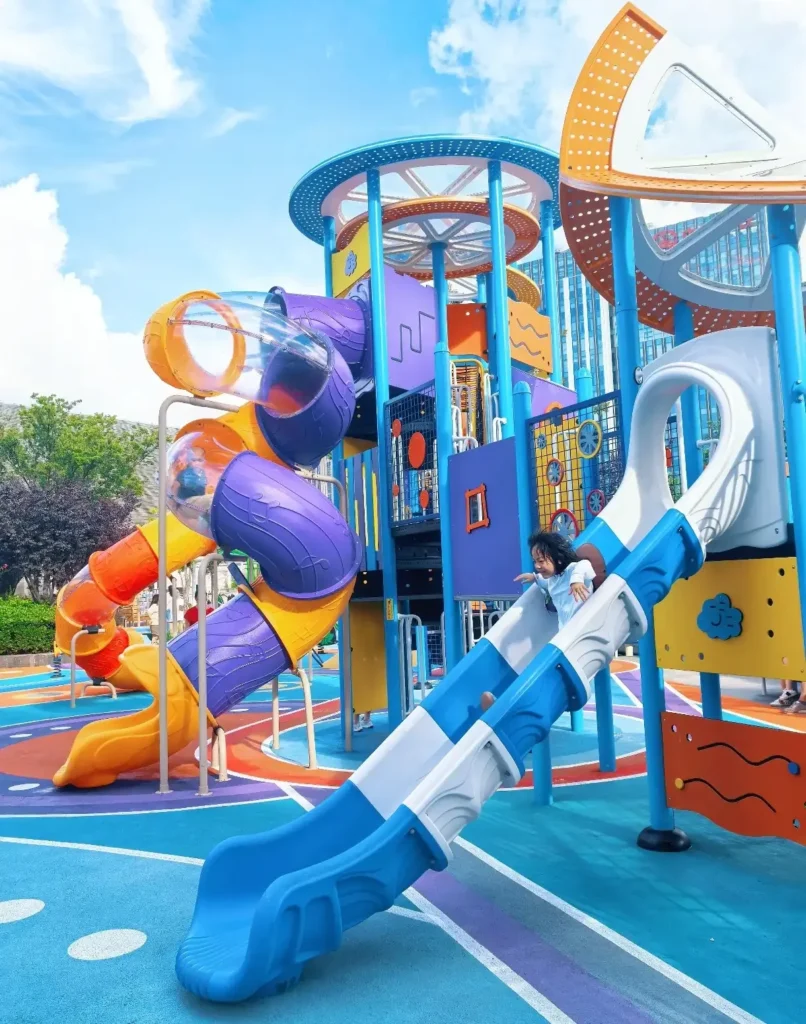
A playground is one of the few purchases a park department, school or resort makes that has to survive a decade of daily use in the open. Buyers want a lifespan figure because it decides how the asset enters a capital plan and when a replacement line gets written. The figure is also easy to misread, since a 20-year-old structure has rarely gone untouched for 20 years. Anyone comparing outdoor playground equipment for a public site runs into the same problem: published numbers vary by material, by component and by how the site is run.
A well-maintained commercial outdoor playground typically serves 15 to 20 years, and projects with a real maintenance program reach the upper end or past it. The steel frame usually outlives that figure. What ages out first are the parts bolted to it: swing hangers, bearings, plastic panels, rope and net elements, and the safety surfacing underneath.
Here is how that range breaks down piece by piece, what moves a site toward the top of it, and how to plan the replacement instead of discovering it.
The realistic lifespan range, and why it is a range
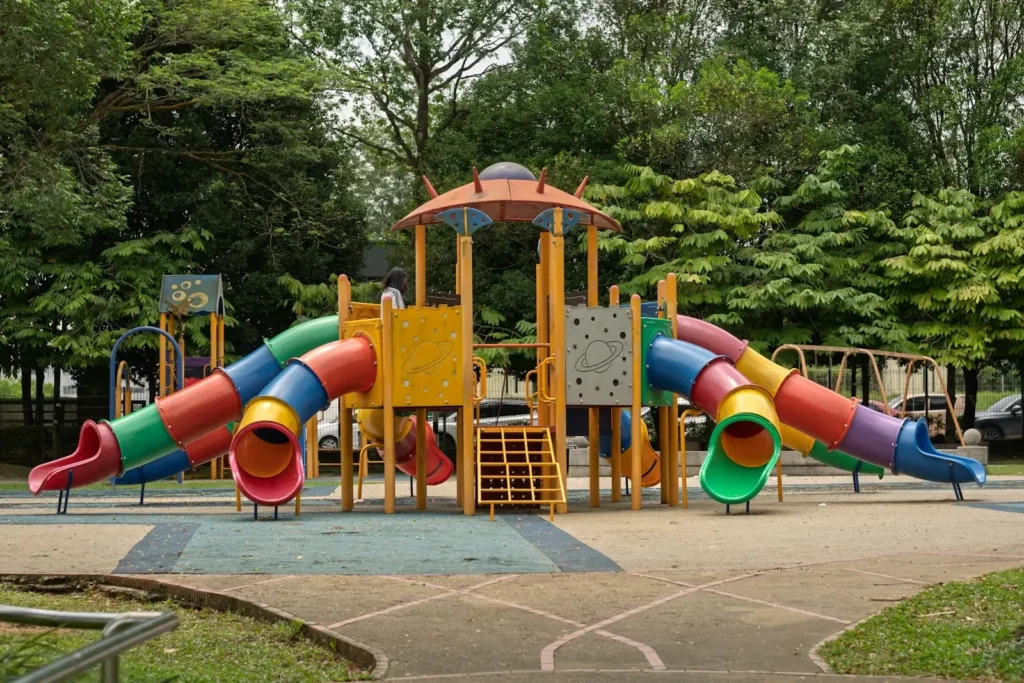
Commercial-grade equipment is usually quoted at 15 to 20 years, with material grade setting the ceiling and maintenance deciding where inside the range a specific site lands. Two identical structures installed the same month won’t be in the same condition at year 15.
Published supplier guidance clusters the same way across markets. The variation comes from how each material fails, not from how strong it is on day one.
| Material | Typical service life | Usual failure mode |
|---|---|---|
| Hot-dip galvanized steel with powder coating | 20 to 25 years and beyond | Corrosion starting at a breached coating or a ground-level weld |
| Stainless steel components | 25 years and beyond | Rarely structural, mostly surface staining and hardware wear |
| Rotationally molded HDPE or LLDPE panels | 10 to 20 years | UV embrittlement, color fade, impact cracking |
| Engineered or treated timber | 10 to 15 years | Rot at ground contact, splitting, insect damage |
| Rope, net and cable elements | 8 to 12 years | Friction wear at anchor points and clips |
| Poured-in-place rubber surfacing | 8 to 12 years | Compression loss, seam failure, UV hardening |
Read the table as ranges, not promises. A coated steel frame beats timber in most climates, and a set of swing hangers will wear out several times over the life of the frame holding them. Residential playsets are a separate category: they see a few children a week, so their 10- to 15-year figures say nothing about a schoolyard running three recesses a day.
The frame outlives the parts, so budget by component
A structure is not one asset. It is a frame with a service life measured in decades and a set of wear items with service lives measured in years, and the budget has to treat them separately.
This is where capital planning usually goes wrong. A department replaces a playground at year 12 because it looks tired, when the frame had another decade in it and the real problems were panels, hardware and surfacing. The opposite failure is patching a structure whose posts are corroded at the footing, where the money goes into a frame that is already finished.
| Component group | Service life | Replacement pattern |
|---|---|---|
| Posts, arches, main frame, footings | 20 to 25 years | Once, at end of asset life |
| Decks, platforms, themed panels | 10 to 15 years | Once or twice |
| Moving parts: swing hangers, bearings, chains, bushings | 5 to 10 years | Every few years, in batches |
| Slides, climbers, handrails | 10 to 15 years | Usually once |
| Rope, net and cable play | 8 to 12 years | Once, sometimes twice |
| Safety surfacing | 8 to 12 years for unitary, annual topping for loose fill | Continuous |
Two consequences follow. A parts list kept from handover is worth more than a warranty folder, because the question at year 9 is whether a hanger is still available, not whether the original install was good. And design that lets high-wear items come off without dismantling the structure is what extends the asset: a tower with bolted panels outlasts an identical one where every panel is welded and costs less to keep.
What decides whether a structure reaches 20 years
Five things separate a 10-year playground from a 20-year one: material specification, climate exposure, traffic, installation quality, and maintenance. Only the last two are under the operator’s control after handover.
Material specification sets the ceiling
Galvanized steel protects itself with a zinc layer, and powder coating over it adds color and a second barrier. Both work until something breaches them. A scratch through the coating is where corrosion begins, and on a coastal site that process runs faster. UV-stabilized plastics resist sunlight far better than standard grades, and the gap shows as brittleness and fading around year 8 rather than year 15. Timber needs re-sealing on a schedule, which is a recurring commitment rather than an option.
Climate and site exposure
Sun, salt and water do most of the long-term damage. UV exposure embrittles plastic and fades color. Humidity and salt air attack metal wherever the coating is compromised. Freeze-thaw cycles work on the footings and joints, pushing posts out of plumb and opening gaps that let water in. Standing water is the quiet one: it rusts posts at ground level, degrades surfacing and turns into ice in winter.
Traffic and age-group mix
A municipal park with weekend peaks wears differently from a school site with five sessions a day. The parts children touch most fail first, so swing hangers, slide run-outs and climbing grips carry the wear. Age mix matters too: a structure serving 5 to 12 year olds takes harder impacts than a preschool set, and hardware works loose faster.
Installation, drainage and hardware
Shallow footings, poor anchoring and bad drainage shorten the life of good equipment. So does mixing metals in direct contact, which sets up galvanic corrosion at the joint. A structure installed level, anchored to specification and draining away from the footings will still be serviceable when a cheaper installation on the same equipment is ready for demolition.
What a maintenance routine actually buys you
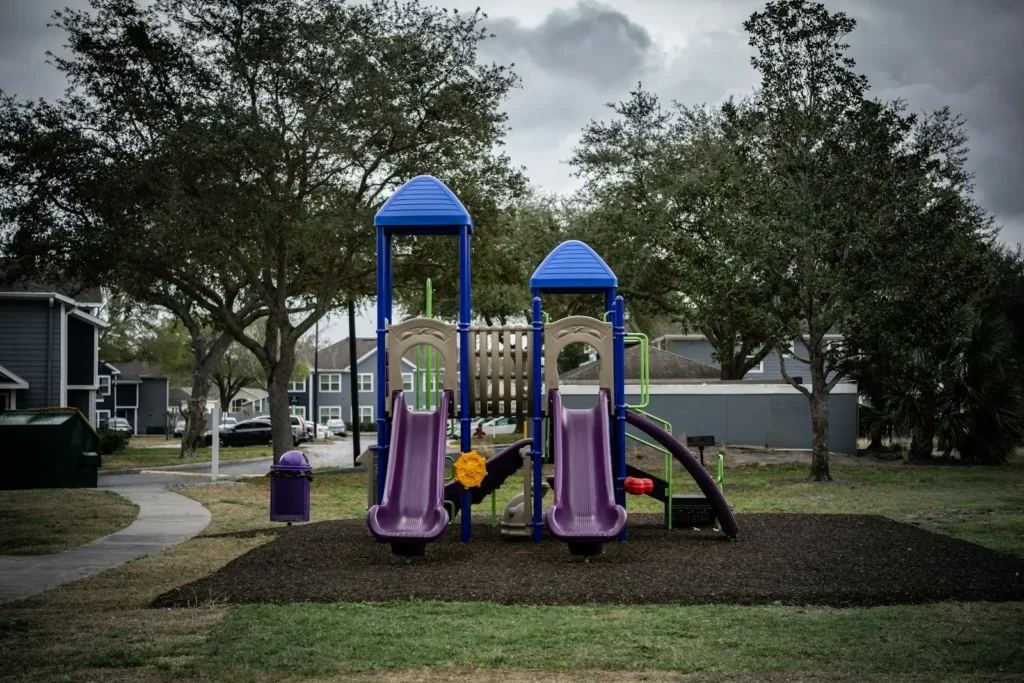
Maintenance is the only variable an operator fully controls, and it’s worth roughly a decade of service life. Neglected equipment can fail inside 10 years; the same equipment on a documented schedule reaches 20.
The tasks are unglamorous and cheap compared with replacement.
| Interval | What gets checked |
|---|---|
| Daily or weekly | Sharp edges, broken parts, protruding bolts, litter and debris, surfacing depth at slide exits and swing bays |
| Monthly | Hardware tightness, swing hanger wear, bearing play, coating damage, drainage |
| Quarterly | Structural joints, footings, corrosion at ground level, surfacing seams, fall zones |
| Annually | Full structural inspection, surfacing impact performance after major repairs, recoating plan |
The U.S. Consumer Product Safety Commission publishes the Public Playground Safety Handbook, which covers installation and maintenance alongside the equipment recommendations, and the ASTM F1487 voluntary standard sits behind most commercial specifications in North America. Those give an operator a defensible baseline. They don’t replace a written record, though, and inspection logs are what manufacturers ask for when a warranty claim lands.
What to do if equipment is damaged or unsafe
Take it out of use first and argue about the repair second. Barricade the item, record the fault with a photo and a date, and get an assessment that separates cosmetic wear from structural failure. Cracked posts, deformed frames, corroded sections at the footing and failed welds mean the item stays closed. A missing bolt or a split panel is a repair. Reopening equipment because a replacement part is on order is the one shortcut that turns a maintenance line into a liability claim.
When repair stops making sense
Four signals together mean the repair cycle has become a down payment on a new playground: repairs are getting frequent, the wear is structural, the equipment no longer meets current safety guidance, and the site’s needs have changed.
Any one of these can be managed. Frequent repairs on a sound frame are a parts problem, and often a cheap one. Structural corrosion at ground level, cracked welds and deformed frames are not repairable in any practical sense. Entrapment openings, protrusions and fall heights that no longer match current guidance sit in a third category, where the equipment might be structurally fine and still fail an inspection. The fourth signal is the one budgets ignore: a structure built for one age group, or without accessible components, can be serviceable and still not serve the community it was bought for.
What to do with old playground equipment
Refurbish, relocate, donate or resell, or dismantle and recycle. The right path follows the condition of the frame, not the appearance of the panels.
| Path | Works when | What to watch |
|---|---|---|
| Refurbish in place | Frame and footings sound, wear is in panels, hardware and surfacing | Parts availability for the specific product line |
| Relocate to a second site | Structure is sound and the new site has room for fall zones | New footings, new hardware, reassembly labor, re-inspection |
| Donate or resell | Equipment is complete, under 10 years old and documented | Liability and condition disclosure transfer with the equipment |
| Dismantle and recycle | Frame is corroded or the design is obsolete | Steel and HDPE recyclers take most of it; disposal is not free |
Relocation looks cheaper than it is: footings don’t travel, hardware shouldn’t be reused, and the assembly needs inspecting again at the new site. Past year 12, the numbers usually favor refurbishing what’s already standing.
What replacement costs, and how to phase it
Replacement budget is four lines, not one: structure, surfacing, installation and removal. A quote that covers only the equipment leaves the other three to be found later.
Surfacing is the line most often underestimated, because unitary surfaces cost more per square meter than loose fill and the fall zones around a big multi-slide tower are large. Removal and disposal of the old structure, plus footing excavation, is the second. Installation method matters too: footing work is where site conditions change the number.
How much does a commercial playground set cost?
There is no useful average. Price moves with the footprint, the number of play events, theme complexity, material grade, fall height and the surfacing under it. A single preschool tower and a themed multi-level structure with several slides aren’t the same product at different prices. Treat any published figure as a starting band and price the actual layout. That’s also the only way to compare bids, since a cheap quote usually means fewer play events, thinner steel or loose fill where the spec called for a unitary surface.
Phasing a replacement across budget cycles
Playgrounds fail in sequence, so they can be replaced in sequence. Worn hardware and surfacing come first, because they carry the safety risk. Panels and themed elements follow. The frame goes last, and often never needs to. Schools have a window in summer, parks have a shoulder season, and working through the list in that window keeps the site open the rest of the year.
How JQK designs for a longer service life
The cheapest way to add years to a playground is to decide the details at design stage, when structure, materials and replaceable parts can still be specified together.
JQK builds custom outdoor and indoor play equipment for parks, schools, resorts and family entertainment centers. The range covers themed combined slides, indoor playground series, trampoline parks and electric amusement rides, and most projects start from a site plan rather than a catalog page. Two details matter for lifespan. Structures are designed so themed panels, slides and hardware can be replaced individually, which keeps a sound frame in service instead of sending it to scrap over one worn element. And the layout is drawn around the fall zones and age groups the site actually serves, which is where wear and compliance get decided. Finished builds are on the product case page.
If you’re planning a replacement or a new site, send the footprint, the age groups and the budget range. JQK will return a layout, a material specification and a quote against it, so the lifespan question gets answered for your site instead of on average.
FAQ
Does a long warranty mean a longer service life?
No. Warranties cover manufacturing defects within a defined period, which is a different thing from how long the structure stays serviceable. A 10-year structural warranty says the frame shouldn’t fail from a defect in 10 years. It says nothing about swing hangers, panels or surfacing, and most warranties require documented maintenance to stay valid. Ask what’s covered, for how long, and on what conditions before treating a warranty as a lifespan figure.
How does a commercial structure compare with a residential playset?
Commercial equipment is engineered for public traffic: heavier steel, reinforced joints, stronger hardware, and anchoring sized for constant use. A residential set might see a few children a week; a school structure can see hundreds a day. That’s why a residential set is often quoted at 10 to 15 years and a commercial one at 15 to 20 or more. The gap isn’t marketing. It’s the load the equipment was designed to carry.
Can a playground stay open while worn parts are replaced?
Usually yes, if the work is isolated. Swapping a swing seat, a hanger or a section of surfacing can be done with the rest of the site open, provided the work area is fenced and the affected item is closed. Structural work is different, and so is anything that disturbs footings or a fall zone. Schedule those for a closure window and order parts in advance, since waiting on delivery with equipment barricaded is where operators lose weeks.