
A trampoline park sells the same raw material a gym sells, which is movement, yet almost nobody describes a gym session as fun. That gap is the entire business model. What began as a backyard toy turned into a paid indoor venue because operators stopped selling exercise and started selling an hour that feels like play, and the format now anchors family entertainment centres, shopping malls and standalone buildings built around trampoline park equipment. Understanding why it works is not a marketing question. It is a question about skill barriers, physics and group behaviour.
The fun comes from three effects stacking on top of each other: the floor drops the skill barrier to almost nothing, the rebound hands out vertical acceleration for free, and the group format turns physical effort into a shared event. Each effect is ordinary on its own. Together they produce an experience most guests repeat.
This article takes the three effects apart, corrects the most widely repeated claim in the industry, and explains what pediatric guidance and the research actually say.
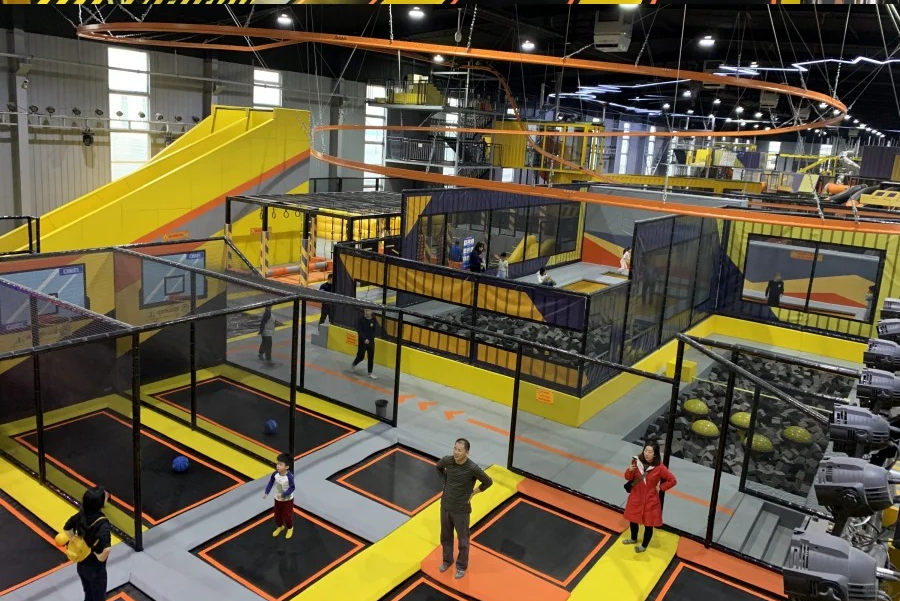
Why Does Jumping Feel Like Play Instead of Exercise?
The floor removes almost every entry requirement a fitness activity normally carries. There is no technique to learn before the first minute becomes enjoyable, no scoreboard, no mirror and no set to fail. A bad landing costs one bounce, not a session.
Compare what the two settings ask of a beginner. A gym asks for a plan, a correct movement pattern and a judgement about whether the rep counted. A trampoline park asks one thing: stay inside your square. Effort is then self-selected, so a nervous first-timer can shuffle in place while an experienced jumper works on layouts a few metres away, on the same floor, in the same session, at the same price. That range is unusual. Most activities split beginners and advanced users into different classes or different rooms.
| Dimension | A typical gym session | A trampoline park session |
| Skill barrier | Form has to be learned first | Start jumping on arrival |
| Intensity control | Set by the plan or the class | Set by bounce height |
| Cost of a mistake | A failed rep, a wasted set | One awkward landing |
| Social structure | Parallel, headphones, screens | Shared, face to face, loud |
The last row matters more than it looks. A session that produces eye contact and laughter is remembered differently from a session that produces a log.
What Does the Rebound Actually Do to Your Body?
Every landing is absorbed by the bed and returned, so the body collects repeated vertical acceleration while the ankle sees a much lower peak than it would in running. That difference is real, measurable, and it is also the most misquoted piece of research in the industry.
The reference study is a 1980 experiment from a NASA research centre and the University of Kentucky. Eight young men aged 19 to 26 walked and ran on a treadmill at four speeds and jumped on a trampoline at four heights, with accelerometers fixed at the ankle, the lower back and the forehead. Running concentrated acceleration in the foot, while jumping spread it upward through the trunk and head. That redistribution, rather than a lower total demand, is why the surface feels forgiving without feeling easy.
| Measure | Treadmill running | Trampoline jumping |
| Peak acceleration, ankle | 3.0 to 12.0 Gz | 3.0 to 7.0 Gz |
| Peak acceleration, back | 0.9 to 5.0 Gz | 3.9 to 6.0 Gz |
| Oxygen uptake | 0.8 to 3.0 L/min | 1.1 to 2.5 L/min |
| Heart rate | 90 to 180 bpm | 102 to 175 bpm |
The study is available through the published record and it supports a narrow conclusion: at matched heart rate and oxygen uptake, the biomechanical stimulus is greater when jumping. Everything else attributed to it is extrapolation.
Is 10 Minutes on a Trampoline Really Equal to 30 Minutes of Running?
No. The 1980 study never compared session lengths, and no controlled trial has shown that ten minutes of bouncing replaces thirty minutes of running. The claim is marketing shorthand built on one real number.
The real number is 68 percent. At equivalent oxygen uptake, external work output was up to 68 percent greater while trampolining, which is a statement about work per unit of oxygen, not a time exchange rate. The sample was eight men with no women included, so the figure carries wide uncertainty even before it is stretched into a duration claim. Bounce height, cadence, body mass and the amount of standing still vary far too much for a fixed ratio to exist. Compare sessions the way coaches do instead: can you speak in short sentences, what percentage of your estimated maximum heart rate are you holding, and how long can you keep good form.
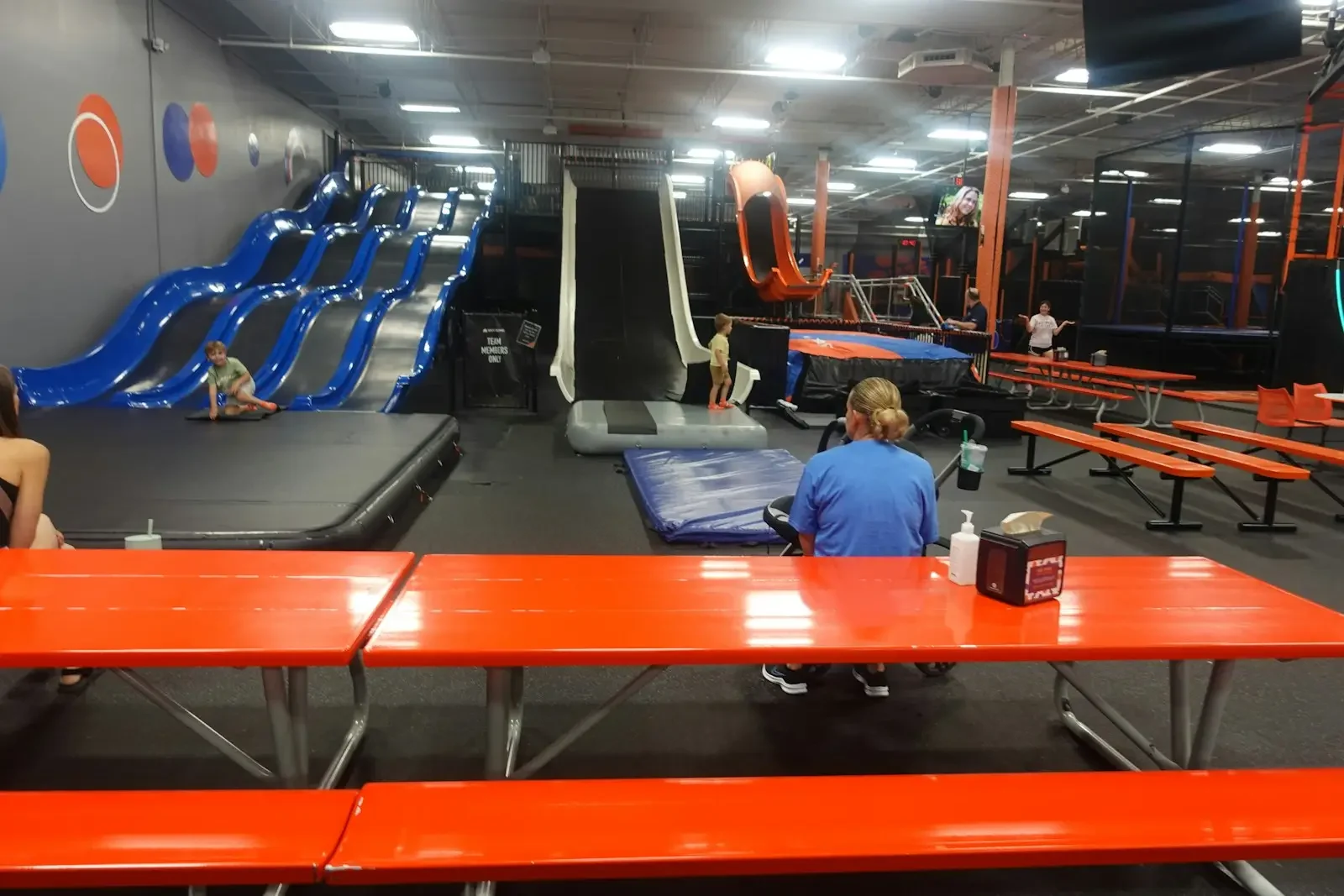
Is a Trampoline Park a Real Workout?
Yes, when the jumping is continuous. Thirty minutes with short breaks sits in the moderate-to-vigorous range for most adults, and repeated landings load the calves, thighs and trunk stabilisers the whole time. It is not a strength session.
Three gains and three limits are worth separating. The gains are cardiorespiratory demand during continuous play, balance and proprioception from correcting position on every landing, and coordination from linking bounce to a target, a ball or a beam. The limits are equally clear: there is no progressive load, no controlled eccentric phase and a low technical ceiling, and bouncing does not replace loaded lifting for bone density. Used as a cardio day with a coordination bonus it earns its place; used as the whole programme, it leaves gaps.
Why Does Fun Matter More Than Calorie Burn?
Because enjoyment predicts whether the session happens again next month, and adherence drives outcomes far more than the intensity of any single visit. A workout someone repeats at moderate effort beats a better workout they quit.
The strongest evidence here is longitudinal rather than mechanical. A study following 1,364 children found that enjoyment of physical activity in grade five predicted sport self-concept, moderate-to-vigorous activity and enjoyment one year later, while the actual amount of activity performed during physical education classes predicted none of those outcomes. The memory of pleasure travels forward. The dose does not. That finding is published in the Sports study on enjoyment and future activity and it explains why the perceived-effort question matters as much as the calorie question.
Self-determination theory adds the mechanism. People persist when an activity supports autonomy, competence and relatedness, and a trampoline park delivers all three within the first ten minutes: you choose your own height, you succeed immediately at a basic level, and you are surrounded by people doing the same thing. Structured exercise classes can deliver the same three, but they usually deliver them one at a time.
Why Are Trampoline Parks Better With a Group?
Because the instability is shared. When everyone on the floor is slightly off balance, other people stop being an audience and become part of the activity, which is something a row of treadmills cannot produce.
The floor is only half the product. The other half is the conversion of bouncing into a game, and four formats do most of that work: dodgeball, where the ball and the bounce interact unpredictably; dunk lanes, where a trampoline adds height to a familiar skill; balance beams over foam, where the loser falls safely; and the foam pit itself, which turns falling into the point rather than the accident. The same footprint then carries birthday parties, school trips and team events without new equipment.
Practical details decide whether the group actually enjoys it. Grip socks are usually mandatory, and what to wear to a trampoline park matters more than guests expect, since zips, belts and loose jewellery catch on bed seams and pockets empty themselves on the first big landing. Arriving twenty minutes early for the waiver and briefing is the difference between a rushed start and a full session.
Are Trampolines Good for ADHD?
The evidence supports movement, not the trampoline specifically. Regular aerobic activity is followed by short-term improvements in attention and executive function in children with ADHD, but no trial has tested trampolines as the intervention.
The exercise literature is reasonably consistent but modest. A 2015 meta-analysis pooling eight randomised trials with 249 children found improvements in attention, hyperactivity, impulsivity, anxiety and executive function, across programmes that were short and samples that were small. A 2020 meta-analysis of ten studies reached a similar view, describing a modest effect on executive function and motor skills that grew with programme length. Single sessions of twenty to thirty minutes show short-term gains in processing speed and working memory.
Against that, one randomised trial assigned 57 children aged three to five to ten weeks of extra mini-trampoline sessions and found no significant change on any of four executive function tests. The honest reading is that bouncing is a vigorous activity a child may actually choose, which makes it more useful than a better activity the child refuses, and that no one should adjust treatment on the strength of it. Impulsivity deserves its own note, because the one-jumper-per-bed rule is exactly the rule a child with ADHD finds hardest to hold, and enforcement is what makes the setting safe.
What Do Pediatricians Actually Say About Trampoline Parks?
Pediatric guidance is cautious. The AAP recommends that children avoid recreational trampolines except in supervised programmes with specialised equipment, states that children under six should never jump, and reports that people injured at trampoline parks are about twice as likely to need surgery as those injured elsewhere. That guidance is written for unmanaged home equipment, and a commercial park’s risk profile depends heavily on enforcement.
The numbers behind the position are not small. More than 800,000 children were injured on trampolines between 2009 and 2018, emergency departments treat roughly 110,000 trampoline-related visits a year in the United States, and children under six carry the highest risk. The doubled surgery rate is the finding most relevant to venue operators, because it points at the mechanism rather than the equipment: many bodies sharing large, bouncy surfaces, with unpredictable mat-to-mat travel and higher fall heights. The full parent-facing guidance is published by the AAP.
What separates a managed venue from a backyard bed is structural. Commercial design and operation are covered by ASTM F2970, which addresses installation, maintenance, inspection, patron education and operator responsibility, alongside fully padded frames and spring decks, one jumper per bed, defined attendant ratios, age banding and a ban on flips in open jump areas. Parents can check four things in five minutes: whether beds are separated by padded dividers, whether an attendant is visible in every zone, whether the under-six area is physically separate, and whether the waiver matches the rules posted on the wall. For a longer treatment of incident patterns, see are trampoline parks dangerous.
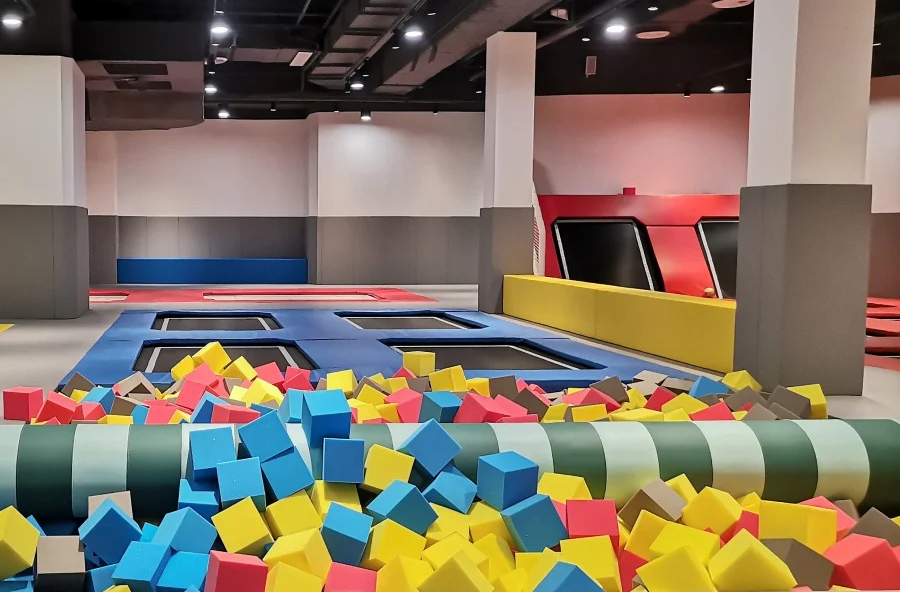
How Is a Trampoline Park Designed to Stay Fun?
Fun is engineered, not accidental. Zoning, sightlines, progression and atmosphere decide whether a guest books a second visit, and each of those is a decision made before the first bed is installed.
Open jump is the anchor and should be the largest single zone, because it is the only area that works for every age and every confidence level. Satellite attractions exist to convert bouncing into a game, which is why they should sit within a few steps of the main floor rather than in a separate wing. Progression needs to be visible from the entrance, so a guest can see the next challenge before paying. Toddler zones must be physically separated, and seating has to face the floor rather than the cafe wall, because a parent who can see the whole room stays longer. Atmosphere is part of the specification, not decoration: sound and lighting set the tempo of a session, and a music and light trampoline makes the connection between rhythm and jump height explicit.
Four design judgements recur across venues that hold their repeat rate:
- Keep open jump as the largest contiguous zone, and resist filling it with attractions.
- Place every paid add-on within a short walk of the main floor.
- Make the progression ladder readable from the entrance, not from the waiver desk.
- Angle all seating toward the floor, and keep sightlines clear of columns and netting.
FAQ
Three questions come up once the mechanics are settled.
How long does a trampoline park session last?
Jump time is usually sold in blocks of 60, 90 or 120 minutes, with twenty minutes added for check-in, waiver and briefing. Most adults are ready to stop at 60 minutes. Children often want the second hour, and the drop in form near the end of it is worth watching.
Is trampolining hard on your knees?
Peak acceleration at the ankle is lower than in running and the landing is spread over a longer contact time, so the surface is genuinely more forgiving. Knees still absorb load, and most next-day soreness comes from volume or from landing on a straight leg. Bend on landing, keep sessions under an hour, and stop when form goes.
Can adults go to a trampoline park without children?
Yes. Many venues run adult-only or late-evening sessions, and some offer fitness formats built around intervals. Adult sessions are quieter and the average bounce height is higher, which is both the appeal and the reason a warm-up matters more than most adults expect.


