
Indoor trampoline park venues have spread faster than most parents expected. A decade ago, many towns had none; today the wall-to-wall jumping format pulls in school groups, birthday parties, and teenagers on weekend nights. That growth has also placed a distinct injury pattern in front of emergency rooms, and families are right to ask what it means for them. The broader category of active playground equipment has its own safety story, and the two are worth reading side by side.
The honest answer is that trampoline parks carry a real but manageable risk. They are not inherently unsafe, yet they are riskier than a well-supervised home setup for younger children, and the injuries that do occur tend to be more severe than the typical backyard sprain.
To judge whether a visit is worth it, look at the published trampoline park injury statistics, the ages that face the most danger, what safety nets actually stop, and how the design of play equipment changes the odds.
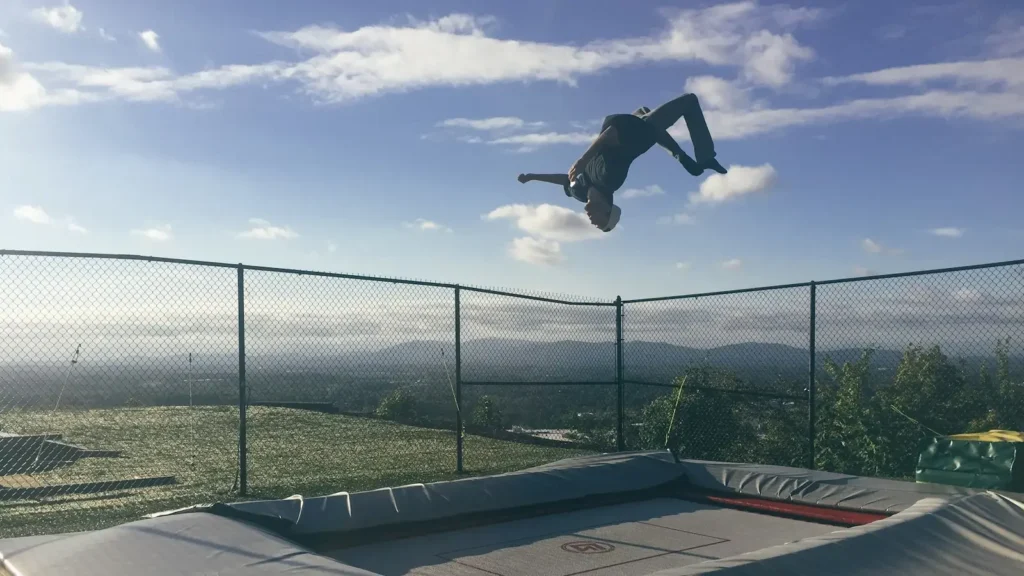
Are trampoline parks dangerous compared with other activities?
Trampoline parks are riskier than ordinary playground structures but fall short of the highest-risk competitive sports. The danger comes from three things working together: large springy surfaces, several jumpers sharing one area, and untrained participants attempting flips they would never try on solid ground.
A 2016 study in Pediatrics tracked emergency department visits for trampoline park injuries from 2010 to 2014. Park-related visits climbed from 581 in 2010 to 6,932 in 2014, a steep and statistically significant rise, while home trampoline injuries held roughly flat over the same window. The authors framed park injuries as an “emerging concern” rather than a settled epidemic, but the trend line was clear.
The same study found park injuries skewed older than home injuries. The average park patient was about 13 years old, against about 9 for home trampolines, and park patients were more often male. Park injuries were also more likely to involve the lower extremities, more likely to be dislocations, and more likely to require hospital admission. In plain terms, when something goes wrong at a park, it tends to go wrong harder.
None of this says parks are unsafe by design. It says the risk profile is different, and the people most likely to be hurt are not the ones most parents worry about.
So is trampoline a high-risk activity? For a supervised school-age child it ranks below competitive contact sports, but for a toddler or a preschooler it is high risk, full stop. The deciding variables are age, body size relative to other jumpers, and whether anyone is enforcing the rules.
How parks differ from home trampolines
The differences matter because the safety advice that works at home does not always transfer. At a park the mats are bigger and bouncier, so jumpers travel farther and land with more force. Multiple people share a single bed, which raises the chance of a collision. And because the space feels enclosed and padded, visitors often take risks they would avoid elsewhere.
| Factor | Home trampoline | Trampoline park |
|---|---|---|
| Typical user age | Younger children | Teenagers and young adults |
| Jumpers per bed | Often one, if supervised | Several at once |
| Most common injuries | Sprains, fractures | Lower-limb sprains, fractures, dislocations |
| Admission rate | Lower | Higher (about 1.76x in the 2016 study) |
| Main hazard | Falls off the edge | Collisions and flips on the bed |
None of this says parks are unsafe by design. It says the risk profile is different, and the people most likely to be hurt are not the ones most parents worry about.
Trampoline park injury statistics
Park injuries rose roughly twelvefold over four years in the only national U.S. count we have, and total trampoline injuries across all settings still run about 100,000 emergency visits a year. The raw numbers are large, but the rate per visitor is the figure that should guide a parent’s decision.
The 2016 Pediatrics analysis estimated 581 park-related emergency visits in 2010 and 6,932 in 2014. That is the clearest signal we have that park injuries are growing as the venues multiply. For context on the whole category, the American Academy of Pediatrics has cited roughly 100,000 trampoline-related emergency department visits per year in the United States, with the large majority on backyard models rather than commercial parks.
How many kids are injured on trampolines every year?
An earlier Pediatrics study covering 1990 to 1995 estimated about 249,400 trampoline-related injuries to children 18 and younger over six years, an average of roughly 41,600 a year. Most of those happened at home. More recent AAP data puts total trampoline emergency visits near 100,000 annually across all ages, with children making up the bulk of the count.
The takeaway is not the exact figure but the shape of it: trampoline injuries are common enough to be a routine emergency-room diagnosis, and they concentrate in school-age children. The question is less “Will someone get hurt?” and more “Who, and how badly?”
What is the most common injury at a trampoline park
The most common trampoline park injury is a lower-limb problem, usually an ankle sprain or a lower-leg fracture, and the most common diagnosis group is sprains and fractures together. Upper-body and head injuries happen, but the legs take the beating because jumpers land on them.
The 2016 park study found sprains and fractures were the leading injuries at both parks and homes, and park injuries were significantly more likely to involve the lower extremities (odds ratio 2.39) and dislocations (odds ratio 2.12). Older CPSC data tells the same story from the home side: leg and foot injuries accounted for about 40 percent of trampoline emergency visits, with arm and hand next at roughly 29 percent, and head and neck around 20 percent.
| Body region | Share of trampoline injuries (CPSC home data) |
|---|---|
| Leg and foot | About 40 percent |
| Arm and hand | About 29 percent |
| Head and neck | About 20 percent |
| Other (trunk, shoulder) | Remainder |
Fractures deserve a separate word. In the 1990s child study, fractures or dislocations accounted for 83 percent of the injuries serious enough to need hospital admission. At parks, the 2016 authors noted that admitted cases included open fractures and even spinal cord injuries. Those are rare, but they are the reason “just a sprain” is not the only outcome on the table.
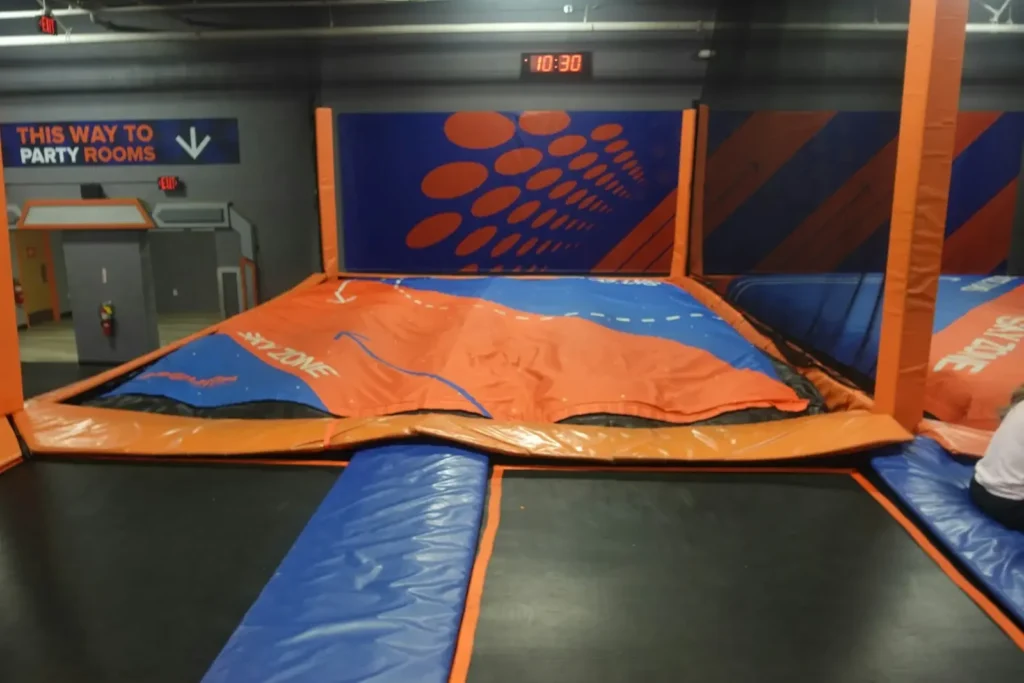
Are trampoline parks safe for adults?
Adults face a lower relative risk than small children, but parks are not automatically safe for grown-ups. The hazards shift from fragile bones to high-impact mechanics: heavier bodies, bigger air, and flip attempts that go wrong.
Most adult injuries at parks come from the same three mechanisms seen in every age group: landing wrong after a jump, colliding with another jumper, and attempting somersaults or flips. Because adults generate more force, a single bad landing can produce a serious ankle or knee injury. The Pediatrics Park study found park patients were older on average and that dislocations were more common there than at home, a pattern consistent with bigger, bolder movements.
Adults who want to jump can lower their odds by going during quiet hours, skipping flips, and treating the padded floor as a reason for caution rather than a safety net. A park is a controlled environment only as long as the people on the bed act like it is one.
Are trampolines safe for 3-year-olds and toddlers?
No. Toddlers and preschoolers should not jump on trampolines at all, and the American Academy of Pediatrics is blunt about it: children under 6 should never jump. Their bones, balance, and judgment are not developed enough to handle the surface, and the consequences land hardest on the smallest bodies.
The AAP notes that toddlers and preschoolers face the greatest risk for trampoline injuries, which is why the under-6 rule exists. The danger multiplies when a small child shares a bed with a heavier jumper. Published research on multiple jumpers shows that having more than one person on a trampoline raises injury risk severalfold, and the smallest child in the group carries the largest share of that risk. A three-year-old next to a teenager is not a playmate on a trampoline; they are a lightweight object in someone else’s bounce.
Parents sometimes ask whether a netted backyard model makes it safe for a toddler. It does not. Nets stop falling off the edge, but they do nothing about the energy transfer when a larger child lands nearby. For a three-year-old or a toddler, the correct equipment is a padded, ground-level play structure, not a trampoline of any kind. Venues such as mini indoor play castle setups give young children active play without the launch-and-land cycle that causes these injuries.
How dangerous are trampolines with nets?
Nets cut one specific danger, falling off the trampoline, but they leave the larger share of injuries untouched. The American Academy of Pediatrics warns that surrounding netting offers a “false sense of security” and does not prevent most trampoline-related injuries, because most happen on the bed itself.
CPSC has said net enclosures can prevent injuries from falling off trampolines, and that is true as far as it goes. The problem is that falls off the edge are a minority of cases. The AAP points out that roughly 75 percent of trampoline injuries occur when more than one person is jumping at the same time, and those injuries come from collisions, awkward landings, and flips, none of which a net addresses. A netted trampoline is safer than an unnetted one in exactly one way, and a family weighing the risk should not mistake that for comprehensive protection.
So a netted trampoline is “less dangerous” in a narrow sense, not “safe.” The measure that matters more is the one-jumper-at-a-time rule, which removes the collision and energy-transfer risks that nets were never built to handle.
Should I let my kid go to a trampoline park?
You can, provided your child is at least six, jumps under active supervision, and follows the rules that actually reduce harm. The decision is less about banning the activity and more about setting conditions before you buy the ticket.
The AAP’s practical guidance for park visits is straightforward: wait until the child is at least 6, avoid the busy hours when collisions are most likely, stay close so extreme moves are less tempting, and read the waiver so you know what the venue allows. Within the park, the rules that change outcomes are one jumper per bed, no flips or somersaults, and a watching adult who will enforce both.
Children under 6 should not go, full stop. For older kids, the risk becomes acceptable when the environment is calm and supervised. A packed Saturday afternoon with free-running teenagers is a different proposition from a quiet weekday session with a parent at the edge of the pit.

How playground equipment design reduces risk
Good equipment design does more to prevent injury than any amount of signage, because it removes the hazard instead of warning about it. The safest play environments separate age groups, pad every hard surface, keep falls close to the ground, and route traffic so jumpers and climbers never share a footprint.
This is where the broader world of outdoor playground equipment and indoor soft-play structures earns its place in the conversation. A well-designed venue gives children active, physical, social play without the high-energy launch cycle that drives trampoline injuries. For operators and schools weighing their options, the equipment choice is itself a safety decision.
Equipment that spins and its own rules
Spinning equipment sits in its own risk category. Rides that rotate have a different injury pattern, dominated by falls and entanglement rather than impact loading, and they belong in a supervised area with proper surfacing and clear entry and exit points. The lesson from trampolines carries over: the hazard is not the fun; it is the combination of speed, shared space, and unmanaged access.
Playground equipment for younger children
For playground equipment for kids under ten, themed soft-play structures, padded climbing frames, and ground-level trendy sports zones deliver the movement children need with a far lower injury profile than trampolines. The play happens close to a padded floor, the pieces are sized to small bodies, and a supervising adult can see every child at once. When the goal is active play for a birthday party or a school group, these setups answer it without the emergency-room tail risk.
Choosing among playground equipment companies
Buyers comparing playground equipment companies should look past the catalogue photo and ask what happens after installation. The equipment that performs best over ten years is the equipment someone is still inspecting in year nine. Key checks include certified padding and frame coverage, rounded and capped edges, impact-absorbing surfacing, age-zoned layouts, and a documented maintenance schedule.
For buyers building or upgrading a venue, JQK designs indoor and outdoor play structures with these safeguards built in, from padded naughty-castle frames to zoned layouts that keep toddlers and older children apart. Our team can tailor a floor plan to your space, your age groups, and your supervision model, then support it with the inspection and maintenance guidance that keeps the equipment safe long after handover. If you are specifying a new play area or weighing trampoline alternatives, contact JQK to review your site and talk through options.
Common playground equipment names
The term “playground equipment” covers a long list of distinct pieces, and knowing the names helps a buyer match the right item to the right age group:
- Naughty castle and themed soft-play structures
- Ball pit and ball-pool play units
- Spiral and straight slides
- Climbing frames and rope towers
- Carousel and mini-ride units
- Soft foam play blocks and padded tunnels
- Spring riders and seesaw sets
- Trackless sightseeing trains for larger venues
Each piece has its own surfacing, spacing, and supervision requirement, and a credible supplier will document all of them before delivery rather than after an incident.
Frequently asked questions
Are home trampolines or trampoline parks more dangerous?
Parks produce more severe injuries on average because the mats are larger, the jumpers are older and bolder, and collisions are common. Homes produce more total injuries, because far more backyard trampolines exist and most child injuries happen there. The safer setting for a young child is neither; it is a padded, ground-level play structure.
Can a netted trampoline be used safely by a 5-year-old?
No. The AAP advises that children under 6 should never jump on trampolines, netted or not. A net prevents falls off the edge but does nothing about collisions with other jumpers or the force of a larger child’s bounce, which are the injuries that hurt small children most.
What should I check before taking my child to a trampoline park?
Confirm the child is at least 6, go during a quiet session rather than peak hours, stay within sight, and enforce one-jumper-per-bed and no-flips rules yourself. Read the venue’s waiver so you know what is permitted, and watch for staff enforcing the rules rather than only posting them.