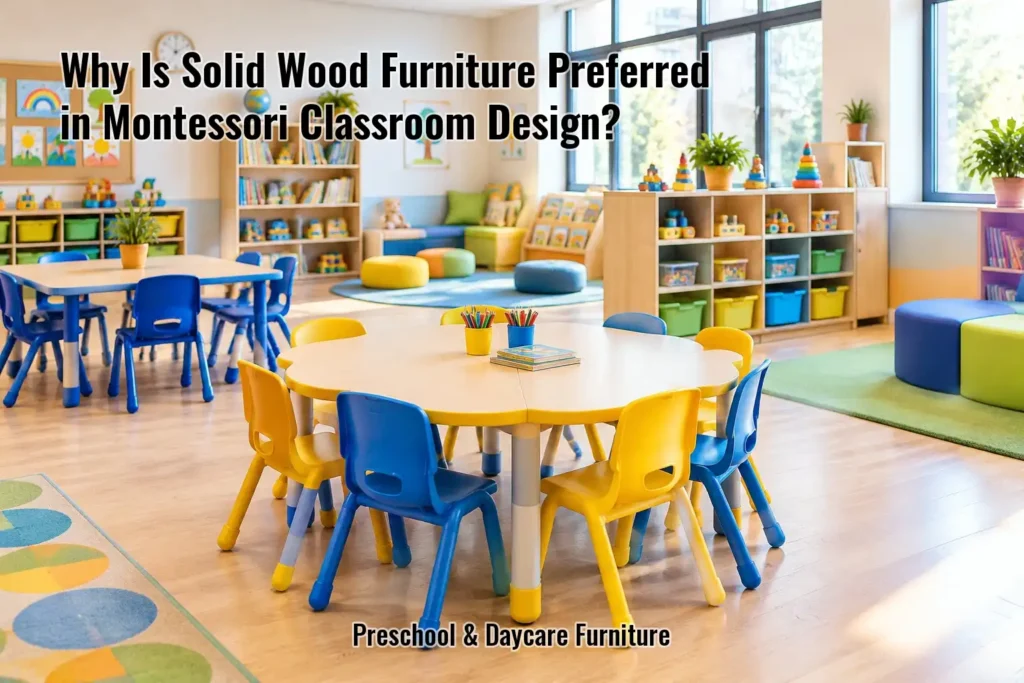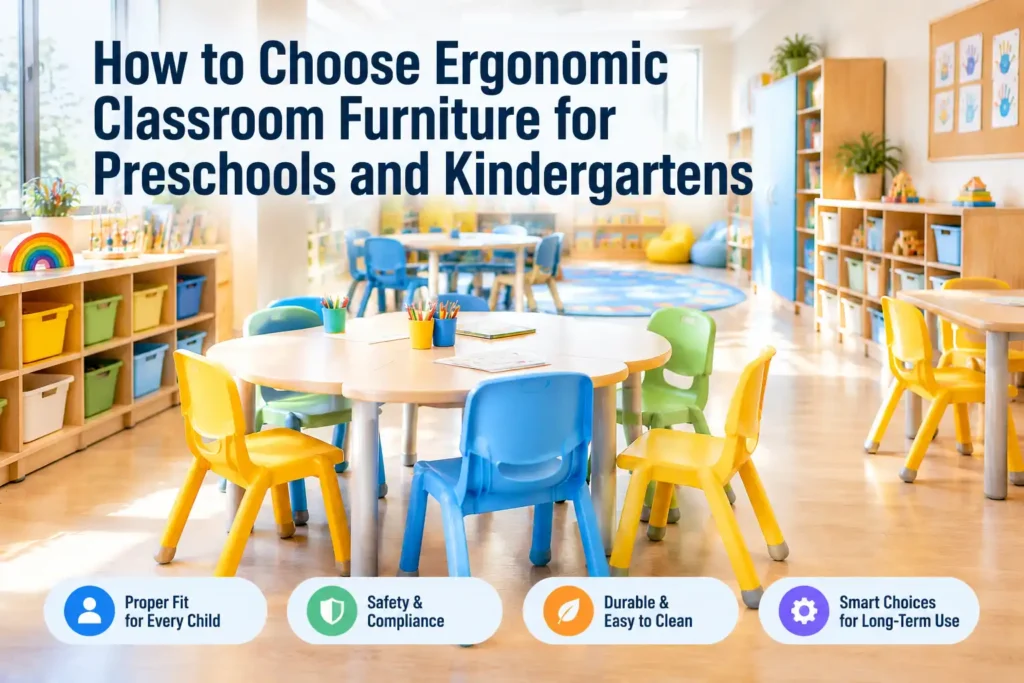
Walk into almost any Montessori house for children aged three to six and the same objects appear: low open shelving, small single tables, chairs a child can lift, trays of real glass and polished timber. Operators inherit the look as a convention, yet a convention is expensive to defend in a budget meeting. The question matters most for preschool and daycare furniture buyers specifying a whole building at once, who need decisions that survive inspection, daily cleaning and a decade of use.
Solid wood is preferred in Montessori classroom design because it meets four requirements at once. It gives children honest sensory information about weight, grain and temperature. It holds a stable, child-scaled structure that stays safe under thirty children a day. It can be sanded and re-oiled instead of replaced, so ownership cost falls over time. And its neutral surface keeps attention on the learning material rather than the furniture.
The reasoning runs from pedagogy through material behaviour to workshop practice, and it is worth taking in that order.
Why Does the Prepared Environment Start With Materials?
Because in Montessori practice the room itself is a teaching instrument. The prepared environment is the set of conditions an adult controls so that a child can choose work, repeat it and correct mistakes without direction, and furniture is the part of it a child touches most often.
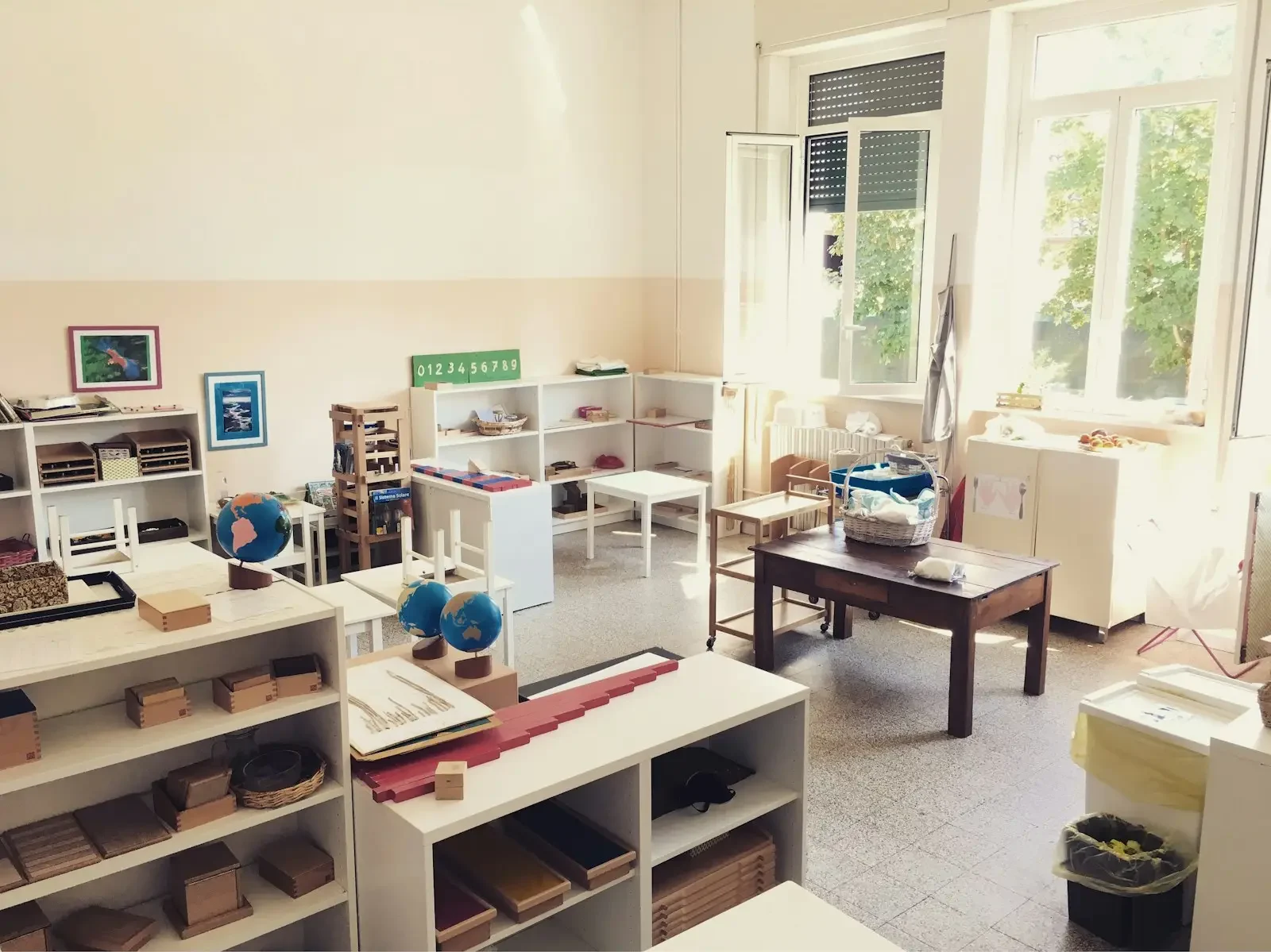
The Association Montessori Internationale defines this environment as one where materials are complete, arranged in developmental sequence and accessible without adult help. That sets a hard requirement on the objects holding them. A shelf out of reach, a table too high for its chair, a latch above shoulder height: each converts an independent activity into a request for help, and the pedagogy collapses into supervision.
What Is the Golden Rule of Montessori?
The phrase quoted as the golden rule is follow the child, routinely misread as permission. It describes observation as the primary adult skill: watch what a child chooses, how long concentration lasts, where frustration begins, then adjust the environment rather than the child.
For a specification, the rule becomes concrete obligations. Shelving must present choices at eye and shoulder height. Seating must be light enough for its user to carry. Work surfaces must seat one or two children, because choice is meaningless if the only free seat is at a six-seat bench.
Why Does Montessori Favor Wood Over Plastic and Metal?
Wood is the only common furniture material that delivers tactile honesty, moderate mass, repairability and visual quiet at once. A child learns an object’s consequence by lifting it, and timber reports size through weight; moulded plastic feels much the same whether the piece is large or small, and coated metal gives almost no mass information while feeling cold.
The claim that Montessori uses only wood is an oversimplification. Metal, glass and ceramic appear deliberately in specific materials, from pouring pitchers to the stands holding geometric solids, because the child should experience real breakability and real weight. What is true is that structural furniture, meaning shelves, tables, chairs and storage, is overwhelmingly timber.
| Material | What it gives the child | Weakness in commercial use |
| Solid wood | Grain, warmth, honest weight, visible ageing | Higher unit cost, needs humidity control |
| Veneered panel | Flat, uniform surface, low cost | Chips at edges, cannot be refinished, adhesive emissions |
| Moulded plastic | Light, cheap, easy to wipe | No mass feedback, cracks, fixed colour, hard to repair |
| Powder-coated steel | Strong thin frames, rigid joints | Cold surface, paint chips expose edges |
How Does Child-Sized Solid Wood Build Independence?
Furniture sized to the child converts independence from an instruction into a physical possibility. When seat height matches lower-leg length and a shelf edge sits at shoulder level, a three-year-old can sit, reach, carry and return a tray without help. At adult scale every one of those actions needs an adult, and the room teaches dependence instead.
Anthropometric fit is therefore a specification item, not a styling preference. The table below gives working ranges for the primary age band, measured to the top surface.
| Age band | Table height | Seat height | Shelf top |
| 2 to 3 years | 46 cm | 26 cm | 90 cm |
| 3 to 4 years | 50 cm | 28 cm | 95 cm |
| 4 to 5 years | 53 cm | 30 cm | 100 cm |
| 5 to 6 years | 58 cm | 32 cm | 105 cm |
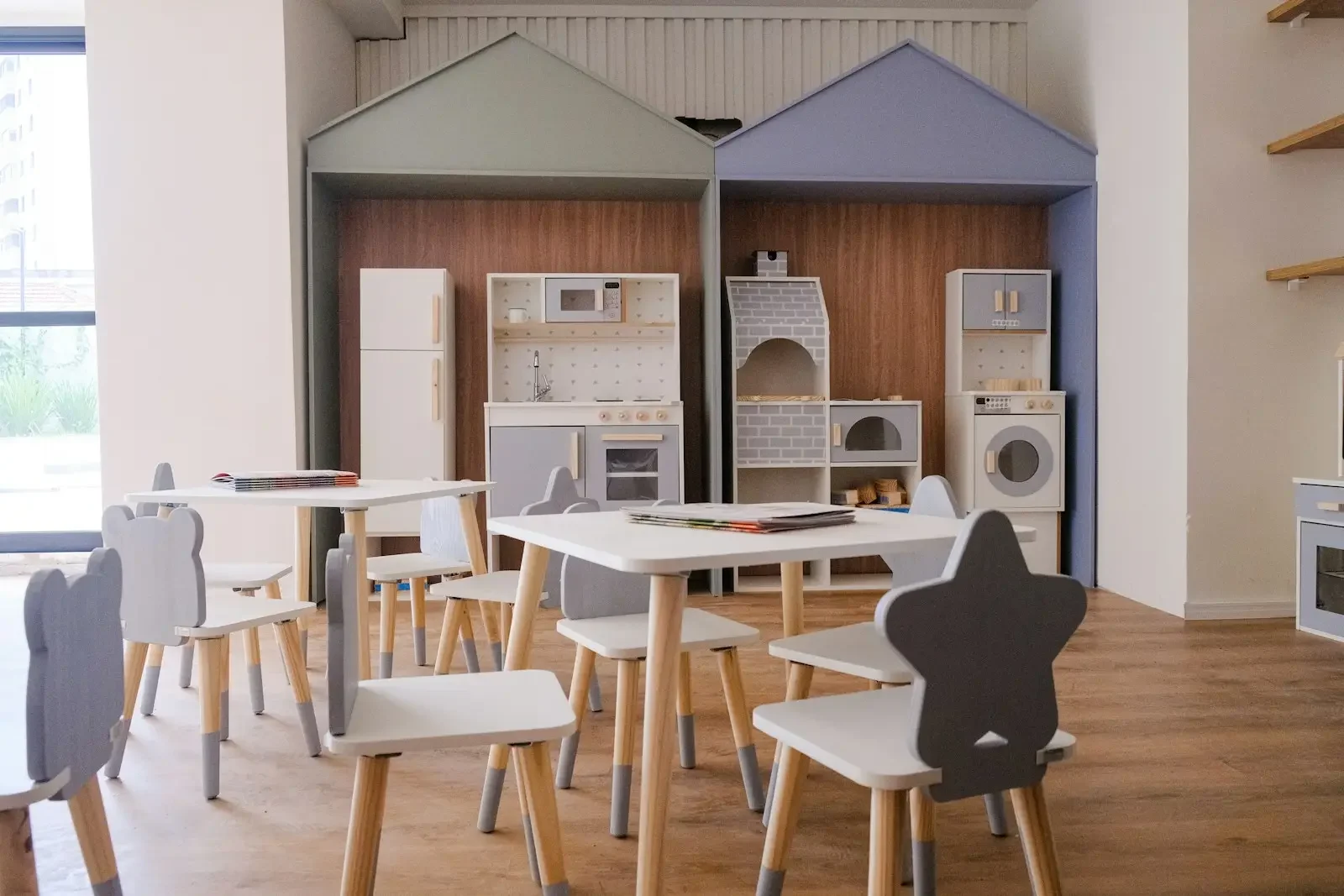
Three details decide whether those numbers work. Chairs should weigh under three kilograms so a child can move one with two hands. Exposed corners need a radius of at least five millimetres, sanded rather than merely routed. Tall units need a wall bracket or a base wide enough that a child leaning on the front edge cannot tip it. Specifiers comparing a whole room set can review the classroom furniture range to confirm that tables, chairs and shelving share one height family.
What Furniture Should a Montessori Classroom Contain?
Six groups carry almost all of the function: low open shelving for each curriculum area, single or two-seat work tables, matching chairs, floor mats for work on the ground, a practical life station with a child-height worktop and water access, and closed storage for material rotated out.
| Group | Typical quantity | Specification note |
| Open shelf unit | 6 to 10 | Braced back panel, top at 90 to 105 cm |
| Work table | 4 to 6 | One or two seats, 46 to 58 cm high |
| Chair | 12 to 20 | Under 3 kg, seat 26 to 32 cm |
| Floor mat | 4 to 8 | Non-slip backing, no pile |
| Practical life worktop | 1 to 2 | 50 to 55 cm, adjacent to water |
| Closed storage | 1 to 2 | Lockable, holds rotation stock |
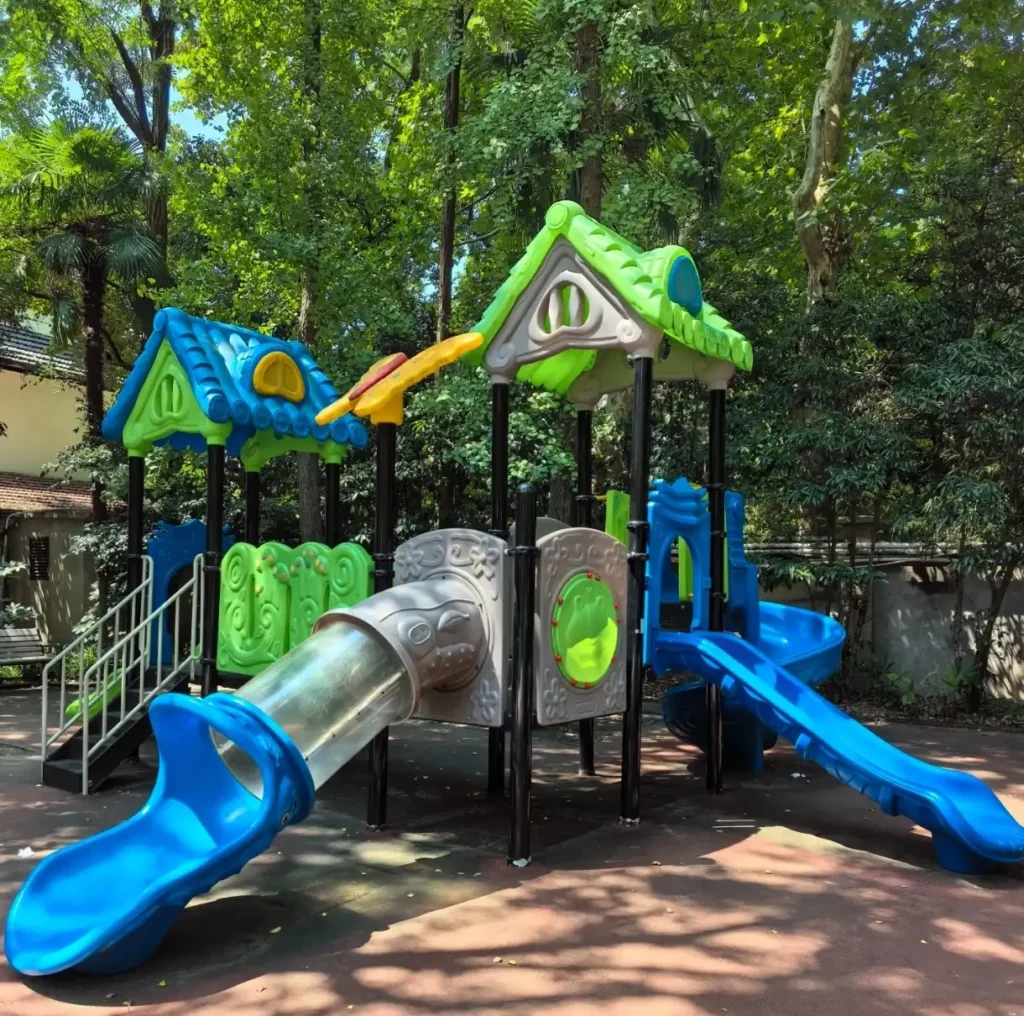
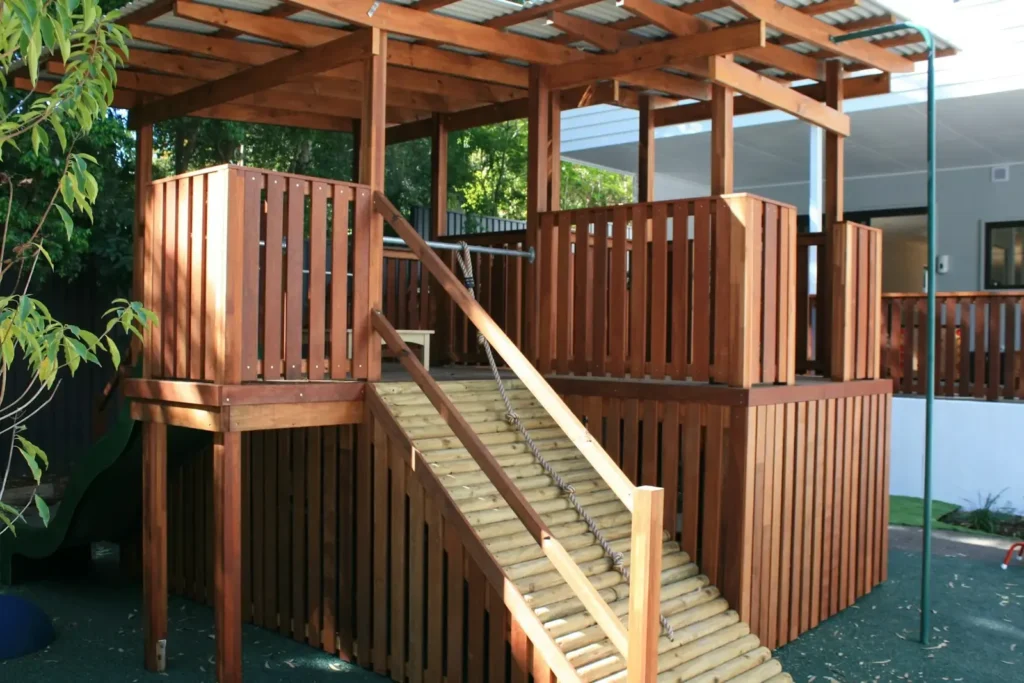
Layout follows the curriculum rather than the wall. Practical life sits nearest the water source, because pouring and food preparation generate spills. Sensorial work occupies open shelving with clear sightlines so a guide can observe several children at once. Language and mathematics run left to right in sequence, matching the direction the materials are read. Aisles of about ninety centimetres let two children pass while carrying a tray. Gross motor work usually belongs outdoors, where a themed kindergarten play slide keeps movement clear of fine motor activity.
Why Do Wooden Shelves Matter for Sensorial Work?
Wooden shelves matter because they present one material at a time against a quiet background. A stable, uncluttered shelf lets a child see at a glance what is present, what is missing and what comes next in the sequence, and that visible order is what allows Montessori materials to be self-correcting.
Shelf design follows from this. Each tray holds one complete material, so a missing piece is obvious. A depth of thirty to thirty-five centimetres takes most trays and stops them being pushed out of sight. A solid back panel prevents components falling behind the unit, the usual cause of incomplete sets. Latches stay out of the child’s zone; a closed section, where needed, belongs above shoulder height.
What Is the Purpose of Montessori Geometric Solids?
The geometric solids are wooden three-dimensional forms, typically a cube, sphere, cylinder, cone, pyramid and rectangular prism, presented on stands. Their purpose is to isolate a single quality, form, so the child can compare it without colour, pattern or function competing for attention. Handling them builds the stereognostic sense, identifying an object by touch alone, and supplies the vocabulary of base, face, edge and vertex that later geometry relies on. A natural rather than painted finish is deliberate: colour would become the cue.
Which Wood Species and Finishes Should Buyers Specify?
Specify a medium-density hardwood with closed grain, joined with formaldehyde-free adhesive and finished with a water-based lacquer or an oil-wax system. Species choice mainly affects hardness, weight and cost. Adhesive and finish chemistry is where the health risk sits, and that is the part of a quotation most often left vague.
| Species | Character and behaviour | Sensible use |
| Birch | Hard, tight grain, stable, takes a clear finish | Shelving, table tops, panels |
| Maple | Hardest of the common species, resists dents, heavier and costlier | High-wear work surfaces |
| Beech | Dense and uniform, machines well | Chairs, frames, legs |
| Rubberwood | Medium density, sensitive to drying quality | Storage, budget ranges |
| Pine | Soft and resinous, dents and prints easily | Not for daily classroom use |
Panel construction deserves the same scrutiny. Multi-layer plywood with a hardwood core is more dimensionally stable than wide solid boards and is legitimate in shelving, provided the adhesive is declared. The US Environmental Protection Agency identifies resins in composite wood products as a principal source of indoor formaldehyde, which matters where small children spend six hours a day and furniture surface outweighs floor area. Ask for a test report and a declared emission class, not a verbal assurance. Chain-of-custody certification from the Forest Stewardship Council answers the sustainability question many parents now ask at enrolment. Buyers wanting a wider comparison of timber against plastic and coated steel can review these playground material comparisons.
How Does Solid Wood Perform Under Daycare Cleaning and Wear?
Solid wood survives a childcare cleaning regime mainly because it can be repaired. Daily wiping, weekly disinfection, paint spills and bite marks are surface events on solid timber, and a workshop can sand and re-finish them. On a veneered or foil-wrapped panel the same events break the surface layer, and the board cannot be restored at any reasonable cost.
Cleaning intensity is higher than in an office, so the finish must be chosen for it. A workable cycle: a pH-neutral damp cloth daily, an approved disinfectant weekly with the stated dwell time followed by a dry wipe, a termly check of joints and fixings, and a re-oil or re-lacquer of high-touch surfaces every two to three years. Chlorine-releasing and high-alcohol products attack both lacquer and oil if left wet, so the disinfectant list should be checked against the finish supplier’s guidance before the room opens. A published set of daily maintenance guidelines is a useful template for the room’s own schedule.
The financial argument follows the repair path. A solid timber shelf that has lost its finish is a two-hour refinishing job. A veneered shelf with a lifted edge is a replacement, and replacement within a matched set often means replacing the whole run.
How Should a Buyer Verify Solid Wood Before Ordering?
Verify by examining cut edges and hidden faces rather than showroom surfaces. A genuine solid component shows continuous grain through the end grain and along the edge. A veneered panel shows a repeating pattern, a visible core line at the edge, and a taped or profiled edge designed to conceal it.
- Inspect end grain and a cross-section on a physical sample, not a photograph.
- Request the panel specification: core material, adhesive type and formaldehyde test report.
- Confirm moisture content of 8 to 12 percent for indoor use, and ask how the stock was kiln dried.
- Test the joinery by hand: dowel, biscuit or corner block, with no fastener heads on child-contact faces.
- Load the front edge of a tall unit with a child’s weight and watch for lift.
- Obtain finish data covering VOC content, cure time and the touch-up procedure.
- Order one complete classroom as a pilot, run it for a term, then place the balance.
Language carries most of the risk. Solid wood particle board and solid wood multi-layer board are constructions in which solid names the board type, not a sawn timber component. Ask for the component list by part, not a material description by product.
Frequently Asked Questions
Three questions tend to surface once the specification is agreed and the order is being placed.
Will solid wood furniture warp in a humid climate?
Warping is a moisture-equilibrium problem, not a property of timber. Boards dried to the service environment, sealed on all faces including hidden ones, and kept in a room at 40 to 60 percent relative humidity stay stable. Acclimatise delivered furniture indoors for two to three days, keep units off damp floors, and leave an air gap behind shelving on external walls.
Is solid wood too heavy for a classroom that reconfigures often?
Separate fixed from mobile items. Shelving and storage stay against walls, so mass helps there. Chairs, small tables and mats are moved daily, so they should be light: chairs under three kilograms, slim table frames, glides rather than castors on low units. Mixed specification beats choosing a lighter material throughout.
Can bamboo replace solid wood in daycare furniture?
Bamboo is a grass, and furniture bamboo is a strand-woven board bonded with adhesive under heat, so its environmental profile depends on the binder rather than the plant. Hardness is high and appearance is close to timber, which suits worktops and shelving. Structural frames carrying ten years of commercial load are less proven, and edges need care because the material splits along its grain.