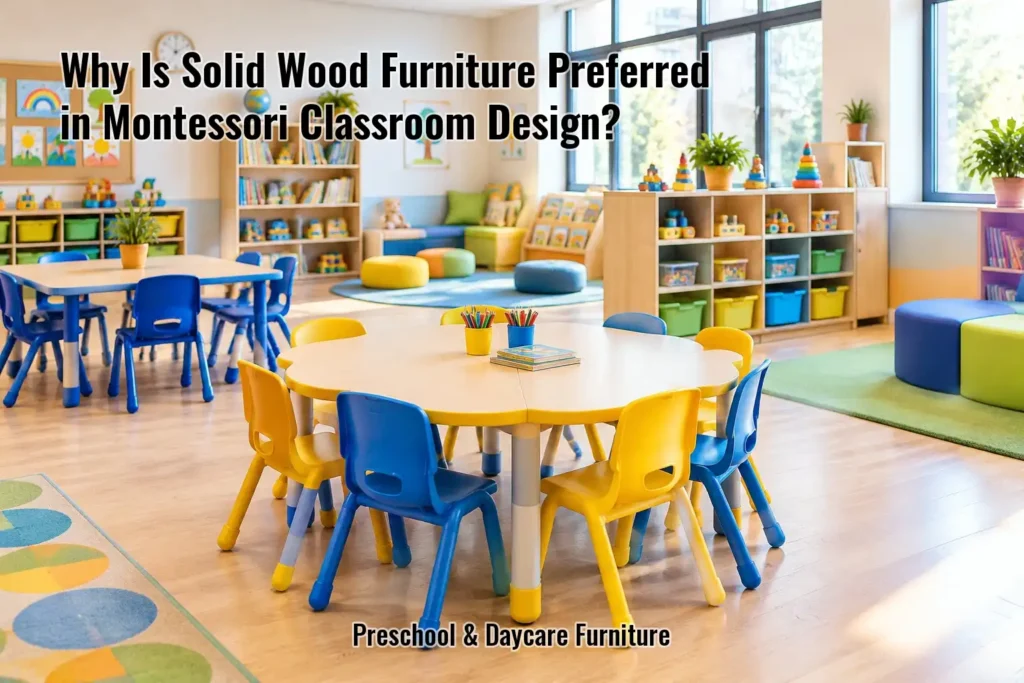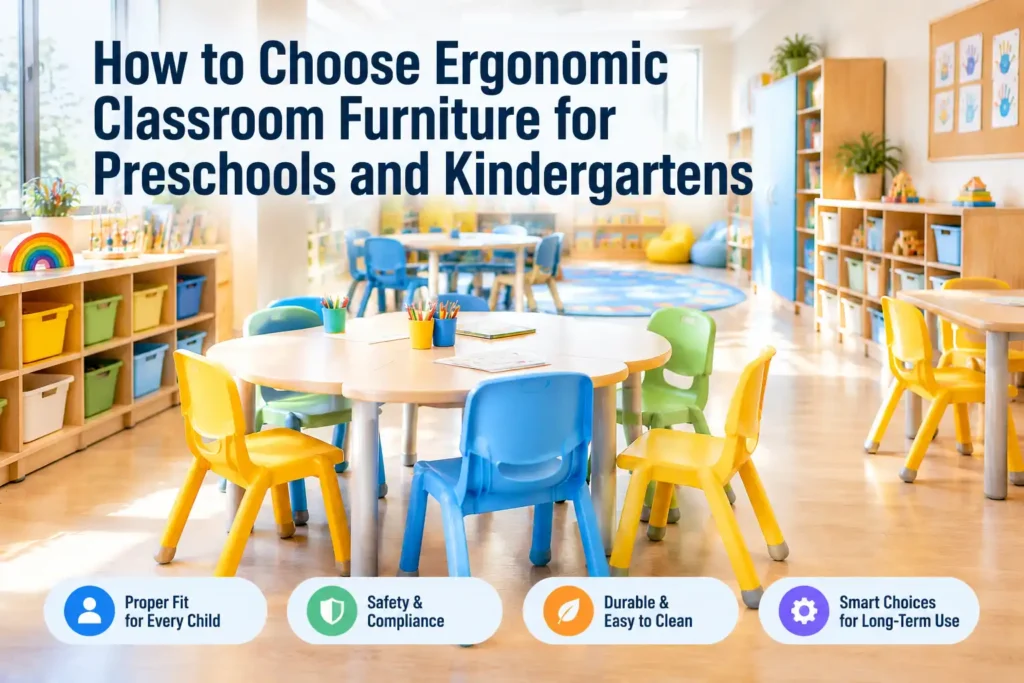
Furnishing an early years room is usually treated as a catalog exercise: pick a color family, pick a table shape, compare price per unit. Children cannot adjust a chair that is too tall, so an oversized table quietly becomes the default for a whole cohort until the next refit.
Choose ergonomic preschool and classroom furniture by fitting it to the bodies in the room rather than to an age label on the box. Measure seated elbow height, pair every chair with a table from the same size mark, confirm a five-point fit with the smallest and tallest children in the group, and only then verify materials, hardware and fixings against the standards that govern educational furniture and children’s products. Size comes first because it cannot be corrected later, compliance comes second because it is a document question, and durability under commercial cleaning comes third because furniture that fails either will be replaced long before its service life ends.
The sections below follow that sequence in the order a real purchase happens, from the first fit check to the wording of the purchase order.
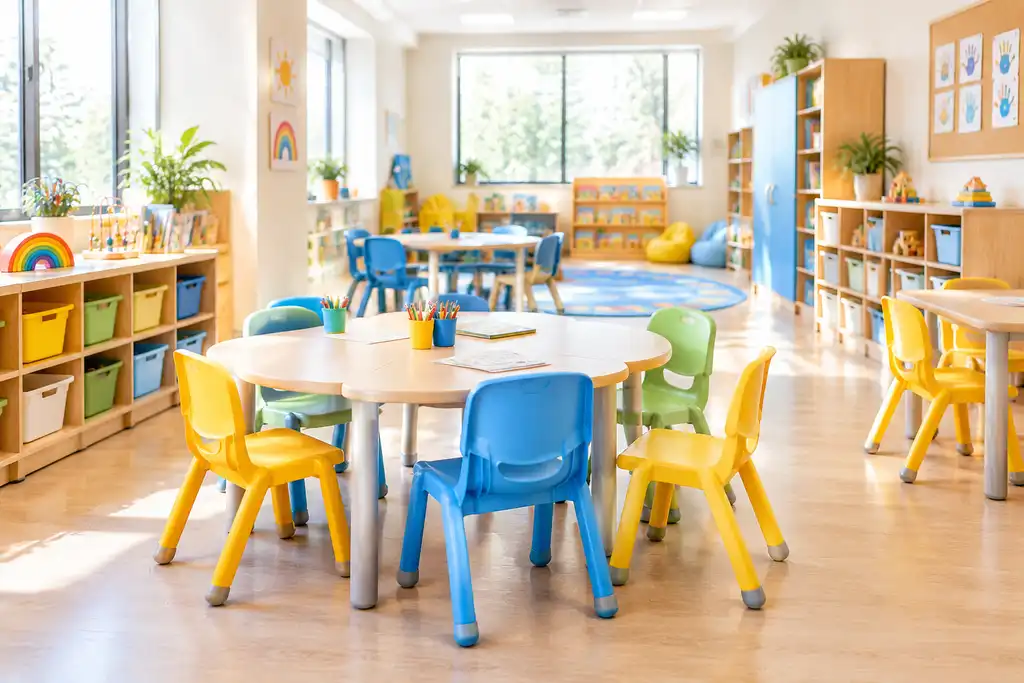
Why Furniture Fit Decides Whether a Classroom Works
A child who cannot place both feet flat on the floor cannot sit stably, and a child whose tabletop sits above elbow height will round the shoulders and rest on the forearms within minutes. Fit is not a comfort preference. It changes how long a three- to six-year-old can stay engaged, how independently they can get in and out of a seat, and how often an adult has to intervene in what looks like restlessness but is actually postural fatigue.
Two failure modes dominate procurement. Buying oversized furniture on the argument that children will grow into it produces dangling feet and constant fidgeting. Keeping undersized toddler chairs into the preschool year leaves no room to slide in without help. A well specified range of preschool classroom furniture publishes the seat and table height of every item, which makes the fit calculation possible before delivery rather than after the first week of term.
The Five-Point Fit Check
Check five things in order, and if any one fails, change the size mark rather than compensating with a cushion.
- Both feet rest flat on the floor, with no dangling and no toe-standing.
- Knees bend at approximately 90 degrees, with thighs roughly parallel to the floor.
- The tabletop sits level with, or slightly below, the child’s seated elbow height.
- There is clear space between the thighs and the underside of the table.
- Chair and table carry the same size mark, since mixing marks is the most common cause of poor posture at mealtime.
Run the check with the shortest and the tallest child in the group; ten minutes of testing tells you more than a page of age recommendations.
Match Seat and Table Heights to Age and Body Size
Use seated anthropometry rather than birthday as the primary variable. Seat height should match the child’s popliteal height so the feet reach the floor and the knees sit near 90 degrees. Table height should then sit roughly 18 to 20 cm above the seat, so the forearms rest on the surface with the elbows close to a right angle. Where a room serves a mixed age band, specify two size marks rather than one compromise size that fits nobody well.
The pairs below cover most early years programs and match the size marks in EN 1729-1, the European standard that pairs each seat height with a matching table height instead of leaving the combination to the buyer.
| Age band | Seat height | Table height | Typical use |
| 18 months to 3 years | 21 to 25 cm | 40 to 46 cm | Snack, toddler activity |
| 3 to 4 years | 26 to 28 cm | 46 to 50 cm | First preschool tables |
| 4 to 5 years | 28 to 30 cm | 50 to 53 cm | Pre-kindergarten work tables |
| 5 to 6 years | 30 to 34 cm | 53 to 58 cm | Kindergarten, early writing |
Treat the age column as a guide. Children of the same age can differ by 10 cm in height, so order the size band that covers the median child and add a few of the adjacent size for the extremes.
When Adjustable Height Is Worth It
Adjustable furniture arrives in three forms. Bolt-on leg sets are the most rigid but mean disassembling a room to change heights. Telescoping legs with locking pins adjust in minutes and suit shared rooms, though the joint is a wear point. Crank or screw columns give the widest range at the highest cost.
Adjustability pays for itself where a room hosts two age bands across the day, is shared with community programs, or mixes ages across three years. In a single-age room with stable enrollment, fixed sizes in two marks are cheaper, stiffer and easier to inspect.
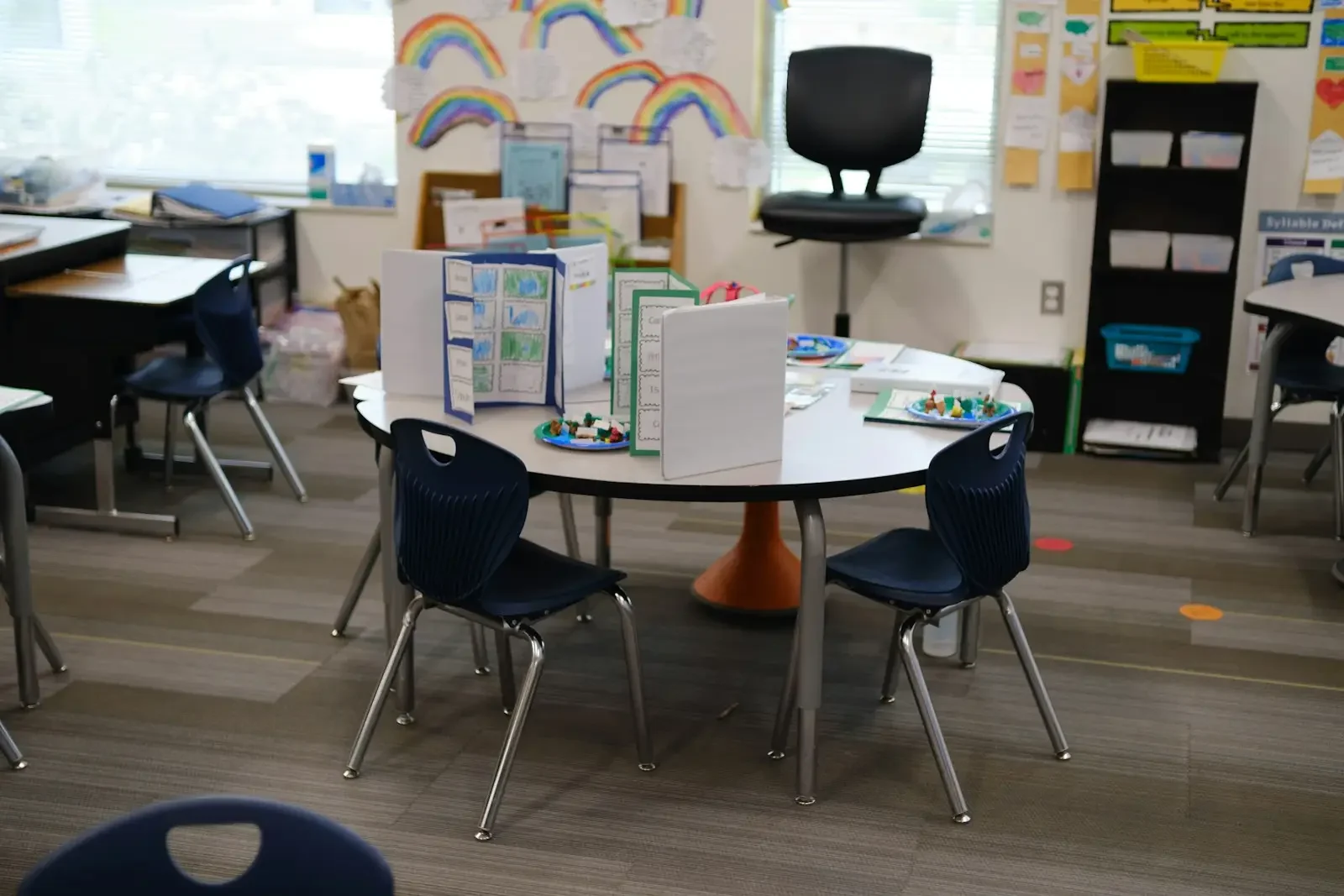
Size the Storage, Shelving and Soft Seating to the Same Logic
Storage is the part of the fit problem most buyers skip. Shelving a child cannot reach converts a self-service classroom into a staff-served one, and a shelf top above eye level stops counting as storage for children at all. Set the maximum reachable height for each age band, keep daily materials inside it, and move everything above that line into locked adult storage.
For toddlers, shelving should top out around 60 to 70 cm. For three- to six-year-olds, an open unit topping out at roughly 90 to 100 cm keeps the upper shelf at eye level, and anything above that is teacher territory rather than accessible storage. Cubby compartments deeper than about 30 cm swallow small bags, so children stop using them. Every unit taller than about 60 cm should be fixed to the wall with an anti-tip bracket, and soft seating needs a core firm enough that a small child can stand up without pushing off the floor.
Hardware is where budgets are quietly cut. Check three items before approving a sample:
- Fixings are concealed or recessed, with no exposed screw heads at child height.
- Hinges are commercial duty and soft close, so a door cannot catch fingers.
- Drawers have stops that prevent full removal, and casters lock by adult foot only.
Verify Safety, Chemical and Structural Compliance Before You Compare Prices
Two products can look identical in a photograph and behave completely differently after two hundred chair drops, one spill of disinfectant and one child climbing a bookcase. Compliance is a document question. Ask for current third-party test reports issued in the supplier’s own name, confirm the report covers the exact model, size and finish you are ordering, and establish which standard family the product falls under, because furniture and fixed play equipment are governed by different rules.
Four layers matter.
- Educational furniture: functional dimensions, strength, stability and test methods for chairs and tables.
- Children’s products: limits on lead, phthalates, small parts, sharp edges and sharp points. The U.S. Consumer Product Safety Commission publishes the requirements and the certification obligations behind them.
- Panel emissions: formaldehyde release class for plywood, MDF and particleboard, plus any low-emission certification required for a sealed classroom.
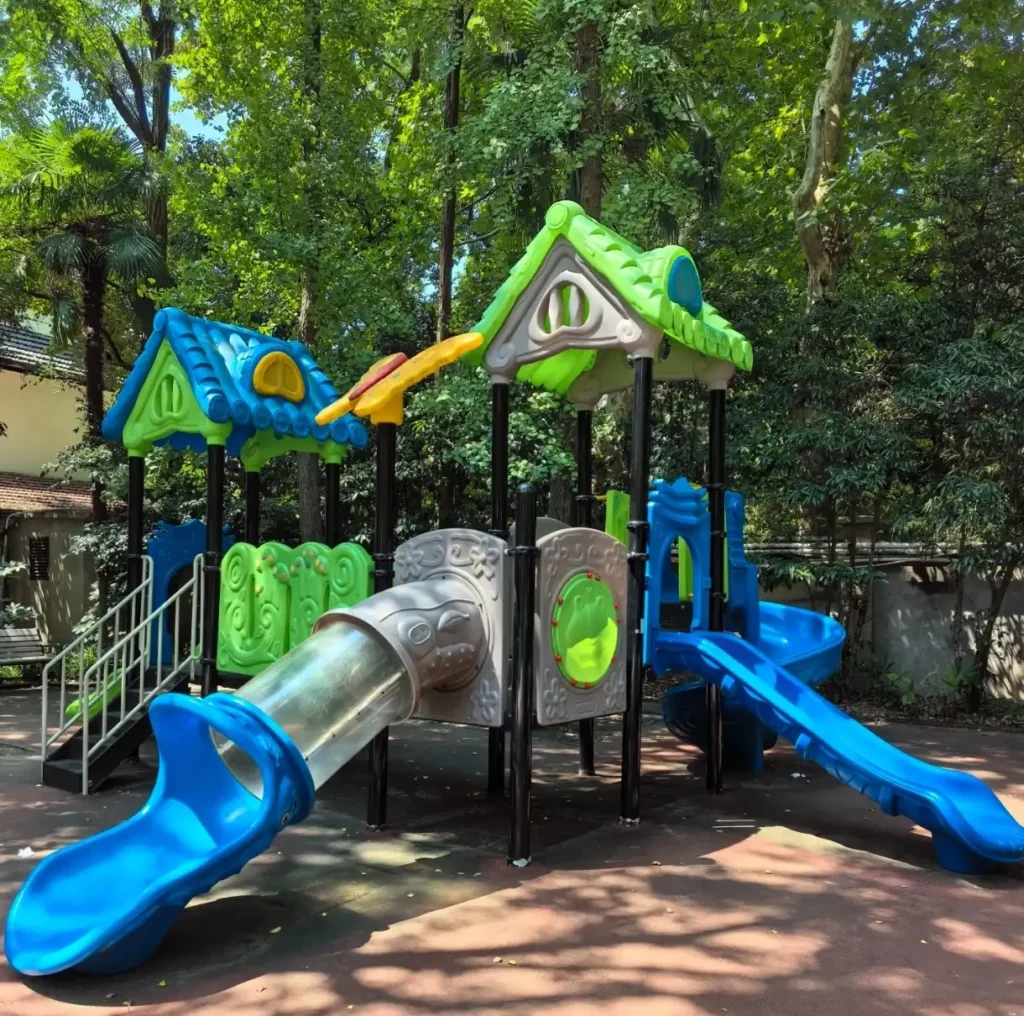
- Fixed play equipment: separate standards and inspection regimes. A climbing structure or slide falls under ASTM F1487 and EN 1176, not under the furniture standards.
Publicly funded programs often carry the same duty in their funding conditions: the Head Start Program Performance Standards require age-appropriate equipment, materials and physical space for indoor and outdoor learning.
Materials Compared
Material choice drives how a piece ages, how much cleaning labour it consumes, and whether it can be repaired rather than replaced. Finish chemistry matters as much as the substrate: water-based low-VOC coatings are the practical default for an occupied room, and any finish should be tested against the disinfectant the center actually uses.
| Material | Strengths | Weaknesses | Best use |
| Solid hardwood | Dense, repairable, holds joints under repeated tightening | Highest cost, heaviest, moves with humidity | Chairs, table frames, shelving |
| Plywood with high-pressure laminate | Stable, wipeable, good screw holding | Edges chip if banding is thin; water ingress at cut edges | Tabletops, cabinets, cubbies |
| Rotomolded plastic | Light, stackable, fully washable | Fades under UV, not repairable | Chairs for shared and outdoor use |
| Particleboard | Lowest cost, uniform surface | Swells permanently once wet, short service life | Not for daily classroom use |
Lay Out the Room Around Circulation, Sightlines and Zoning
Ergonomics does not stop at the chair. A room can be furnished with perfectly sized tables and still fail if a child cannot carry a tray between them, if a shelf cuts the sightline from the door to the quiet corner, or if the art zone shares a walking route with block play. Plan circulation first, then place furniture footprints inside what remains.
The numbers that matter are unglamorous but enforceable. A main route between zones needs 90 to 100 cm of clear width, and a secondary route between a table edge and a wall needs 60 to 70 cm, which is also the minimum for a chair to be pushed back and occupied. Allow 75 to 90 cm between two tables used back to back. Door swings, fire exits and radiator zones stay clear, and low units rather than tall ones go under windows.
Zoning follows the same logic. Keep large-movement activity away from reading and rest areas, and keep the route from the door to the washroom clear, because it is the most-used path and the one most often blocked by a drying rack. Tall storage belongs against perimeter walls where it cannot interrupt a sightline, with the heaviest units in corners. At least one table in a licensed room should meet accessible height and knee clearance. Where the room includes a fixed climbing structure, the footprint follows the same discipline as indoor playground space requirements, with the fall zone kept free of furniture.
Budget for Cleaning, Inspection and Replacement, Not Just Purchase
Purchase price is the smallest part of the cost of classroom furniture. Cleaning labour, replacement parts and premature replacement dominate the total cost of ownership, and all three are decided at quotation stage by edge banding quality, finish chemical resistance, hardware grade, and whether individual components can be reordered years later.
Require a component-level parts list with the quotation, then price the three items most likely to fail first: casters, hinges and chair glides. A supplier who cannot supply them individually is selling disposable furniture. Inspection only works when it is scheduled and written down.
| Interval | What to check |
| Daily | Wipe contact surfaces; remove broken pieces from the room |
| Weekly | Tighten visible fixings; check caster locks and chair glides |
| Monthly | Test anti-tip anchors; check hinges, drawers, chipped banding |
| Termly | Audit the room against the fit chart; log defects and replacements |
Typical service life runs eight to fifteen years for hardwood and laminate tables, five to eight for plastic stacking chairs in shared use, and three to five for soft seating. Replace on function rather than appearance: a chair that wobbles at the joint, banding lifted enough to trap a fingernail, or a loose anchor. Folding inspection into existing routines is the cheapest way to extend the interval, using the approach in these daily maintenance guidelines adapted to a classroom.
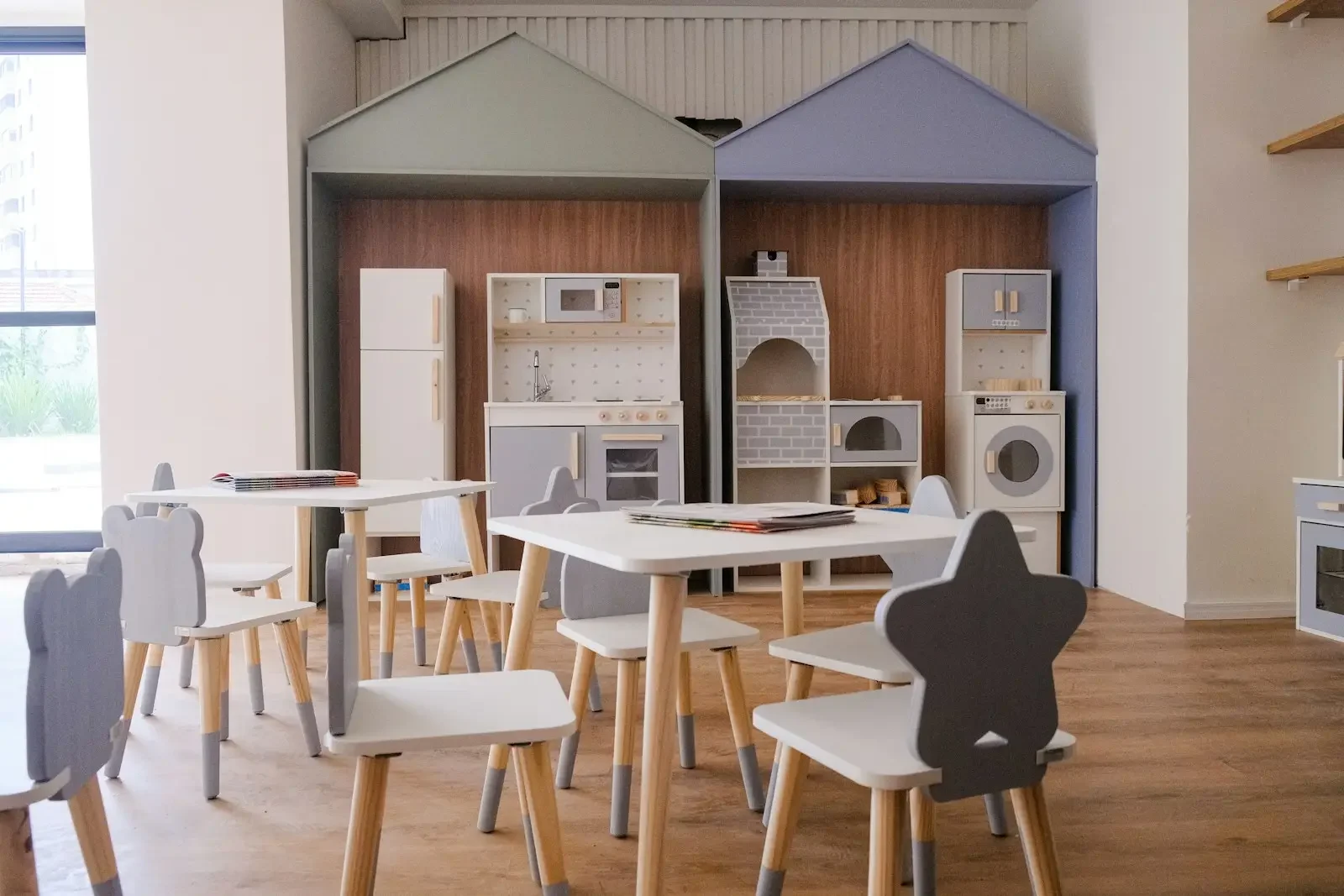
Specify the Order So the Supplier Cannot Drift
Most furniture disputes are specification disputes. If the purchase order does not name the size mark, board thickness, edge treatment, hardware grade and finish, the delivered product will satisfy the letter of a vague agreement and none of the intent. Write the specification as a table of measurable values and make it part of the contract.
At minimum, the written specification should lock the following:
- Size mark and exact seat or table height, stated as a tolerance range.
- Substrate and nominal thickness, including back panel thickness.
- Edge treatment, banding thickness and radius on exposed corners.
- Finish system and the disinfectant compatibility that was tested.
- Hardware function: soft close, drawer stops, concealed fixings.
- Caster type, load rating and locking mechanism.
- Wall anchoring fixings, with the anchor type named.
- Packaging, spare parts allowance and warranty response time.
Then approve a physical sample against that table, keep a signed reference sample, and require pre-shipment photographs of the production units rather than of a showroom model. A five percent spare parts allowance of glides, casters and shelf pins costs little and removes the most common reason for a mid-year emergency purchase.
FAQ
Three questions come up after the specification is agreed, and each one sits outside the sequence above rather than inside it.
What furniture is typically required for daycare licensing?
Requirements vary by jurisdiction, but most licensing frameworks expect age-appropriate seating and table space for every child present at once, a safe sleep surface for infants, anchored storage, and surfaces free of sharp edges, lead paint and accessible small parts. Fixed play equipment is usually inspected separately. Confirm the local schedule of requirements before ordering, because licensing conditions override catalog conventions.
How should classroom furniture be cleaned and disinfected?
Wipe with a mild detergent first, then apply the disinfectant your public health guidance specifies, and allow the stated contact time rather than wiping it dry immediately. Avoid abrasive pads on laminate and solvent products on plastic, both of which dull or craze the surface. Rinse food-contact tabletops with clean water afterwards.
How many tables and chairs does one preschool room need?
Provide a seat and a table place for every child present at the busiest part of the day, then add one accessible place and a reserve of two to four chairs. Table count follows seating capacity per table rather than room area. Keep enough clear floor for a group gathering space and one large-movement zone, or the room will be rearranged daily and the layout will not hold.