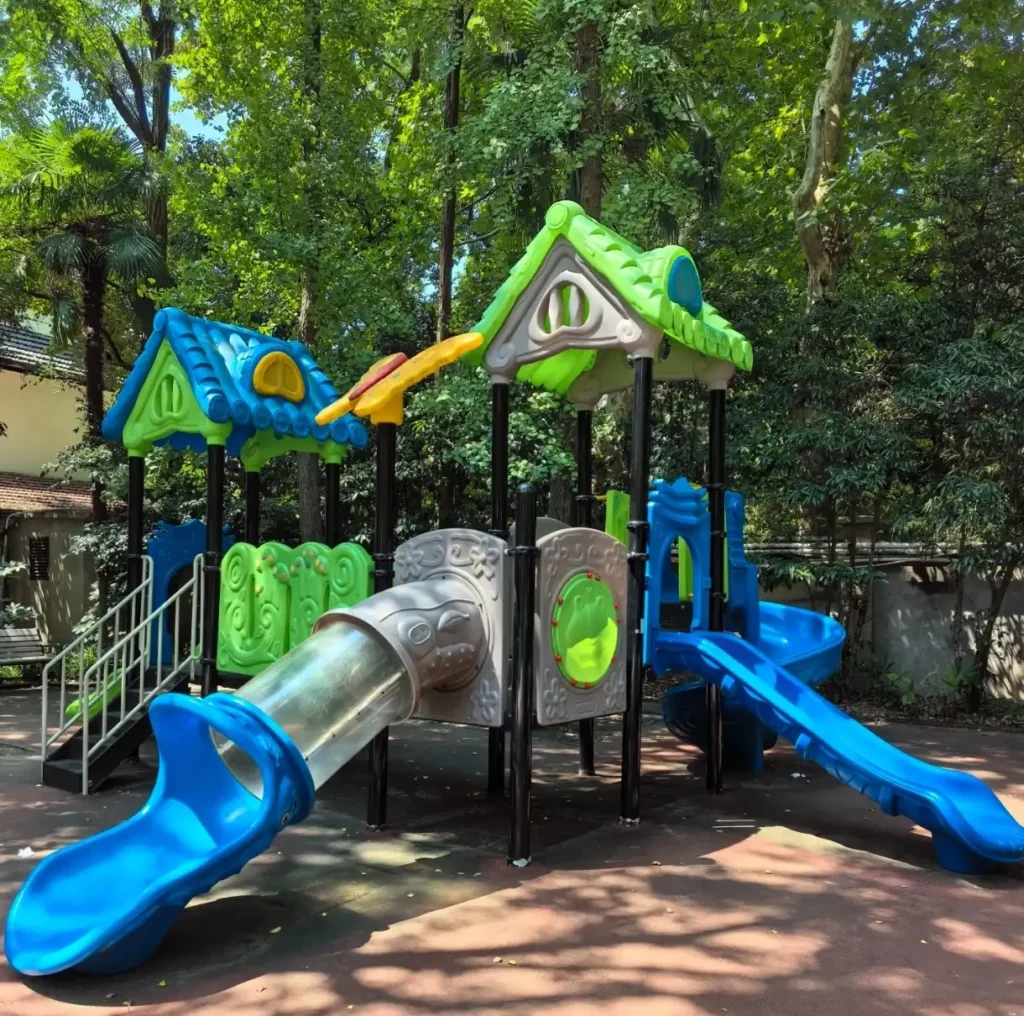
Kids Slide for Commercial Play Venues is always the focal point of play zones, and it serves as a key benchmark for buyers evaluating indoor playground equipment and outdoor playground equipment. For kindergartens, residential communities, shopping‑mall play areas, family entertainment centers and resort kids’ clubs, slides shape the overall layout and visitor experience of children’s activity spaces. Selecting a suitable slide solution is far more than picking preferred colors. platform height, material quality, slide gradient, site footprint and local safety compliance standards together determine whether the product suits your venue and will pass official safety inspections.
When sourcing commercial children’s slides, purchasers need to assess three core dimensions: target age brackets that define platform height and slope angle; material options. Rotomolded plastic is the mainstream choice for general‑purpose indoor playground equipment, while fiberglass and galvanized steel are widely used for high‑flow or custom‑built outdoor playground equipment; and regional safety certification requirements, including ASTM F1487 and F1292 for North America markets, and EN 1176 as well as EN 1177 for European markets. Measure on‑site dimensions in advance, reserve sufficient buffer landing space beyond the slide exit, and cooperate with manufacturers capable of providing complete test reports and professional installation support.
The following content compares slide classifications, material advantages & disadvantages, applicable age groups, site conditions and commercial price ranges, helping buyers screen proper models before sending inquiry emails.
What are commercial kids slides, and who are the target buyers?
Commercial kids slides are amusement facilities built for public play areas, covering application scenarios of both indoor playground equipment and outdoor playground equipment. Though household clients and commercial operators will purchase slides, their practical demands vary greatly.
Home‑use vs Commercial‑use slides
Household slides are small‑sized and lightweight. Foldable plastic toddler slides can be placed on foam mats or carpets and stored conveniently after use. Home buyers pay more attention to price, occupied space and soft landing performance. Even so, users still need to check for sharp edges and product recall notices.
Commercial slides operate under heavy‑duty conditions. Dozens or hundreds of kids use the facilities every day. Thus certified non‑toxic materials, fixed steel support frames, shock‑absorbent ground surfacing and formal load‑bearing documents are essential. Venue insurance agencies and local safety inspectors usually require these certification documents before commercial opening.
Main buyers of commercial‑grade slides include:
- Kindergarten and preschool chains, installing combined slides in yards or soft-play corners as part of indoor playground equipment
- Shopping mall operators adding children’s play zones to extend family visitors’ dwell time
- Family entertainment centers, taking large combined slides as core tourist attractions
- Hotels and holiday resorts equipped with special kids’ activity clubs
- Daycare institutions and early education centers
For these commercial customers, slides belong to high‑capacity amusement products. Practical indicators such as the number of kids served per hour, monitoring visibility of stairs and slide outlet, and impacts on insurance costs carry equal weight with product appearance.
Comparison of major kids slide categories
Common slide styles contain straight, wave, tube, spiral, double‑lane and integrated combination units. Straight and wave slides fit spaces with limited area. Tube and spiral slides bring more fun and higher capacity on the premise that vertical clearance meets installation requirements.
| Type | Best for | Typical Age Range | Key Notes |
|---|---|---|---|
| Straight Slide | Small play zones, toddler corners | 2‑6 years old | Simple structure, easy for staff supervision |
| Wave Slide | Kindergartens, preschool yards | 3‑8 years old | Undulating surface slows sliding speed and enhances play fun |
| Tube Slide | Malls, family entertainment centers | 4‑12 years old | Fully enclosed tunnel design; sufficient vertical clearance is required |
| Spiral Slide | Landmark amusement projects | 5‑12 years old | Realize long sliding distance within limited ground space |
| Double‑lane Slide | High‑traffic public venues | 3‑10 years old | Racing design effectively shortens visitor queuing time |
| Combined Play Unit | Themed playground projects | 2‑12 years old | Integrate slides with climbing structures, suspension bridges and other accessories |
Material selection: Rotomolded plastic, fiberglass or steel?
Rotomolded plastic serves as the mainstream material for most indoor playground equipment, oboasts advantages including a smooth surface, low noise and comfortable touch. Fiberglass fits heavy‑load customized themed projects. Galvanized steel and stainless steel are widely applied for durable outdoor playground equipment.
| Material | Advantages | Points to Notice | Typical Application |
|---|---|---|---|
| Rotomolded Plastic | UV‑resistant, impact‑resistant, comfortable touch, low maintenance cost | Low‑cost thin‑wall products are prone to cracking | Indoor playground equipment, kindergarten outdoor activity zones |
| Fiberglass | Rich color rendering, support complex curved modeling, long service life under heavy use | Higher initial procurement cost | Shopping malls, water parks, custom theme projects |
| Galvanized / Stainless Steel | Long service life, outstanding weather resistance | Its surface heats up quickly under direct sunlight; shading or protective cushions are needed | Public parks, large‑scale outdoor playground equipment |
| Steel frame + plastic slide surface | Balance structural stability and play comfort | Pay attention to welding craft and joint tightness | Most commercial combined slide sets |
Buyers often wonder whether plastic or metal slides perform better for indoor scenarios. Plastic has obvious advantages in enclosed spaces: metal surfaces turn cold in winter and may produce condensation, while plastic maintains stable and comfortable surface temperature all year round. Steel materials still play an irreplaceable role for outdoor playground equipment and high‑end custom projects, where long service life offsets high procurement cost. For children‑oriented amusement goods sold in North America, CPSIA standards restricting lead and phthalate apply to all material types. Please ask suppliers for official test certificates instead of only accepting verbal commitments.
Space planning & safety requirements for commercial slides
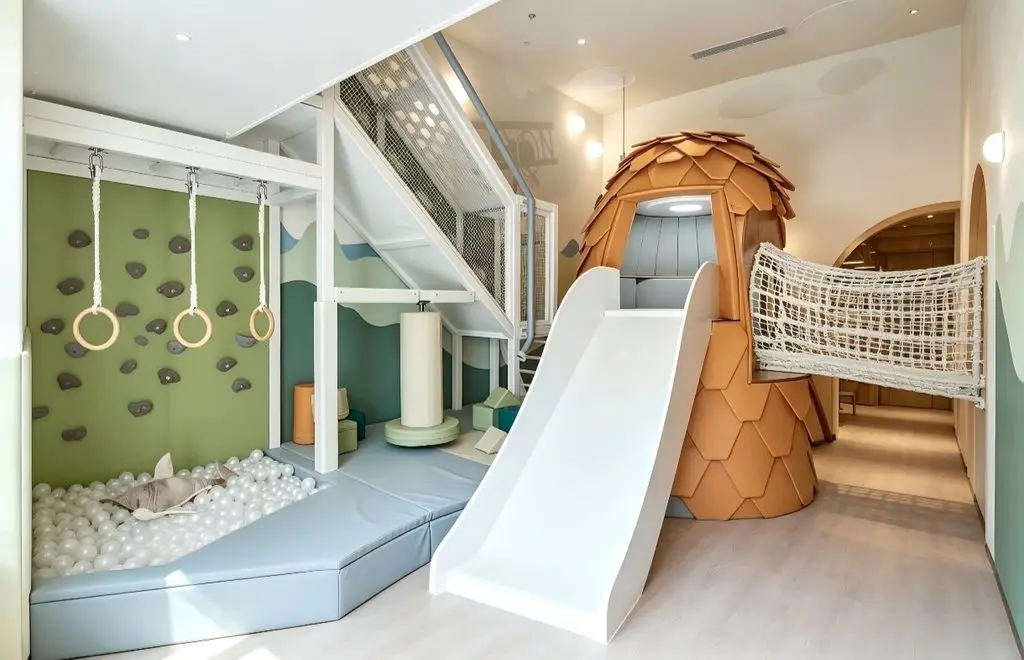
Reserve sufficient vertical clearance above the highest point of the slide structure, keep deceleration buffer area beyond slide outlets, and lay ground surfacing that satisfies critical fall‑height standards of target markets. North America adopts ASTM F1487 for facility standards and F1292 for ground surfacing test standards; European markets implement EN 1176 and EN 1177 accordingly.
Before confirming any model, measure venue size and check the following key points:
- Vertical clearance: Keep a minimum 3‑foot gap between the top of slides and ceilings. Note that air‑condition ducts, sprinkler heads and hanging ornaments will reduce available height for indoor playground equipment.
- Landing run‑out zone: Each slide needs deceleration space at the outlet. Commercial industry guidelines recommend reserving extra 6‑8 feet floor space for safety mats behind slide exits.
- Total footprint: A practical empirical rule is multiplying official product dimensions by roughly 1.4, to cover buffer zones and access passages for outdoor playground equipment.
- Supervision sightlines: Arrange climbing sections so that staff can clearly observe both stair entrances and slide outlets. This requirement is mandatory for fully enclosed tube slides.
- Shock‑absorbing surfacing: Landing ground must meet shock‑absorption requirements matching equipment critical fall height.
The CPSC Public Playground Safety Handbook provides easy‑to‑understand guidance covering activity zones, monitoring layout and ground surfacing reference. It is suggested to read this document before placing purchase orders.
Price reference for commercial slides
Household slides are priced at approximately $50‑$850. Fixed commercial slides start from $8500. Projects with custom themes, increased height and matching ground surfacing may exceed $26000, with production lead‑time of 6‑12 weeks.
| Product Tier | Price Range | Typical Buyer Groups |
|---|---|---|
| Foldable toddler slide | $50‑$130 | Family private use |
| Freestanding large plastic slide | $160‑$850 | Families, home daycare sites |
| Permanent commercial‑grade slide | $8500‑$26000+ | Kindergartens, malls, family entertainment centers |
| Commercial inflatable slide | $1600‑$6200 | Temporary event operators, pop‑up play projects |
The above price ranges are collected from public playground industry resources and wholesale platforms for reference only and do not constitute formal quotations. Final cost is determined by platform height, theme complexity, material grade, freight and on‑site installation. Inflatable slides cost less and can be quickly reassembled, but they only have a 3‑7‑year service cycle under daily heavy commercial use. Rotomolded plastic or fiberglass slides applied for indoor playground equipment and outdoor playground equipment can work for 15‑20 years with regular surface maintenance. Treat slides as long‑term assets: low‑cost products failing safety inspections within two years will bring higher comprehensive loss than certified qualified products.
Customization and cooperation with playground manufacturers
Lots of commercial clients choose customized slides rather than standard catalogue products. The manufacturer you choose impacts safety document provision, production lead time and spare parts supply, and these factors are just as important as slide design itself.
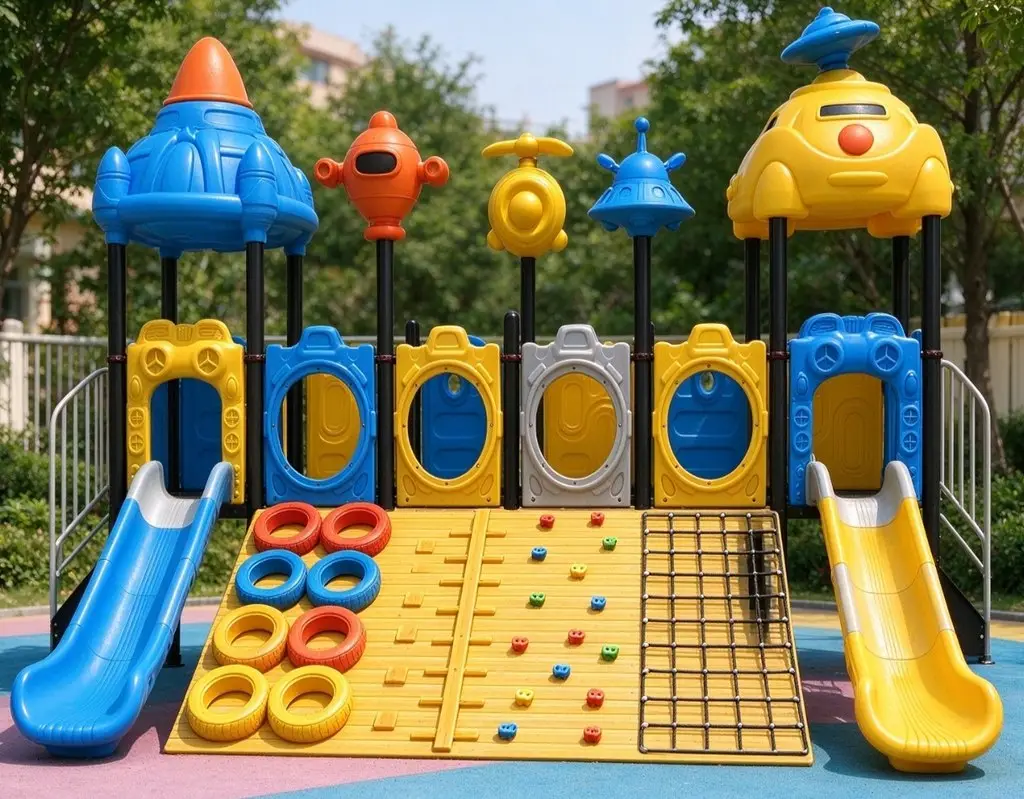
Customization mainly includes three dimensions. Visual theming adjusts colors, cartoon decorations and patterns to match venue styles. This explains why ocean, space and animal themes are widely applied in kindergarten and mall indoor playground equipment. Structural customization adapts facilities according to actual floor plans, combining slides with climbing walls, ball pits or multi‑lane passages for high‑visitor‑flow venues. Material customization selects rotomolded plastic, fiberglass or steel components based on project budget and whether the product belongs to indoor playground equipment or outdoor playground equipment.
When comparing different suppliers, remember to raise these five vital questions:
- Can you provide formal test reports conforming to ASTM F1487, EN 1176 or CPSIA standards?
- Is your quotation factory‑direct price or involving intermediate dealers?
- Do you supply remote guidance or on‑site installation service?
- Are replacement spare parts available several years after order delivery?
- Could you share completed reference projects with venue conditions similar to ours?
JQK (JinQiKai) independently designs and manufactures indoor playground equipment and outdoor playground equipment in its own factory, supplying themed slides and integrated combined units for kindergartens, shopping malls and family entertainment centers. Direct cooperation with original manufacturers brings competitive ex‑factory price, site‑oriented custom schemes, eco‑friendly certified raw materials and technical support from the production team. Browse our outdoor playground equipment product portfolio to check combined slide solutions for parks, schoolyards and residential communities. Please send your floor drawings and target age requirements via contact page to get layout proposals and formal quotations.
FAQ
How long is the service life of commercial kids slides?
With regular inspection and surface renovation, well‑maintained permanent fiberglass or rotomolded slides can serve 15‑20 years for both indoor playground equipment and outdoor playground equipment. Commercial inflatable slides normally last 3‑7 years under daily heavy‑load operation. Please keep simple maintenance logs, because maintenance records will affect insurance evaluation and safety inspection results.
Can a single slide serve toddlers and older children simultaneously?
It can only be realized by setting independent separated lanes. Multi‑zone combined facilities can configure low‑height lanes for toddlers alongside high lanes for elder kids, and each lane is equipped with exclusive stairs and outlets. Single‑surface shared slides cannot meet mixed‑age demands, because slope gradient and platform height cannot fit both toddlers and school‑age children.
Do indoor slides need special ground surfacing?
Yes. Landing zones must satisfy shock‑absorption standards corresponding to the critical fall height of indoor playground equipment. Certified foam or rubber safety mats are necessary. Ordinary carpets or bare tiles cannot pass inspection.Inspectors will verify surfacing certificates alongside compliance documents for amusement equipment