A mall atrium is the most expensive floor space in the building, and any paid attraction has to out-earn the kiosk it replaced. That is why operators shortlisting a family ride keep comparing the same two products: a trackless train that tours the building, and a carousel that sits in one fixed circle. Both are proven commercial amusement park rides selling to the same family indoors all year. Most buyers start inside the same category of electric amusement rides, then find the two solve different problems.
Neither is better in general. The train wins when your problem is circulation across a large floor plate; the carousel wins when your problem is a compact, photogenic anchor that turns a dead corner into a destination. Match the ride to the constraint you have.
The comparison runs through space, throughput, cost, compliance and guest experience, in the order a mall project usually fails.
What these two rides actually are
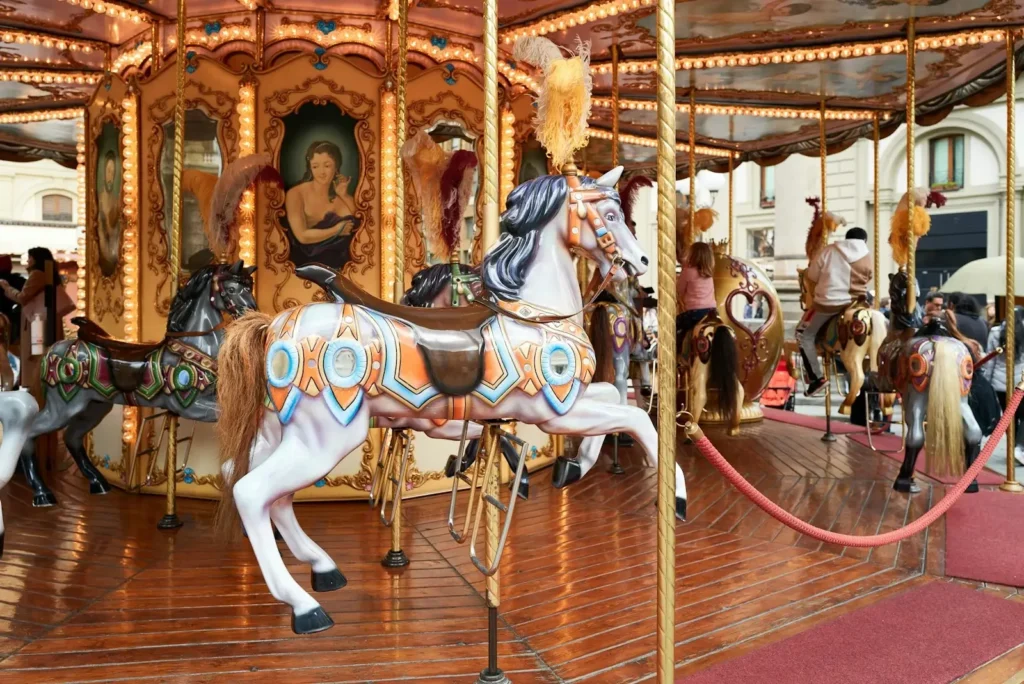
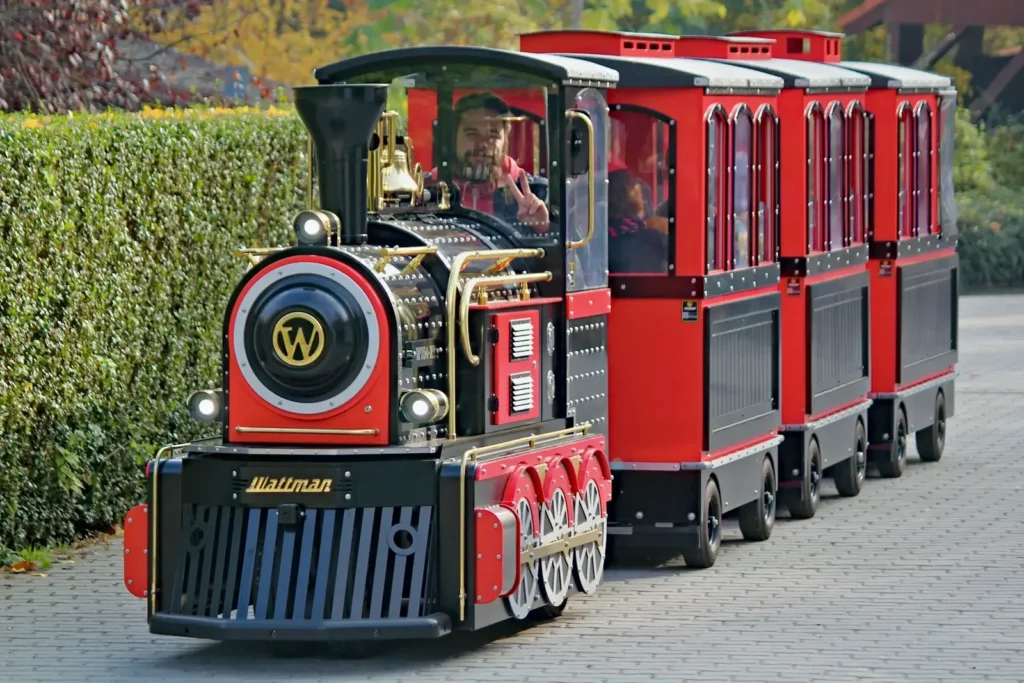
A mall train is a battery-electric locomotive towing coaches on rubber tyres along a planned route with no rails. A carousel is a powered rotating platform whose seating never leaves its spot.
Mall trains, also called trackless trains or mini express trains
If you searched for what the trains in malls are called, you met three names for one product: mall train, trackless train or trackless sightseeing train, and mini express train. Keep all three in your enquiry, because manuals, spares and certificates follow whichever term the factory uses.
A locomotive carries a 24V to 72V battery pack and pulls two to four coaches at walking pace, usually 5 to 10 km/h indoors. Published sheets for Chinese-made units quote 7 to 8 hours per charge, a 3 to 3.5 metre turning radius and four to eight riders per coach.
The detail first-time buyers miss is supervision. A train needs marked stops and an attendant holding the queue clear of a moving vehicle in public space, while a carousel needs only a gate.
Carousels as a fixed-footprint attraction
A carousel is a rotating deck driven from a centre column, adjustable between roughly 1.8 and 4 rpm, seating six on a kiddie unit up to 48 on a large single-decker.
Diameter scales predictably with seats: about 6 metres at 12 seats, 9 at 24, and 14.5 for a 48-seat double-decker, with platform heights near 5.2 metres on smaller units.
Space and floor requirements decide more than price
Inside a building the site usually chooses the ride. A carousel needs one circular pad with clear height above it; a train needs a closed loop with corner clearance, boarding stops and a queue area that does not block a fire exit.
Footprint and turning radius
| Requirement | Trackless mall train | Carousel |
|---|---|---|
| Shape of space | Closed loop, roughly 60 to 150 m of route | Single circle plus perimeter gate |
| Footprint | Route width plus 3 to 4 m corner clearance | 6 m to 14.5 m diameter by seat count |
| Clear height | 2.0 to 2.5 m along the route, plus signage | 5.2 m typical, higher for double-deck |
| Surface | Smooth tile, concrete or epoxy; carpet adds drag | Flat pad or load-spreading base |
| Power | Charging point at the depot position | Fixed supply at the centre column |
| Installation | Days, no civil works | Days, plus base or foundation |
Trains manoeuvre better than expected: one manufacturer describes a 15-metre set U-turning inside 5.5 metres of width with four-wheel steering. The real constraint is what the turn passes, from planters to shoppers who stop mid-route.
Floor loading, ceiling height and fire egress
Three checks belong in the first site visit.
- Slab loading. A carousel concentrates weight on a centre bearing and circular track; a loaded train spreads it along the route. Both need structural sign-off, and an upper-floor carousel often needs a load-spreading base.
- Clear height. The canopy is the tall element, so measure ceiling, sprinklers and hanging signage, then leave access for maintenance above it.
- Egress. Routes cannot permanently narrow an escape path or block a fire door, so mark the route for fast clearing and keep the fence off any exit lane.
Throughput, dwell time and revenue per square metre
A carousel turns more paid seats per hour in a smaller footprint; a train carries more people per departure and pulls footfall through the building. The carousel wins on revenue density, the train on reach.
Riders per hour under realistic mall conditions
| Ride | Seats per departure | Cycle | Departures per hour | Theoretical hourly riders |
|---|---|---|---|---|
| 12-seat carousel | 12 | 2 to 3 min | 15 to 20 | 180 to 240 |
| 24-seat carousel | 24 | 2 to 3 min | 12 to 18 | 288 to 432 |
| Mini train, 2 coaches | 10 to 16 | 6 to 10 min | 5 to 8 | 50 to 128 |
| Mall train, 4 coaches | 24 to 32 | 8 to 12 min | 4 to 6 | 96 to 192 |
These are calculated from manufacturer capacity and cycle specifications, assuming disciplined loading and no breakdowns. Treat them as ceilings, then measure your own site over a trial weekend.
The circulation effect a train creates for tenants
This argument rarely appears in brochures and often decides approval. A route can pass the food court, the cinema and the upper-floor family zone, moving paying families past tenants that rely on destination traffic, which supports rent reviews in weak positions. A carousel concentrates people instead, which suits a cafe with outdoor seating or a promotions stage.
What a mall train costs, and what a carousel costs
Purchase prices overlap far more than operators expect. The real difference is total installed cost: a train’s money sits in the vehicle and battery, a carousel’s in the platform, finish and fixed installation.
The bands below compile 2026 supplier price guides reviewed on 23 October 2026, FOB China.
| Configuration | Capacity | 2026 FOB range (USD) |
|---|---|---|
| Mini mall train, 2 coaches | 10 to 16 | 6,000 to 20,000 |
| Mid-size mall train, 3 to 4 coaches | 20 to 32 | 15,000 to 45,000 |
| Full-size train, 4 to 6 coaches | 40 to 70 | 50,000 to 120,000 |
| Kiddie carousel | 12 to 16 seats | 7,000 to 18,000 |
| Mid-size carousel | 24 to 30 seats | 17,000 to 35,000 |
| Large carousel | 36 to 48 seats | 35,000 to 95,000 |
How much does a mall train cost?
A mall train costs roughly 6,000 to 120,000 US dollars before freight, and four variables explain the spread: coach count, seating density, battery and motor, and how much of the body is custom moulded. A two-coach mini train for a community mall sits at the bottom; a five-coach themed trackless sightseeing train with bespoke characters sits near the top, where the premium is tooling and paint rather than capacity. Quote every supplier on the same coach and seat count.
Carousel price bands and what drives them
Carousel pricing tracks seats and finish: 12 to 16 seats is the entry point, 24 to 30 the volume seller for malls, 36 upward a landmark purchase that brings a design review. Within one seat count, price moves on drive position, fibreglass layers, lighting and custom moulds.
The costs that sit outside the invoice
In an awkward building these can rival the equipment price.
- Freight, insurance and import duty
- Foundation, load-spreading base or floor protection
- Electrical upgrade and a train charging point
- Operator hours, including break cover
- Tyres, batteries, spares and gel-coat touch-up
- Public liability cover
- Signage, queue barriers and a ticket reader
Payback should be calculated, not asserted: total installed investment divided by annual net contribution, where net is ticket revenue minus wages, power, maintenance and spares. Only you can supply opening hours, riders per day, ticket price and staff per shift. A payback number without those is marketing.
Safety, compliance and staffing differences
Both are commercial amusement devices governed by ride-safety rules in most markets; the compliance work differs in kind, not in whether it exists. The train adds a moving-vehicle risk, the carousel a rotating-platform and restraint risk.
The design reference serious suppliers work to is ASTM F2291, the standard practice for design of amusement rides and devices, which sets criteria for structures, restraints, acceleration limits, control systems, electrical requirements and fencing. Buyers outside the United States often specify EN 13814 instead.
Three points decide how smoothly inspection goes. Classification first: authorities grade rides differently, so confirm where a slow indoor train sits before signing. Then on-machine safety: an emergency stop within reach, a non-overridable speed limit, anti-collision protection, age-appropriate restraints, and gates that lock while the platform turns. Then staffing: a train needs a driver plus a boarding attendant, a carousel a panel operator plus gate control, and both need a daily checklist and maintenance log that landlords now request.
Guest experience, theming and brand fit
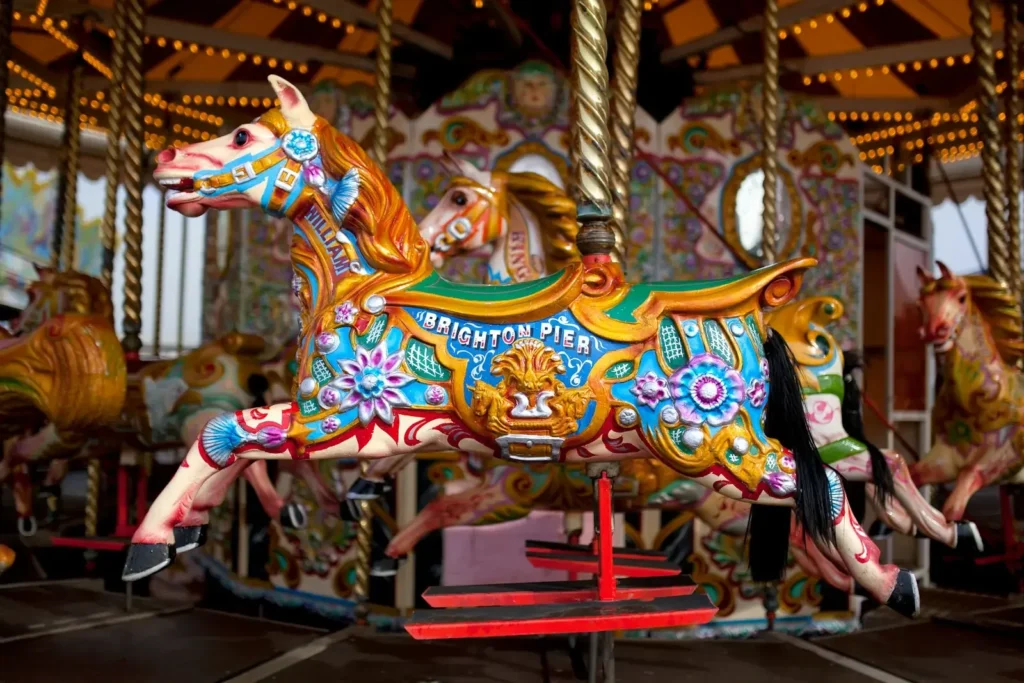
A carousel sells the photograph; a train sells the journey. Families photograph a carousel from every angle, then photograph a train as it arrives and spend the ride looking out at the shops.
That shapes marketing. A carousel becomes the visual signature of a family zone, which is why palettes and custom figures matter here. A train becomes a moving billboard passing every storefront, which suits seasonal campaigns and sponsor wraps.
Which ride suits which mall profile
| Mall profile | Better first choice | Reason |
|---|---|---|
| Community mall with a grocery anchor and young families | Carousel, 12 to 16 seats | Compact, quick cycle, repeat visits, low staffing |
| Lifestyle mall with a central event space | Carousel, then a small train | The fixed ride anchors events, the train extends the offer |
| Large floor plate with weak upper-level traffic | Train, 3 to 4 coaches | Route design redistributes footfall |
| Transit-linked mall with transient traffic | Train | A ride with a route reads as an attraction to passers-by |
| Outlet centre with long internal walkways | Train | Turns a long walk into a paid experience |
Seasonal campaigns and customization
Both accept theming, though not equally. A carousel’s theme lives in figures, panels and canopy, so a refresh means new decor or a factory repaint. A train’s theme lives in coach bodies and lighting, which can be wrapped between campaigns, and the vehicle can move to another entrance for a holiday.
Which one should you buy first
With budget for one ride, buy the one that removes your biggest constraint: a carousel for a compact anchor with fast repeat ticket sales, a train to move families through a large or underperforming floor plate. Add the second after one full season of real ridership data.
| Your situation | Buy first |
|---|---|
| Under 100 square metres of usable space | Carousel, 12 to 16 seats |
| Atrium with 5 m clear height and a 10 m circle | Carousel, 24 seats |
| 150 metres or more of practical route | Train, 3 coaches |
| Upper-floor traffic needs lifting | Train |
| Two staff maximum per shift | Carousel |
| Ride must move between sites or events | Train |
Phasing works because both share the customer and the payment point. A carousel installed first sets ticket price, queue culture and staffing rota; a train in year two runs on the same systems. When you run both, keep the routes apart, because a train crossing a carousel gate during loading causes a queue collision neither design anticipated.
How to brief a supplier and get comparable quotes
Quotes become comparable only when the brief is identical. Send every supplier the same eight points: floor dimensions, clear height, slab loading limit, target age band, riders per hour at peak, available power, theme direction and the certification your local authority requires.
Add the delivery window and the spare parts list you expect to hold on site, and ask for a layout drawing with the ride placed in your actual space. In the factory, check the fibreglass workshop and mould condition, the gel-coat process, the electrical components, and whether manuals exist in your language. Buyers choosing a kids electric rides supplier on price alone usually pay twice.
JQK manufactures indoor and outdoor play and ride equipment for commercial venues, with electric rides and carousels as established lines. The range covers trackless sightseeing trains in themed series, from retro and macaron palettes to character-led designs, and carousels from 6 to 24 seats in custom colours, gel-coat finishes and lighting packages. For a mall project, send the floor dimensions, clear height and target age band, and the team can confirm which model fits and what the delivered scope includes.
FAQ
Can a trackless train run on carpet or on an upper floor?
Carpet works but costs. Pile raises rolling resistance, shortens battery runtime and loads the motor on starts, so a long carpeted route may need a higher-torque specification. Upper floors are structural: a loaded train spreads weight along the route, so the building engineer has to approve axle loads. Lifts are usually the real limit.
How long does installation take before the ride can sell tickets?
Allow one to three days on site for a carousel: assembly, levelling, electrical connection, then inspection. A train is faster to place but slower to commission, because the route must be marked, the charging point installed and the driver trained. Book the inspection before the container lands.
What spare parts should a mall keep on hand?
Tyres or wheel assemblies, brake pads, a spare controller or relay set, fuses, LED modules and a gel-coat touch-up kit, plus one spare battery pack per train. A carousel adds a drive belt or coupling and figure-mount fasteners.