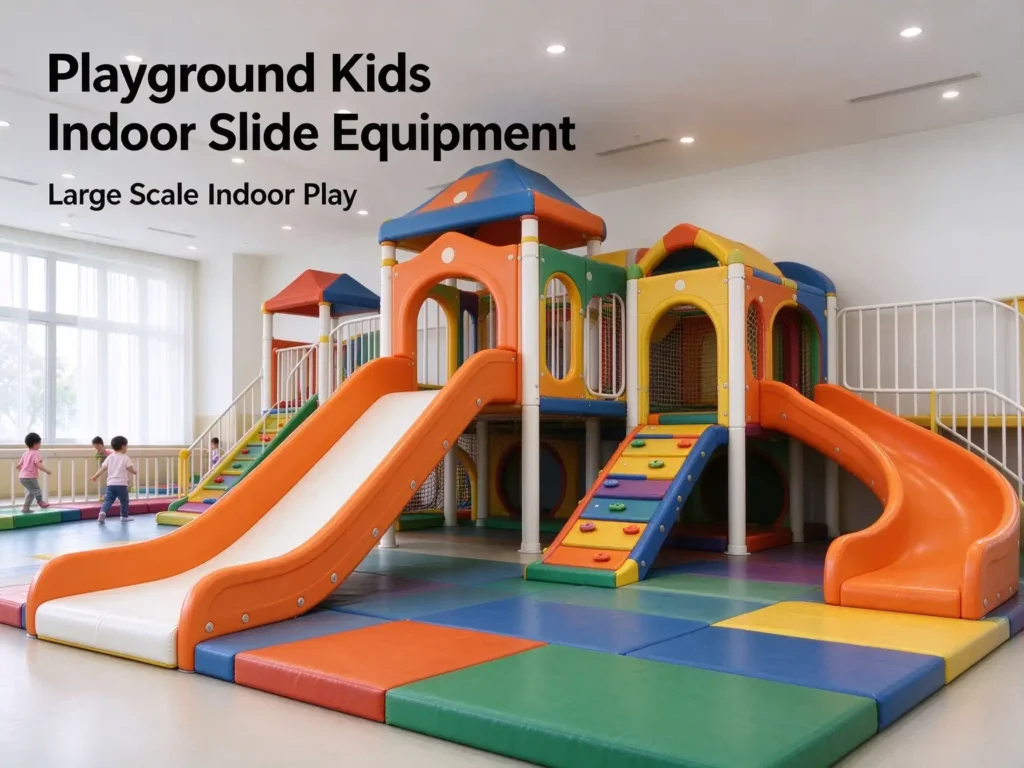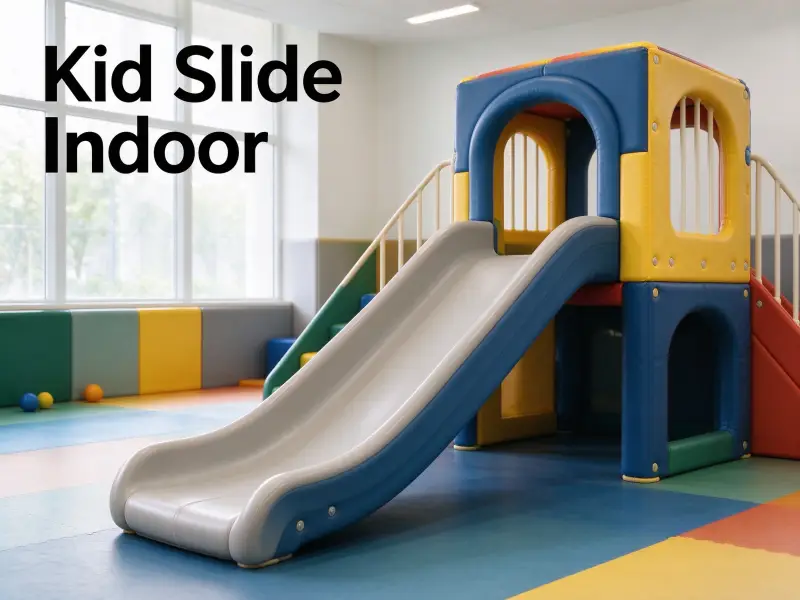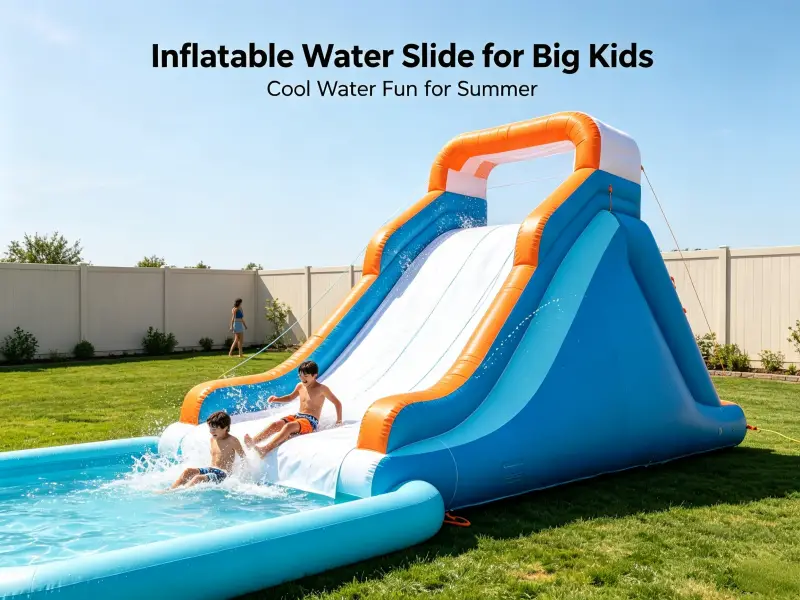
Search results for a kids’ swing set with a slide all look alike. A photo, an age sticker, a price, and a star rating. What they leave out is what decides whether the set still earns its space in year three: deck height, the clear area the structure needs, and the standard edition the hardware was tested against.
The right kids’ swing set with a slide is the one whose deck height, clear space, and materials match the children who will actually use it, and whose slide is sized to their age rather than to the product photo. Buyers miss this in both directions. A parent orders a big kid slide for a five-year-old who still needs a low platform and a long run-out.
A park manager orders toddler-scale equipment for a site that fills with eight- and ten-year-olds every afternoon. Both problems were visible on paper before the order went out. The same checks apply to one set in a garden or twelve in a kindergarten, and they’re the checks a design team runs through when it quotes a layout from the outdoor playground equipment range.
This guide works through them in order: who plays on the set, how much room it needs, what the materials have to survive outdoors, and what documentation has to reach you before a deposit does.
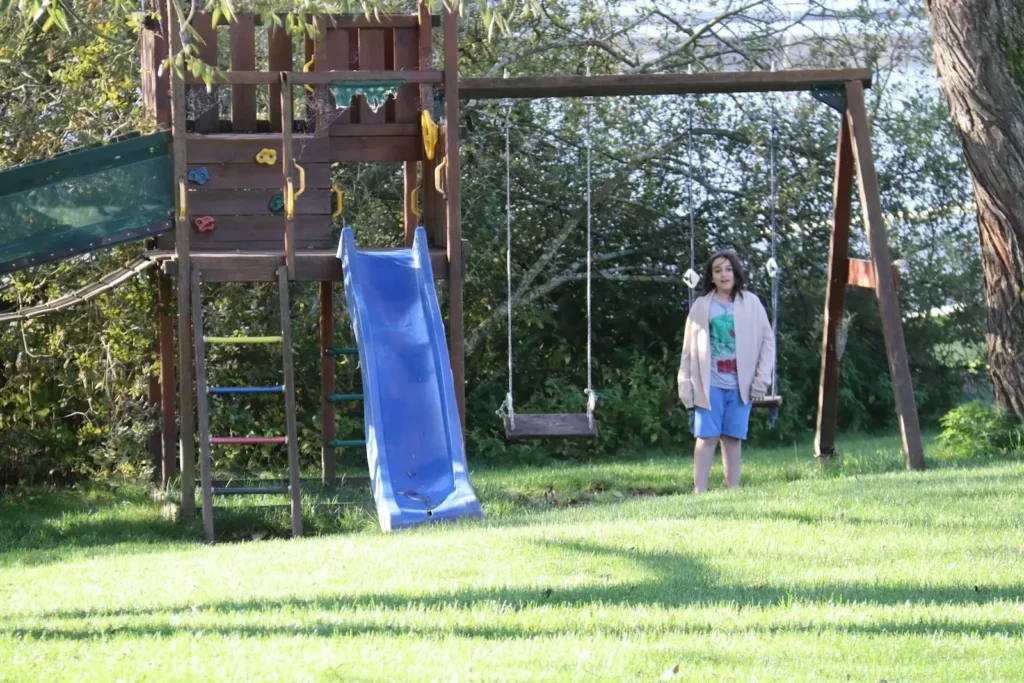
What should you check before buying a swing set with a slide?
Six checks cover most of the risk: who will use it, how much clear space it needs, what it’s made of, how it’s anchored, how children get on and off, and what test documents come with it.
| Check | What it decides | How to verify before ordering |
| Age band and peak headcount | Platform height, slide type, number of stations | Count the children who will play at once, not the ones who live in the house. |
| Deck and exit height | Which ages can use the slide without a hand? | Ask for both figures in writing, plus the run-out length. |
| Clear space (the use zone) | Whether the set fits the site at all | Measure the site, then compare with the use zone the supplier states. |
| Material specification | How it holds up to sun, rain, and daily use | Ask for the steel grade, coating process, and UV treatment. |
| Anchoring method | Whether the frame stays level after years of swinging | Ask how the legs fix down and on what surface. |
| Labels and test reports | Whether the set clears a school, park, or tender requirement | Request the report number and the standard edition behind it. |
Start with the age band, not the price.
A set built for toddlers has a low platform, a shallow slide angle, and a short run-out. A set built for older kids has a higher deck, a longer slide, and swing bays spaced for bigger children. The designs don’t substitute for each other. A set rated for ages three to ten still needs a platform a three-year-old can reach and a slide a ten-year-old doesn’t find boring, which is why manufacturers use age zoning instead of one compromise height.
Measure clear space, not just the footprint.
The footprint is where the equipment stands. The use zone is the area around it that has to stay clear, and it’s the number that catches buyers out on small urban plots and courtyard sites.
CPSC’s Public Playground Safety Handbook treats that as part of the specification rather than a suggestion. The baseline is six feet of clear space in all directions from stationary equipment and more in front of and behind a swing bay, where the protected area extends by roughly twice the height of the top bar. The handbook also sets surfacing depths against fall height, and the current edition is the 2025 update, which replaced a version in circulation since 2010. On a tight site, that requirement usually changes the layout rather than the equipment: moving, rotating, or splitting the set is cheaper than buying a smaller one.
Backyard playsets for older kids vs. a little kid slide: how the two differ
The split isn’t about size. It’s about who the structure was engineered for. A little kid slide is built for a child who needs help getting up and can’t absorb a hard landing. A set for older kids is built for speed, height, and load.
| Little kid slide (roughly 18 months to 5) | Backyard playset for older kids (roughly 5 to 12) | |
| Platform height | Low, reached by wide steps with handrails | Higher deck, reached by ladder or climbing net |
| Slide | Short, shallow angle, side walls, or a hood at the top | Longer run, often spiral, tube, or double parallel |
| Swing Bay | Full bucket seat, seats close together | Belt or flat seat, wider spacing, higher frame |
| Play value | One activity at a time | Climbing, sliding, swinging, and route-finding together |
| Relevant standard | ASTM F1148 covers home playground equipment for children over 18 months through 10. | ASTM F1487 covers public use equipment from the 5th percentile (2-year-old) to the 95th percentile (12-year-old). |
| Common regret | Outgrown within two seasons | Bought for a site with no room for its use zone |
The standards row matters more than it looks. ASTM F1148 applies to home playground equipment and explicitly excludes schools, nurseries, day-care centers, and parks. ASTM F1487 does the reverse. So a playground set for backyard use and a school installation are judged against different documents, even when the equipment looks similar.
What tells you a set has been outgrown?
The signals show up before complaints do. Children climb the outside of the structure instead of using the ladder. The slide becomes a bottleneck because it’s too short to be interesting. The swing bay gets used by two children at once. Swing sets for older kids also need a heavier frame and a wider stance, because the load per seat is higher and the movement is more forceful. Metal swing sets bought for a five-year-old rarely survive an eight-year-old’s use.
Why backyard playsets for older kids need more space
Speed needs run-out. A longer slide exits faster, so it needs more clear space past the exit, and a swing bay for bigger children travels further in both directions. That’s where a backyard that looked big enough on paper stops working: the equipment fits, but the use zone doesn’t.
When area is the constraint, the practical fix is a combined unit rather than a longer single slide. A structure that packs a spiral and a double run into one footprint, like this outdoor play slide with spiral configuration, keeps two children sliding at once without doubling the space the site gives up.
Metal playground set, plastic, or wood: what lasts outdoors?
Metal frames with plastic play parts hold up best in public and semi-public settings. Wood suits gardens where appearance matters more than maintenance. In both cases the surface treatment decides service life, not the material family.
| Material | Strong at | Watch for | Fits |
| Galvanized steel frame | Load capacity, long service life, low movement | Thin walls, uncoated cut edges, mild-steel fasteners | Parks, schools, residential communities, kindergartens |
| Stainless steel slide surface | Smooth sliding, corrosion resistance | Grade substitution, thin plate, unpolished edges | Coastal sites, high-use public equipment, premium projects |
| UV-treated plastic parts | Fade and crack resistance, rounded edges, easy cleaning | Resin without UV stabilizing, sharp molding seams | Slides, panels, cabins, toddler elements |
| Wood | Warm appearance, blends into garden settings | Splitting, rot, seasonal checking, refinishing | Home gardens, landscape-led projects with a maintenance plan |
Galvanized steel frames and stainless steel slide surfaces
The combination that survives longest outdoors is a hot-dip galvanized steel structure with a stainless steel sliding surface. Galvanizing protects the whole frame, including the inside of the tube. Stainless steel keeps the sliding face smooth after years of abrasion from clothing, sand, and grit.
One coastal build runs 304 stainless steel plates, 12 mm thick and mirror-polished on both faces, as the sliding surfaces, with a hot-dip galvanized shell under a double-layer anti-rust electrostatic coating and a UV-resistant topcoat, 316 stainless anti-theft lock screws, and nylon rope climbing nets. That specification exists because of salt fog, not marketing. The custom stainless steel slide shell and its transparent PC tunnel panels resist wind, rain, and salt air that would take the finish a standard powder-coated frame in a few seasons.
What anti-UV, food-grade plastic actually buys you
On outdoor kid slides, the plastic takes most of the daily contact. Anti-UV stabilizing slows the color fade and chalking that make equipment look tired long before it becomes unsafe, and food-grade resin keeps the material clear of additives you don’t want near a child’s hands and mouth. Integrated molding with rounded, polished edges also removes the sharp seams behind most minor injuries.
Outdoor kid slides vs. kid slides indoors: can one unit serve both?
A slide can move indoors, but it stops being the same product. Indoors you lose wind loading and gain ceiling height, floor protection, and evacuation constraints, so the checks change even when the equipment looks identical.
Families want one kid to slide indoors for the wet months and outdoor kid slides for the rest of the year. Play cafes and kindergartens ask the same question for the opposite reason. Some units cross over. Most don’t.
What changes when a slide moves indoors?
Ceiling height comes first. A slide that needs three meters of clearance outside needs the same headroom inside, plus room for an adult to reach a child at the top. Then floor protection: an indoor slide wants a padded or rubber surface rather than grass or bark, and it has to be anchored into a floor you’re allowed to drill.
The standard changes too. Home playground equipment, public playground equipment, and fully enclosed play structures sit under different specifications, and a product tested against one isn’t automatically compliant with another. CPSC’s handbook covers public playground equipment, ASTM F1148 covers home equipment, and ASTM F1487 states plainly that soft contained play equipment falls outside its scope. If the venue is commercial, say so at the quotation stage so the documents match the venue.
Kid slide for pool and coastal sites: what to specify
Water changes the material list. Around a pool you want stainless steel on the sliding surface rather than plastic that chalks under chlorine and sun, no downward-facing traps where water sits, and fasteners that won’t stain the decking. A kid slide for pool areas also needs an exit that lands on a slip-resistant surface rather than wet tile, placed so children moving between water and slide don’t cross a queue. For salt-water exposure, 304 stainless handles fresh water and general weathering, while splash zones and marine air push you towards 316 for fittings.
Sizing the slide: outdoor slide for 5-year-olds and big kid slide for backyard
Slide size follows the user, not the yard. A five-year-old needs a platform they can reach safely and a run-out that slows them gradually. A big kid slide for a backyard needs enough height to be worth the climb and enough exit space to be safe at speed.
| User | What the slide has to do | Slide type that fits | What you watch |
| 2 to 4 | Build confidence, no long drop. | Short straight slide, low deck, side walls | Step height, part gaps, sharp edges |
| 4 to 6 | Independent climbing, controlled speed | Straight or gentle curve, moderate deck | Ladder access, run-out length, sightlines |
| 6 to 10 | Speed, challenge, repeated use | Spiral, tube, or double parallel | Exit speed, clear space past the exit, queue behavior |
| 10 to 14 | Variety, more than one route | Long spiral, tunnel, or drop slide | Structural load, zoning away from smaller children |
Angle, exit height, and run-out
Three dimensions decide whether a slide feels right. The entry angle sets the speed. The exit height sets how the child leaves the slide and how hard the landing is. The run-out is the flat distance past the exit where they slow down and clear the way for the next child. A slide without enough run-out turns a queue into a collision.
This is where a supplier’s drawings are worth reading properly. The equipment height on a quotation usually means platform height, not total structure height and not exit height. Buying the wrong number is a common error.
Fall surfacing and clear space after the exit
Protective surfacing is part of the slide specification, not a landscaping decision made later. Required depth is tied to fall height and varies by material, whether that’s rubber tiles, wet-pour, bark, sand, or engineered wood fiber. Loose fills need more depth than a tested rubber system for the same fall height, and they need raking. The surfacing also has to extend past the slide exit and under the swing bays, with a contained edge so the material doesn’t migrate into the play area. If the surfacing budget is fixed, choose the slide layout first and the surface second.
What does a manufacturer-built slide and swing set include?
Beyond the frame and the slide, a commercial unit includes configured slide types, a swing bay matched to the age group, climbing routes, safety railings on every elevated platform, and the installation and maintenance documents that keep it compliant.
Slide types you’ll be quoted
- Spiral slides, which compress a long ride into a small footprint
- Straight slides, the simplest to supervise and the cheapest to replace
- Double parallel slides, which let two children slide side by side and cut queueing at peak times
- Transparent tunnel tube slides, which add a route-finding element for older children
A multi-functional slide and swing play set shows how these combine in one structure: cartoon cabin themes, spiral slides, straight slides, wide double parallel slides that take two children at once, and on some models a swing bay, built around anti-UV food-grade plastic parts and galvanized steel frames with anti-slip climbing ladders and full platform railings.
Themes, zoning, and layout
Theme choice isn’t decoration. Cabin, forest, ocean, and space themes hide the structure’s working parts inside the scene, and they help operators separate age groups by zone rather than by fence. Age zoning also raises how many children a site handles at once, because a high-activity zone and a quiet zone with different foot traffic stop competing for the same clear space.
Documentation and installation support
Ask what arrives with the equipment: installation instructions in a language your contractor reads, a ground plan showing anchor positions, the maintenance schedule, and the spare parts list. On larger projects, on-site installation guidance is worth more than a small discount, because the first assembly sets the anchor positions, the frame level, and the alignment of every slide joint.
Questions to ask a playground supplier before you order
Ask about the standard edition and the report number first, then customization limits, production time, shipping documents, warranty terms, and spare parts. The answers tell you more than the catalogue does.
| Question | What a solid answer looks like. |
| Which standard was this model tested against, and which edition? | A named standard with a year, plus a report number you can check |
| How much can the layout be adapted to my site? | Concrete limits: platform height, slide length, tunnel curvature, color scheme, and which parts are modular |
| What’s the production time, and what changes it? | A range that depends on the design, not one fixed number for every order |
| Who supplies the installation drawings, and in what language? | Bilingual manuals and a ground plan with anchor positions, as standard |
| What documents ship with the container? | Export documents for customs clearance, plus material and inspection documents for tenders |
| What does the warranty cover, and for how long? | Different periods for different components, stated per part rather than as one blanket figure |
| Can I reorder a single damaged part in three years? | A parts list and a reorder route, in writing |
On standards, ask to see the report rather than the certificate, because a compliance statement and a test report are different documents. ASTM F1487 was revised in 2025, so an answer citing an older edition tells you the technical file is out of date. For public, school, and community projects, the buying decision usually runs through ASTM F1487 at the procurement layer. For a private garden, the relevant document is generally home playground equipment compliance, and it’s worth saying out loud which of the two applies to your site before you compare prices.
How JinQiKai handles custom swing sets and slide projects
Fujian Jinqikai designs, manufactures, and installs custom themed play equipment as one package, from site survey to after-sales. That removes the handover gaps that appear when the structure, the layout, and the installation come from three different suppliers.
JinQiKai has been building children’s playground equipment since 2016, works from a 35,000-square-meter workshop, and has supplied more than 10,000 kindergartens and communities. The outdoor range includes the compact Little Doctor Slide series alongside larger themed combined slides.
- Site survey and themed design, based on plot dimensions, target age group, and budget
- Configuration of platform height, slide types, and swing bays to the ages on site
- Production with the material and inspection documents a tender or customs clearance needs
- Modular packing, with bilingual construction drawings and installation manuals
- Installation guidance and after-sales support, including replacement parts
Customization runs through the structure rather than a color swatch. Body length, platform height, slide length, tunnel curvature, and color gradient can all be adjusted to the site. Send your plot plan, target ages, and budget, and the team replies with a free layout suggestion and price list within 12 hours, with no obligation. A site-specific layout is easier to compare between suppliers than a catalogue page.
FAQ
Can a kids’ swing set with a slide stay outdoors all year?
Yes, if it was specified for it. The parts that fail are the ones nobody asked about: uncoated fasteners, ungalvanized tube interiors, plastic without UV stabilizing, and sliding surfaces that chalk. In cold climates the winter routine is inspection rather than removal, so check anchors, fittings, and moving parts when the ground thaws.
How many children can use one slide and swing set at the same time?
Capacity depends on the number of stations and the layout, not on the overall size. A double parallel slide takes two children at once. A spiral slide clears a queue faster than a straight one because the ride is longer and children space themselves out. A swing bay gives one child per seat. Give the supplier the peak number you expect on a busy afternoon rather than an average, and ask which layouts handle it.
Can an outdoor kid slide be installed on sloping or uneven ground?
It can, but the slide itself should be level and the ground beneath it prepared, so what changes on a slope is the groundwork, not the equipment. The options are a levelled platform, adjustable anchor feet, or a stepped layout that follows the terrain with separate access routes. On steeper sites, the design usually splits the structure into levels and puts the slide on the flat section, which keeps the exit and run-out safe.