
Catalogs and category pages sort outdoor play equipment by product family: swing sets, slides, climbers, playhouses, sand and water tables. Anyone specifying for a five-year-old does not work that way. They start from a child who can climb a ladder unaided, hang from a bar for a few seconds and push a swing alone, but who still cannot judge a landing or read a drop. The WHO physical activity guidelines put the daily target for this age at 60 minutes of moderate-to-vigorous play, which is a lot of circuits around a structure. That mismatch between catalog logic and developmental logic is where most disappointing purchases of outdoor playground equipment begin.
The best outdoor play equipment for a five-year-old is a linked circuit rather than a single showpiece: a deck the child can reach without help, a slide that returns them to the ground, a belt swing on a frame they can drive themselves, and one upper-body element sized to preschool limits, all set inside a use zone wide enough to run between them.
Everything that follows is a way of testing a candidate set against that description, beginning with the play loop itself.
What Is the Best Outdoor Play Equipment for a 5-Year-Old?
A multi-function play set is the best single answer, because a five-year-old plays in loops: up, across, down, back to the start, then again with one variation.
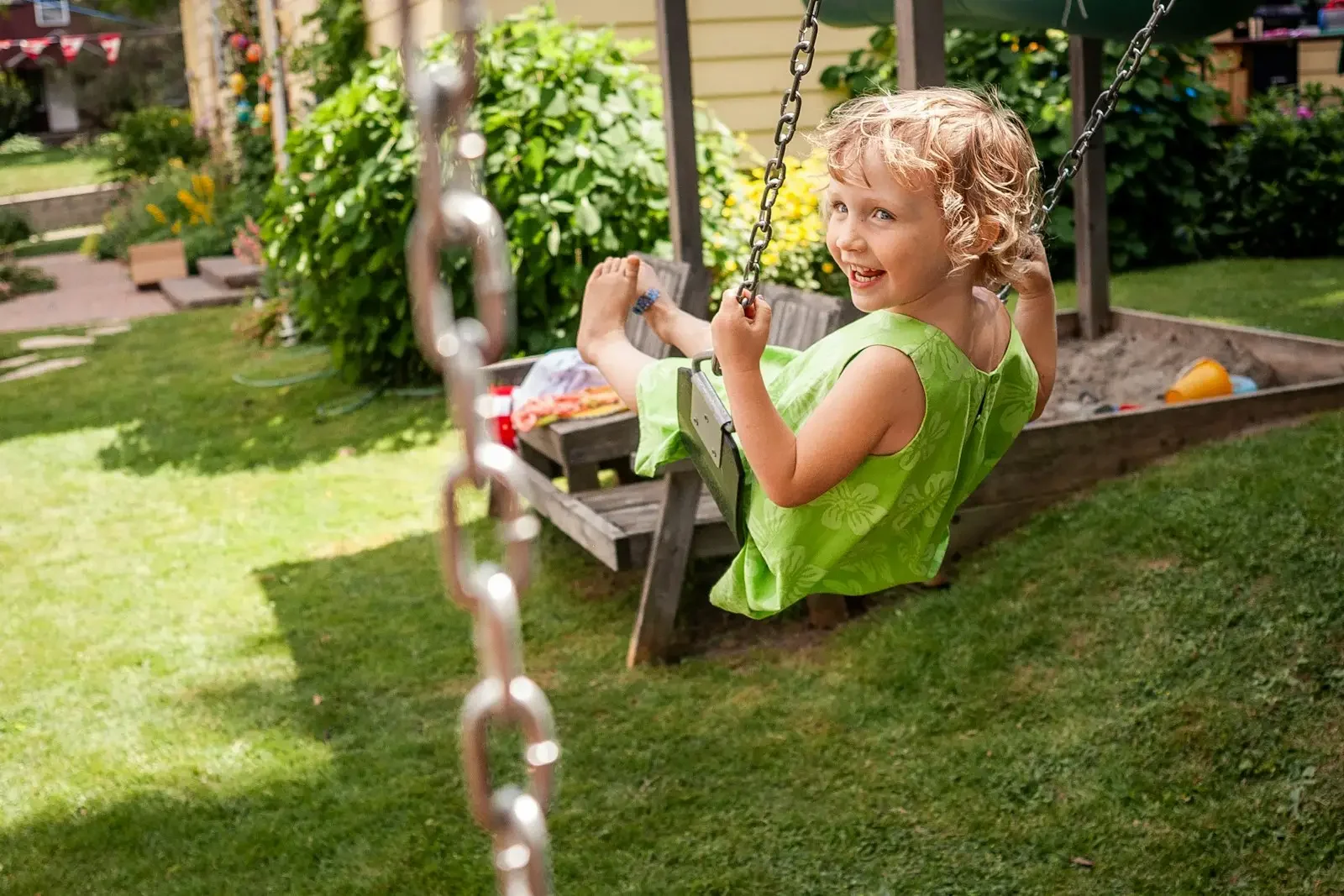
Watch a child of this age on a good structure and the route repeats with small edits each time. That is why a single tall tower with one slide holds attention for minutes while a compact set with three linked moves holds it for half an hour. The set does not need more equipment; it needs a closed route. A multi-function play set with a climbing panel, a deck and a slide usually outperforms three separate single-purpose pieces bought for the same money, because the child never has to leave the structure to find the next move.
| Element | What it delivers | What to check |
| Climbing frame with deck | Ladder, panel and platform; the anchor of the loop | Rung spacing, handhold height, guardrail height |
| Slide | The return leg that closes the route | Exit height, side wall depth, transition at the top |
| Belt swing | Self-propelled rhythm and balance work | Pivot height, seat type, front and rear clearance |
| Upper-body element | First real grip and hang work | Bar height and rung spacing against the age band |
| Pretend or sensory piece | Language, role play, a quiet landing point | Ground level, no fall height, drainage |
Treat the first four rows as the working structure and the last as the calm corner beside it. A set that offers only climbing, sliding and swinging produces a child who climbs, slides and stops.
Why Five Is the Hardest Age to Specify
Because a five-year-old belongs to two age bands at once. The CPSC Public Playground Safety Handbook, revised in July 2025, defines preschool-age as 2 through 5 years and school-age as 5 through 12 years, and states that the overlap between the groups is anticipated and provides a margin of safety.
That single sentence explains most of the confusion in this category. A structure built to the preschool band is not wrong for a five-year-old, and neither is one built to the school-age band. They simply permit different heights, and the gap is wide enough to change what the child can actually reach. The practical consequence for anyone writing a specification is that the band has to appear in the document. Suitable for ages 5 and up is not a specification. Conforms to the preschool age group limits is.
| Dimension | Preschool band (4 and 5 years) | School-age band |
| Horizontal ladder bar height | 60 in maximum | 84 in maximum |
| Rung spacing, center to center | 12 in maximum | 15 in maximum |
| Take-off platform for upper-body equipment | 18 in maximum | 36 in maximum |
| Guardrail top edge above platform | 29 in or higher | 38 in or higher |
| Barrier replaces guardrail when fall height exceeds | 30 in | 48 in |
The Numbers Behind the Two Bands
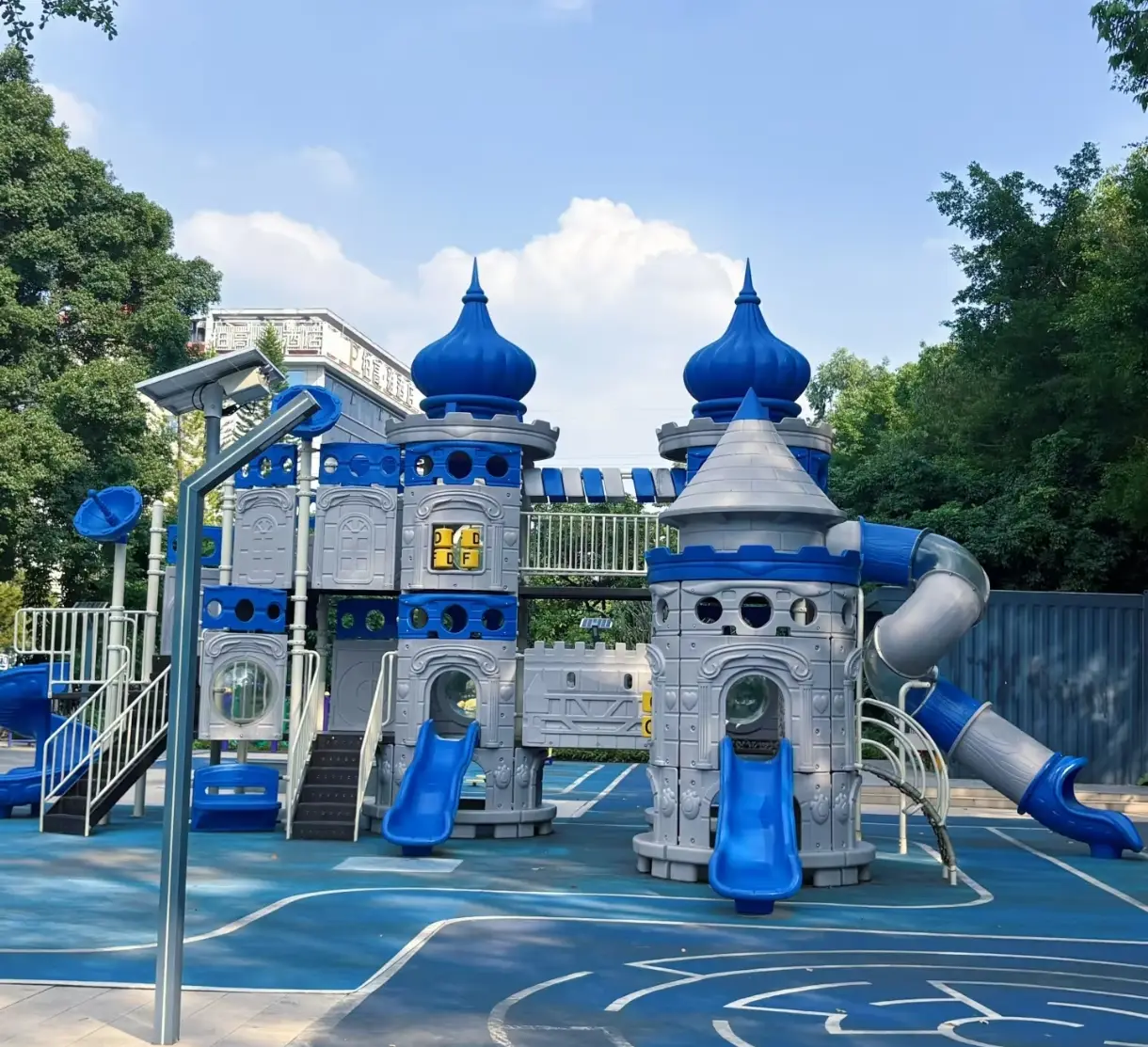
These figures also settle a question that comes up in almost every preschool project: can a five-year-old use monkey bars? On a structure built to the preschool band, yes, at a bar no higher than 60 in with rungs no more than 12 in apart and a mounting platform no higher than 18 in. On a school-age structure the same child is permitted a bar at 84 in. Both installations are compliant and only one is reachable, which is why a preschool combination slide looks under-scaled to the adults standing beside it and reads as exactly right to the children on it.
Two rules follow. Never accept a quotation that gives one age range spanning both bands without stating which limits apply. And if the site serves three- to six-year-olds, specify the preschool band for the shared structure and move genuinely school-age elements into a separate zone rather than stretching one structure across the gap.
How Much Room Does It Actually Need?
Clear space decides whether a set of outdoor play equipment fits: take the footprint, add 6 ft on all four sides, then add extra front and rear clearance for every swing equal to twice the vertical distance from the pivot to the ground.
The 6 ft figure is a floor and not a target. It applies to the sides of a single-axis swing and to stationary equipment, and it may overlap the side zone of an adjacent structure. The front and rear swing zones are stricter: they extend to twice the pivot height and must never overlap another use zone, including the use zone of a second swing bay. That single rule rules out more tight-yard layouts than any other clause in the handbook.
A worked example makes the arithmetic concrete. A combined frame measuring 8 x 10 ft with a swing beam 7 ft high needs 14 ft of clearance in front of and behind the beam instead of the 6 ft minimum, so the usable site is roughly 22 x 36 ft rather than the 80 sq ft the catalog quotes. That is close to ten times the footprint in area, and it is the number that decides whether a set belongs in a yard or in a playground.
The Vertical Requirement
The horizontal plan is only half of the problem. Fall height is measured from the highest designated play surface to the surface below it, not from the top of the frame, and the surfacing underneath must carry a critical height at least equal to that fall height. Loose fill at 9 in covers falls of roughly 8 ft. Turf, packed soil and asphalt do not count as protective surfacing at any depth. The base layer under loose fill matters as much as the fill itself, because without drainage the material compacts, loses depth and stops meeting its rated critical height inside a single season. The depth tables by material are set out in this guide to critical fall height surfacing.
Which Material and Build Quality Hold Up?
Material determines the maintenance routine; the connections determine the service life.
Two structures in the same polymer can differ by years in service because of how the deck is fixed to the post and how the slide is joined to the platform. Buyers who compare only material spec sheets are comparing the least variable part of the product.
| Material | Where it earns its place | Standing maintenance |
| Rotationally molded LLDPE | Panels, slides and play events at child height | Wash twice a year, watch for UV chalking |
| Hot-dip galvanized steel | Posts, swing beams, main frames | Touch up coating at ground line and welds |
| Preservative-treated timber | Decks, cladding, natural-themed units | Annual hardware check, inspect post bases for rot |
Three points fail first on any structure used daily by five-year-olds: the swing hangers, the slide exit where feet land, and the bolts joining deck to post. Specify stainless hardware with a locking element and a bolt length that allows one retightening after the first month, because a deck that loosens in week three and is never re-torqued is where most long-term wear starts. Below the hardware, check the ground line. A post that stands in water rots or corrodes from the base upward, and no coating specification survives a site that does not drain.
How Should a Group Setting Lay This Out?
Zone outdoor play equipment by competence rather than by age label, so that a five-year-old standing in one spot can see both a low-challenge area and the next tier up.
A yard that fences three-year-olds away from five-year-olds solves an adult problem and creates a child problem, because the five-year-old loses the chance to move down a level on a bad day and up a level on a good one. Run a graded sequence instead: ground-level sensory and role play at the quiet end, low climbers and a short slide in the middle, the shared deck and swing bay at the active end.
Capacity follows the same logic. Allow about 75 sq ft of usable play area per child, and count use zones as circulation rather than as play space. One deck with one slide realistically serves one child at a time on the slide and two or three on the deck, which is the arithmetic behind the queue at ten in the morning and the empty deck at two in the afternoon.
What Should Be Verified Before Purchase?
Ask for three documents: a test report against ASTM F1487-25, a surfacing report stating the critical height achieved, and an installation manual that shows the anchoring detail.
The first document shows the equipment was evaluated against the current edition of the public playground standard rather than an older one still quoted in many catalogs. Read the report date as well as the standard number, because a report issued against a superseded edition is still a report, just not one worth accepting. For European destinations the reference changes to the EN 1176 series, and a report to one standard does not substitute for the other. Anchoring any outdoor play equipment is the third item because it is the one most often dropped on site: surface-mounted feet on a slab, in-ground concrete footings in turf, and no mixing of the two on a single structure.
Then set the rhythm for after handover. A documented visual check before each session, a hardware check monthly for the first quarter, and a full inspection at every change of season. Written records matter more than the inspection itself when a licensing body or an insurer asks what was done and when.
FAQ
Three questions come up once the layout is settled and the specification is written.
Can a home-grade set be used in a daycare or preschool yard?
Generally no. Home outdoor play equipment is evaluated to a different standard, ASTM F1148, which assumes a few children in a private yard rather than a group under licensing. Using a home set in a licensed setting leaves a documentation gap: no report to the public playground standard, no stated user capacity, and no commercial anchoring detail. The equipment may look identical, but the paperwork is what a regulator will ask for, and the missing report is what gets written up after an incident rather than before one.
What fails first on equipment used daily by five-year-olds?
Swing hangers and their bushings, the slide exit where feet land and slow the child, and the deck-to-post hardware. All three take repeated shock rather than steady load. The consumables are the swing seats and the surfacing under the swing bay, which compacts and needs topping up more often than the rest of the site.
How long should a commercial set last in daily use?
Plan on 10 to 15 years for the structure and 5 to 8 years for the moving parts, with the surfacing replaced more often than either. The variable that moves those numbers most is not material but shade and drainage. A deck that stays wet through winter ages faster than one that dries, and a unit under trees needs more cleaning and less repainting.


