A playground is the most shared space most children touch in a week. The same slide handle, swing chain, and ball pit ball pass through dozens of small hands before lunch, and none of those hands get washed in between. For parents, that raises an obvious worry during cold and flu season. For operators, it raises a practical one: what does the cleaning schedule actually need to cover? For the owner of an indoor venue such as a trampoline park, the same question comes with higher stakes, because vinyl pads and foam blocks stay warm, dry, and heavily used all day.
On typical playground surfaces, most common viruses stay alive anywhere from a few hours to a few days, while norovirus can survive for about two weeks on hard plastic, so routine disinfection of high-touch playground equipment is the only reliable way to cut transmission between children.
The sections below explain the science behind those numbers, which pieces of equipment carry the most risk, and the cleaning routine that actually works in a busy play area.
How long do viruses stay alive on objects?
Most respiratory and stomach viruses stay alive on playground objects for a few hours to several days, and the exact survival time depends mainly on the virus type, the surface material, and the surrounding temperature and humidity.
This is the question behind the searches that bring parents here, and it is worth asking it precisely. “How long do viruses stay alive on objects?” has a different answer for a cold virus than for a stomach virus and a different answer again on plastic than on cloth. Knowing the range for each helps a facility decide how aggressive its routine needs to be.
Virus type matters more than people expect
Viruses split into two broad groups that behave differently on surfaces. Enveloped viruses, such as influenza and coronaviruses, carry a fatty outer layer that dries out and falls apart once moisture leaves. They tend to lose infectiousness within hours to a couple of days. Non-enveloped viruses, such as norovirus, rhinovirus, and rotavirus, are little more than a tough protein shell with genetic material inside. They survive drying, resist many disinfectants, and linger far longer.
| Virus or illness | Typical survival on hard surfaces | What shortens survival |
| Common cold coronaviruses | A few hours to a few days | Warm temperature, higher humidity |
| Influenza A | 24 to 48 hours on plastic and stainless steel | Humidity above 40 percent, sunlight |
| SARS-CoV-2 | Up to 72 hours on plastic, 48 hours on steel | Heat and direct UV light |
| Rhinovirus (common cold) | A few hours to a few days | Drying, porous materials |
| Norovirus | Up to about two weeks | Very little; needs bleach-based disinfection |
| Rotavirus | Days to weeks | Most ordinary cleaners only partially inactivate it |
| RSV | About six hours on hard surfaces | Dies quickly on skin and cloth |
The table reflects figures reported by public health agencies and peer-reviewed studies, including a widely cited New England Journal of Medicine study that measured viable SARS-CoV-2 for up to 72 hours on plastic and 48 hours on stainless steel. The United States Centers for Disease Control and Prevention similarly describes norovirus as able to survive on hard surfaces for up to two weeks.
Surface material and environment set the clock
The same virus lives for different lengths of time on different playground materials, which is why a facility that mixes plastic slides, coated steel frames, and foam padding faces a complex schedule.
- Non-porous surfaces such as plastic slides, coated steel, and vinyl hold moisture and can keep viruses infectious for hours to days.
- Porous surfaces such as fabric, rope, and unfinished wood dry out faster, which shortens survival for many respiratory viruses, but they trap moisture inside and are far harder to disinfect.
- Foam padding and ball pit balls sit in the middle: they hold moisture at the surface, giving viruses a longer window, and their texture makes wiping unreliable.
- Cool, dry air extends the survival of flu and coronaviruses, while warm, humid conditions shorten it for most enveloped viruses.
- Direct sunlight is the strongest natural killer. Ultraviolet light inactivates viruses on exposed surfaces in minutes to a few hours, but shaded crevices, underside rails, and indoor spaces never see that benefit.
These factors explain a common observation: the same playground can have very different virus loads in a sunny outdoor corner and in a shaded tunnel two meters away.
How long do viruses stay contagious on surfaces?
A virus can stay detectable on a surface long after it stops being contagious because viral load falls quickly once the virus dries, and most viruses lose the bulk of their infectivity within the first few hours.
Laboratory tests distinguish between finding viral genetic material and finding live virus. A swab can return a positive PCR result days after the last live virus died, which often leads to alarming headlines that do not match real risk. The practical measure is viability: how long the virus can still infect a person who touches the surface and then touches their eyes, nose, or mouth.
For most respiratory viruses, infectivity drops steeply in the first hours. The 72-hour figure for SARS-CoV-2 on plastic describes the outer limit of viable virus in a controlled lab sample, not a steady level of danger. By 24 hours the amount of infectious virus left on that plastic is a small fraction of the starting load. The same decay applies to influenza and cold viruses.
The exception is the stomach virus group. Norovirus needs a very small dose to cause illness; the CDC estimates as few as 18 virus particles can make a person sick, and it survives long enough on hard surfaces that a small missed spot can infect the next child. That is why facilities treat vomit and diarrhea incidents as urgent cleanup events rather than routine wipes.

Which playground equipment carries the most germs?
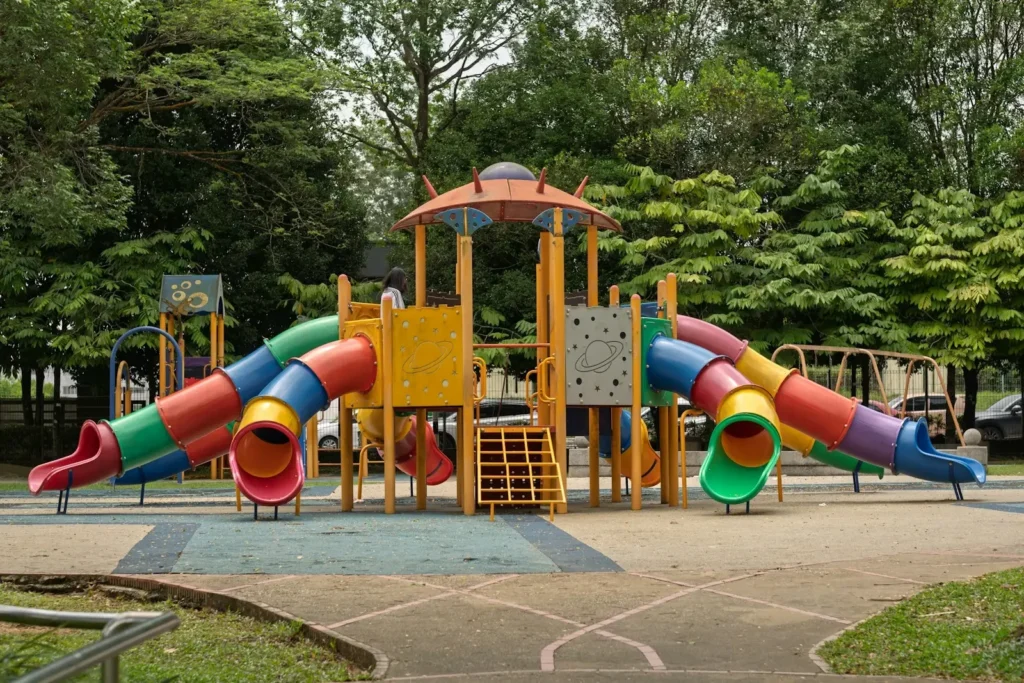
Slides, handrails, climbing grips, swing chains, and spinning rides are the highest-risk spots because hands touch them constantly and they are rarely cleaned between users.
Risk is not spread evenly across a playground. The pieces that get touched most, hold moisture, and see the most face contact deserve the most attention in the cleaning plan. A quick look at common playground equipment names shows the difference between a slide rail that every child grips and a spring rider that only one child uses at a time.
High-touch pieces on any playground
- Slide edges and the climbing ladder rails beside them, which every child grips on the way up.
- Swing chains and the rubber or plastic seats, which collect hand oils and mouth contact.
- Climbing frames, monkey bars, and tunnel openings, where grip surfaces are shared back to back.
- Ball pit balls, which are nearly impossible to wipe and are cleaned by the batch.
- Seesaw handles and spring rider handles, which sit at child height and get licked as often as they get gripped.
These items are the reason many operators rotate through zones with a checklist rather than spot-cleaning what looks dirty. For parents, the practical takeaway for playground equipment for kids is the same: wash hands or use sanitizer immediately after play, before snacks.
Spinning rides bring hands and faces together
Spinning equipment deserves its own category. When parents search for playground equipment that spins, they usually mean carousels, spinning bowls, and cup rides, and those are exactly the pieces that keep children in close contact while their hands grip the same rails. The motion also spreads respiratory droplets more easily than static play. Indoor spinning rides, including most electric amusement rides, also run in temperature-controlled rooms with recirculated air, so the surfaces around them rarely dry out. Operators should treat ride handlebars, seat edges, and restraint areas as daily disinfecting points rather than weekly ones.
Indoor and outdoor settings differ in real ways
The indoor versus outdoor split changes the risk profile more than any other single factor. Outdoor playgrounds get free disinfection from sunlight on exposed surfaces, and rain washes dust and some organisms off smooth plastic. But shaded slides, tunnels, and underside rails stay damp and cool, which helps viruses survive, and wood or rope structures trap moisture where sun cannot reach. When buyers compare outdoor playground equipment options, it is worth asking how much of each surface the sun actually reaches during a normal day.
Indoor facilities face the harder case. There is no UV light, temperatures are kept comfortable for children, and air is recirculated. Every surface stays at roughly the same temperature all day. Studies and public health guidance agree that enclosed, climate-controlled play areas need scheduled disinfection rather than relying on natural decay, which is why most indoor play centers adopt a written routine instead of an occasional wipe-down.
What kills a virus on surfaces?
Soap-and-water cleaning removes most viruses physically, and an EPA-registered disinfectant used at its listed contact time kills what remains; bleach and 70 percent alcohol cover most playground materials.
The question “what kills a virus on surfaces” has a two-part answer that many cleaning plans skip. The first step is cleaning, which lifts dirt, body oils, and the viruses hiding inside them. The second step is disinfecting, which inactivates viruses that remain on a visibly clean surface. Disinfectants cannot work through a layer of grime, so the order matters.
Match the disinfectant to the virus
| Disinfectant | Contact time | Best for | Practical notes |
| EPA-registered quaternary ammonium wipes | 30 seconds to 10 minutes, per label | Daily touch-ups on plastic and vinyl | Check the dwell time on the label |
| 70 percent isopropyl alcohol | About 1 minute | Enveloped viruses such as flu and coronaviruses | Evaporates fast; good for small surfaces |
| Bleach solution, about 1000 ppm | 1 to 5 minutes | General playground disinfection | Mix fresh daily; rinse from metal parts |
| Bleach solution, about 5000 ppm | About 5 minutes | Norovirus and vomit or diarrhea incidents | Strength recommended by the CDC for cleanup |
| Hydrogen peroxide wipes | 1 to 5 minutes | Non-enveloped viruses | Gentler on plastics than bleach |
The Environmental Protection Agency maintains a searchable list of registered disinfectants with their approved contact times, and the CDC publishes bleach mixing guidance for facilities that prefer bulk solutions.
The two-step rule that prevents failure
A disinfectant only works if the surface is clean first and stays wet for the full contact time. Dirt shields viruses from the chemical, and wiping a surface dry early cuts the contact time short. For a slide rail, the correct routine is to wipe away visible dirt, apply disinfectant, leave it wet for the time stated on the label, and then let it air dry. Facilities that skip the wet time get the habit without the result.
Sunlight and heat are helpers, not replacements
Direct UV light inactivates many enveloped viruses on exposed outdoor surfaces within minutes to a few hours, which is a genuine advantage for unshaded plastic slides. But viruses survive in shaded crevices, under seats, and inside tunnels, and non-enveloped viruses resist UV far better. Treat sun as a bonus and keep the scheduled disinfecting routine regardless of weather.
A practical cleaning routine for busy play areas
Clean and disinfect high-touch playground equipment at least once a day in normal operation, and move to multiple passes per day during cold and flu season or after any confirmed illness in a play session.
A realistic routine is built on frequency tiers rather than a single heroic deep clean. Daily passes handle the shared surfaces that carry most of the risk; weekly and monthly tasks catch the places where dirt and viruses accumulate slowly.
| Frequency | Tasks |
| Daily opening | Wipe slide edges, handrails, swing chains, and ride handles with a disinfectant matched to the surface |
| Daily midday | Repeat the high-touch pass in the busiest zones, especially near snack areas and restrooms |
| Daily closing | Full high-touch pass, plus spot cleaning of visible marks on padded floors |
| Weekly | Deep clean ball pits by the batch, wash foam padding and vinyl surfaces, vacuum tunnels |
| Monthly | Inspect for cracked surfaces and worn padding that trap dirt, and replace damaged parts |
| After incidents | Treat vomit or diarrhea as an immediate 5000 ppm bleach cleanup, not a routine wipe |
A staff checklist helps more than a general instruction. Assign each zone to a named person, rotate zones weekly so no one routine goes stale, and keep a dated log so the schedule is verifiable. Indoor trampoline parks and soft play centers typically operate at the top end of this range, because their surfaces are all climate-controlled, all shared, and all made of materials that hold moisture. When equipment is selected from the start with cleaning in mind, these tasks get faster, and the log gets shorter.
Choosing equipment that is easier to sanitize
Playground equipment built from smooth, non-porous materials, sealed foam, and corrosion-resistant hardware is faster and cheaper to keep clean, which lowers daily workload and the risk of transmission at the same time.
Surface design decides how effective a cleaning routine can be. A slide with a smooth, one-piece plastic bed dries quickly and wipes clean in seconds. The same slide with decorative crevices, rivet heads, or textured panels collects grime in every seam and needs a brush for each groove. Over a year of daily cleaning, the difference is hours of labor and a measurable difference in how often surfaces actually come out clean.
The features that matter most:
- Smooth, sealed, non-porous panels such as HDPE and coated steel, which resist absorption and wipe down without residue.
- Seams and fasteners that are capped or countersunk, so there are no exposed edges where moisture and dirt collect.
- Foam and vinyl padding that is sealed, not open-cell, and removable where possible so it can be washed rather than only wiped.
- Powder-coated or stainless hardware that does not corrode, because rust creates porous surfaces that are impossible to sanitize.
- Ball pits and loose parts designed to be emptied and washed in batches, with replacement stock available.
When a facility compares quotes from playground equipment companies, cleanability is a legitimate part of the specification, not a minor detail. Ask how each surface is sealed, whether padding comes off for washing, and how replacement panels are supplied when a surface wears out. The same logic applies to spinning rides and carousels, where grip areas see constant hand contact and need surfaces that can handle repeated disinfection without degrading.
The equipment our factory builds follows this approach as a design rule. Slide beds are formed as single smooth pieces; coated steel and sealed foam are standard on indoor and outdoor lines; fasteners are covered; and soft parts are built to be removed and washed. Maintenance teams tell us the daily pass on this equipment takes noticeably less time than on comparable units with more seams. If you are planning a new facility or upgrading an existing one and want to compare how different surfaces clean up, send us your layout and we will walk through the options. Start the conversation through Contact Us, and mention which zones you expect to see the heaviest traffic so we can point you to the right configuration.
Frequently asked questions
Does sunlight really kill viruses on playground equipment?
Direct ultraviolet light inactivates many enveloped viruses on exposed outdoor surfaces within minutes to a few hours, which is a real advantage for unshaded plastic slides. Survival under shade, on underside rails, and inside tunnels is much longer, and non-enveloped viruses such as norovirus resist UV far better, so sunlight should be treated as a bonus rather than a substitute for scheduled disinfection.
Can a child catch a stomach virus from playground equipment?
Yes. Norovirus and rotavirus survive on hard surfaces for days to weeks and need only a tiny dose to infect, and young children put hands in their mouths constantly, which makes playgrounds a realistic transmission point. This is why health agencies recommend a stronger bleach-based cleanup after any vomiting or diarrhea incident rather than routine wiping.
How do I disinfect a playground without harsh chemicals?
Start with plain soapy water, which removes most viruses physically, then follow with a hydrogen peroxide-based disinfectant or a quaternary ammonium wipe. These inactivate most common respiratory and stomach viruses while being gentler than bleach on plastics, paint, and vinyl. Save bleach for confirmed illness incidents where its stronger action is genuinely needed.