
Daycare and preschool procurement teams comparing classroom furniture quotations are routinely asked to prove that what they are buying is non-toxic, and suppliers routinely answer with a logo on a specification sheet. Two labels dominate those conversations: GREENGUARD, an emissions certification developed in North America, and EN 71, the European toy safety series. They answer different questions, they are enforced in different ways, and treating one as proof of the other is the most common specification error in childcare fit-outs.
No single standard makes daycare furniture non-toxic. GREENGUARD, and its stricter Gold tier, certifies that a finished product releases chemical emissions below defined limits into indoor air, so it addresses the inhalation route. EN 71-3 limits how much of nineteen elements can migrate out of coatings, plastics and metal parts that a child may mouth or swallow, so it addresses the ingestion and skin-contact route. Formaldehyde rules such as TSCA Title VI sit underneath both as legal limits, which means a defensible specification for daycare furniture normally needs air-emission evidence, material-migration evidence and legal compliance documents side by side.
This guide separates what each standard measures, where the actual limits sit, and how to audit a supplier’s evidence before a purchase order is signed.
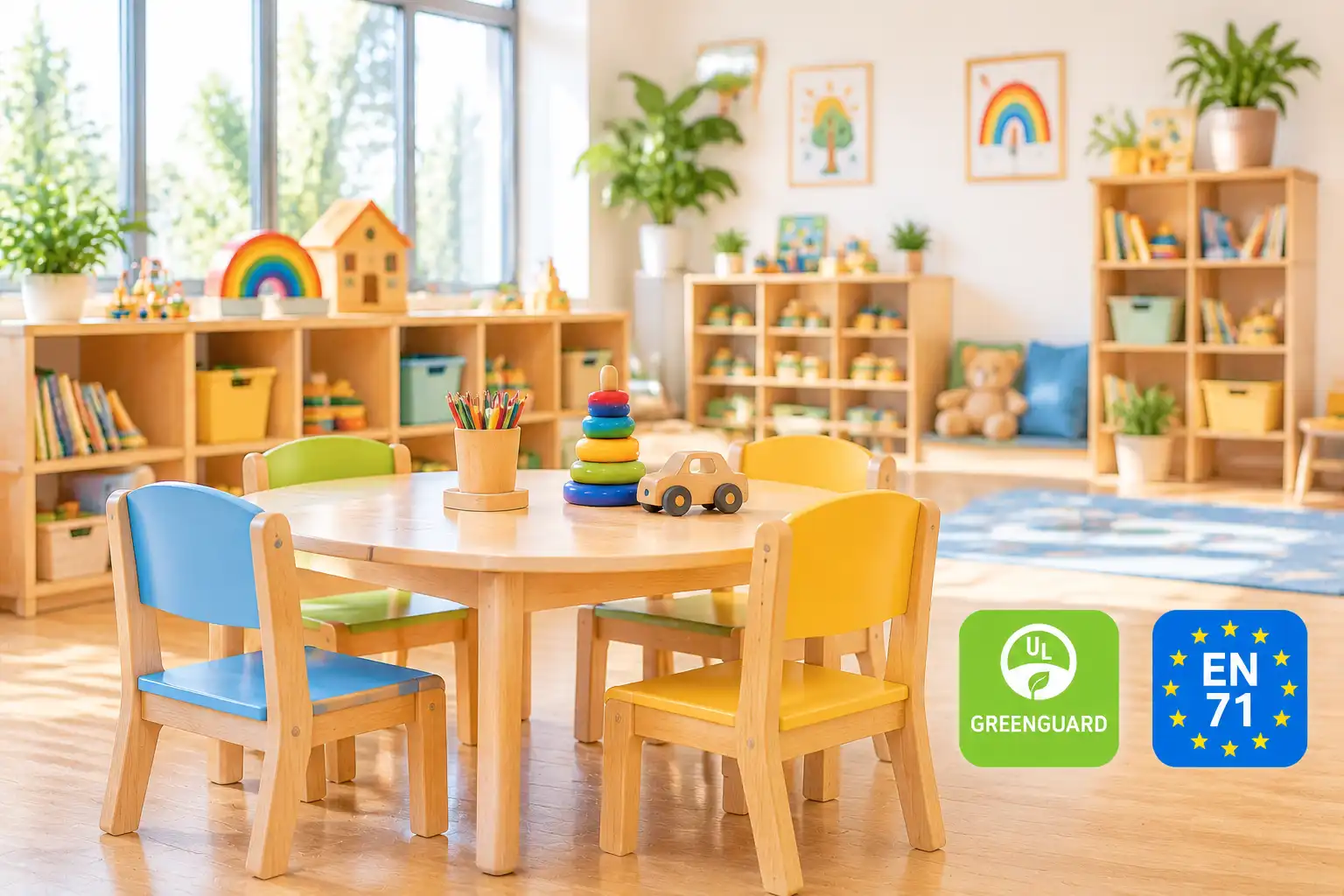
What Do GREENGUARD and EN 71 Actually Regulate?
They regulate different exposure routes. GREENGUARD measures what a finished product releases into room air over time, which is an indoor air quality question. EN 71 measures what a child can absorb from direct contact with materials, including mouthing, scratching and swallowing, which is a material safety question. A product can pass one and fail the other, so neither can stand in for the other in a tender.
The distinction matters because daycare furniture is used by children who spend six to ten hours a day in the same room, at floor level, with hands and mouths on every surface. Inhalation exposure builds up slowly from the whole room, while contact exposure is concentrated on the specific parts a child reaches. Different standards, different sampling, different failure modes.
| Standard | What it measures | Exposure route | Typical market | Legal status |
| GREENGUARD / Gold | VOC and aldehyde emissions from the finished product | Inhalation | North America, specified worldwide | Voluntary, third party |
| EN 71-1 | Mechanical and physical hazards | Contact, entrapment | EU and UK | Harmonised under EU toy law |
| EN 71-2 | Flammability of materials | Fire | EU and UK | Harmonised under EU toy law |
| EN 71-3 | Migration of nineteen elements | Mouthing, skin contact | EU and UK, referenced globally | Harmonised under EU toy law |
| TSCA Title VI | Formaldehyde from composite wood | Inhalation | United States | Mandatory federal rule |
What Does GREENGUARD Certification Require for Daycare Furniture?
A representative production unit is placed in a dynamic environmental chamber and air samples are drawn over a defined period. Emissions of formaldehyde, total VOCs, total aldehydes and hundreds of individual compounds are then modelled against a classroom exposure scenario, and certification is granted only if every value stays under the published limits of the UL 2818 standard, measured by the UL 2821 test method.
For classroom furniture the model is unusually specific: a room of 231 cubic metres at 0.82 air changes per hour holding 27 students. That is why the label is quoted so often in school and nursery projects. Certification is issued to a manufacturer for named models built at a named factory, published in UL’s public database with a number and an expiry date, and renewed annually with periodic retesting. It is not legally required for daycare furniture anywhere, so its force comes entirely from what buyers write into their specifications.
| GREENGUARD Gold criterion | Maximum allowable level |
| Total VOCs | 0.22 mg/m3 |
| Formaldehyde | 9 ug/m3, about 7.3 ppb |
| Total aldehydes | 0.043 ppm |
| 4-phenylcyclohexene | 6.5 ug/m3 |
| 1-methyl-2-pyrrolidinone | 160 ug/m3 |
| Individual VOCs | Lower of half the chronic reference exposure level or one hundredth of the workplace threshold |
GREENGUARD and GREENGUARD Gold Are Not the Same Tier
The base certificate allows total VOCs up to 0.5 mg/m3, formaldehyde up to 50 ppb and total aldehydes up to 100 ppb, and it is written for general commercial interiors. Gold roughly halves those ceilings and adds compound-specific caps across more than 360 chemicals, which is the version aimed at schools, daycare centres and healthcare rooms. A spec sheet that says GREENGUARD certified without naming the tier does not demonstrate suitability for a room full of three-year-olds.
What the Certificate Does and Does Not Cover
It covers named models made at a named site with the tested board, foam, fabric and coating system. Change the lacquer, the foam grade or the panel supplier and the certificate no longer describes the item being shipped. It also says nothing about stability, structural strength, tip-over resistance or flammability, which live in separate standards. Buyers starting from a low-emission brief often shortlist ranges such as the green environmental protection series and then request the emission report for the exact models quoted.
What Does EN 71 Cover, and How Does EN 71-3 Reach Furniture?
EN 71 is a multi-part toy safety series: EN 71-1 covers mechanical and physical hazards, EN 71-2 covers flammability, and EN 71-3 limits the migration of nineteen elements from materials a child can reach. Daycare furniture is not legally a toy, but child-sized tables, painted surfaces and mouthable parts are routinely tested to EN 71-3 because the exposure is identical.
EN 71-3 is harmonised under the EU Toy Safety Directive 2009/48/EC, so for toys it is mandatory. For daycare furniture it is contractual rather than statutory, yet EU buyers, inspectors and insurers treat it as the default reference for any coated or plastic surface in a childcare room. The test classifies materials into three categories; coatings, rigid plastics and plated hardware usually fall into category III, the scraped-off material group. Samples are extracted in hydrochloric acid at 37 C for about one hour and analysed by inductively coupled plasma mass spectrometry.
| Element | Category III limit, mg/kg |
| Lead | 23 |
| Cadmium | 17 |
| Mercury | 60 |
| Arsenic | 47 |
| Chromium III | 460 |
| Chromium VI | 0.053 |
| Barium | 18750 |
| Antimony | 560 |
Two practical points follow. Metal frames, plated screws, edge trims and handle inserts are accessible materials, so a report that covers only the wooden top is incomplete. Foam components carry their own requirement: EN 71-15 caps formamide at 200 mg/kg, which matters for soft blocks, mats and padded benches.
Where Do Formaldehyde Limits Come From Outside GREENGUARD?
Formaldehyde is regulated as well as certified. In the United States, TSCA Title VI sets mandatory emission limits for composite wood products and for furniture built from them. In Europe, REACH restrictions and the EN 717-1 chamber method do comparable work. A GREENGUARD Gold certificate is performance evidence and does not discharge those legal limits.
The regulated limits apply to the panel, not the finished chair, which is where procurement often loses the thread.
| Panel type | TSCA Title VI limit, ppm |
| Hardwood plywood | 0.05 |
| Particleboard | 0.09 |
| Medium density fiberboard | 0.11 |
| Thin medium density fiberboard | 0.13 |
Solid wood avoids panel limits but not the adhesives, sealants and edge treatments around it. A supplier claim of E1 or E0 board describes the panel, while the emission of finished daycare furniture depends on total exposed surface area, how well edges are sealed, and how completely the coating has cured.
How Do US and EU Requirements Differ for the Same Product?
The United States regulates the product and its paperwork; the European Union regulates the substances and their migration. A US-bound children’s chair needs CPSIA lead compliance and a Children’s Product Certificate. An EU-bound chair needs REACH conformity, EN 71-3 migration data and a declaration of conformity. Neither document set substitutes for the other, so daycare furniture sold in both markets carries two compliance files.
The lead thresholds are the clearest example. Under 16 CFR Part 1303, paint and similar surface coatings may not exceed 0.009 percent lead by weight, which is 90 ppm, while accessible substrate materials are generally capped at 100 ppm under CPSIA. Those figures come from a federal regulation and a certificate must be backed by testing at an accepted third-party laboratory.
| Requirement | United States | European Union |
| Chemical basis | CPSIA lead limits and applicable children’s product rules | REACH Annex XVII restrictions plus EN 71-3 migration limits |
| Conformity document | Children’s Product Certificate issued by manufacturer or importer | Declaration of conformity, CE marking where applicable |
| Testing | Third-party laboratory accepted by the CPSC | Accredited laboratory report against harmonised standards |
| Enforcement | Consumer Product Safety Commission | National market surveillance authorities |
Play structures are governed separately, by ASTM F1487 and EN 1176, which run alongside furniture standards rather than replacing them. A room that mixes climbing equipment with tables and storage needs both sets of evidence.
Which Furniture Items Need Which Standard?
Requirements follow the item, not the room. Tables and chairs, soft seating, nap cots, storage and floor mats each sit under a different mix of product rules and voluntary standards, so one compliance statement covering an entire daycare furniture fit-out is almost always too vague to audit.
| Item | Primary requirement | Additional evidence |
| Child tables and chairs | CPSIA in the US; EN 1729 dimensions, strength and stability in the EU | EN 71-3 on coatings, GREENGUARD Gold |
| Soft seating and cushions | Flammability under 16 CFR Part 1640 | GREENGUARD Gold, EN 71-15 formamide |
| Nap cots and cribs | EN 716 and EN 1130 in the EU, applicable crib rules in the US | EN 71-3, formaldehyde data |
| Storage and shelving | Tip-over resistance and wall fixing | TSCA Title VI, GREENGUARD |
| Floor mats and play surfaces | Slip resistance and impact absorption | EN 71-15, emission data |
Design determines the rule. Folding chairs and stools fall under 16 CFR Part 1232 with ASTM F2613, changing tables under 16 CFR Part 1235 with ASTM F2388, and high chairs under 16 CFR Part 1231 with ASTM F404. When a single order mixes these with ordinary classroom seating, specify to the strictest item rather than the average.
How Should Buyers Verify a Non-Toxic Claim?
Ask for the certificate number, the exact model list, the issue and expiry dates, and the underlying laboratory report. A logo on a brochure proves nothing. The evidence lives in a database entry and a test report that name the product, the method, the sample and the date.
A five-step check covers most of the risk when ordering daycare furniture:
- Match the certificate to the model code being quoted, not to the product family name.
- Confirm the certificate holder and manufacturing site match the supplier on the purchase order.
- Confirm the tier, Gold or standard, and the version year of the standard cited.
- Request the full report, including laboratory accreditation, method, sample description and test date.
- Ask in writing how material changes are notified and whether the certificate is reissued after a change.
Certificates expire, and a document dated three years ago may describe a product that no longer exists in that form. Renewal status is a legitimate question in a tender response.
Where Do These Standards Stop Short?
Certification describes a product at a point in time under a modelled scenario. It does not describe the room. Ventilation rate, furniture density per square metre, cleaning chemistry, humidity and the age of the installation all change real exposure, which is why certified daycare furniture can still sit in a space with poor indoor air.
Freshly installed rooms need a flush-out period, and cleaning agents can leave residues on exactly the surfaces children touch most. Specification is therefore only half of the control; the other half is a routine that includes inspection, cleaning records and periodic retesting, which is the same logic behind published daily operation and maintenance guidelines for childcare and play environments.
FAQ
Three questions come up after the specification is agreed, and each sits outside the standards themselves.
How long should new daycare furniture air out before the room is used?
There is no fixed number, because the answer depends on ventilation, temperature and how much furniture is packed into the room. A practical routine is one to two weeks of continuous ventilation at elevated temperature before occupancy, with the room kept off the daily schedule. If a sharp odour persists beyond that window, request a retest rather than assuming the product is at fault, since coatings and adhesives cure at different rates.
Does certification add cost or lead time to a daycare furniture order?
Chamber testing typically takes a few weeks and certificates carry annual maintenance fees, but the larger cost sits in the materials rather than the test. Projects that require the Gold tier often need no-added-formaldehyde panel, water-based coating and controlled edge sealing, which changes unit price and production scheduling more than the certification process itself. Retrofitting a standard product line is rarely economical.
Is EN 71 relevant if daycare furniture is sold outside Europe?
It is widely used as a benchmark. Tender documents in the Gulf, Southeast Asia and Australia frequently cite EN 71-3 because the limits are familiar and easy to compare across suppliers, even where local toy regulations differ. Sellers should still check national children’s product rules and any labelling requirements, and treat the European standard as supporting evidence rather than a substitute for local compliance.


