A soft play project produces paperwork before it produces children. Mall developers, insurers, and franchise teams ask for safety documents before approving a site, and the first file a buyer receives often names the wrong standard: outdoor playground rules copied onto a fully enclosed indoor structure, or a certificate with no standard number on it. A test report is only as strong as the factory process behind it, so buyers now ask how amusement equipment manufacturing standards are documented at the source.
Soft play areas are not covered by the playground standard most buyers quote first. In North America the relevant document is ASTM F1918, the safety performance specification for soft contained play equipment. In Europe it is EN 1176-10 for fully enclosed play equipment, read with EN 1177 for surfacing. ASTM F1487 covers playground equipment for public use and excludes soft contained play, though it still applies to open public-use components inside a commercial venue.
The sections below cover what each standard contains and which documents to request before you pay a deposit.
Do soft play areas need different standards from outdoor playgrounds?
Yes. A soft play area is fully enclosed and built from pliable materials, so containment replaces open fall zones, padding replaces clearance, and supervision visibility becomes a design requirement rather than an assumption.
What counts as soft contained play equipment?
The U.S. Consumer Product Safety Commission defines soft contained play equipment as structures where the user enters a fully enclosed play environment built from pliable materials such as plastic, netting, or fabric. Ball pits, padded climbing frames, enclosed tube slides, and netted towers all fall inside it.
The same agency’s Public Playground Safety Handbook states that its guidelines are not intended for soft contained play equipment, then lists ASTM F1918 among the related standards. The most cited U.S. playground document steps aside for this category.
Where the wrong standard shows up later
A mismatch rarely appears in the showroom. It appears later and always as a documentation problem.
- Customs, where documents naming the wrong standard or model trigger a hold.
- Insurance, where an underwriter’s named standard cannot be traced to the equipment.
- Landlord or franchise approval, where a file naming an untested standard fails review.
Which ASTM standards apply to soft play in North America?
ASTM F1918 is the primary equipment standard for soft contained play. ASTM F1487 applies to public-use playground equipment and excludes soft contained play. Surfacing, toddler zones, and home products each have their own specifications, and one project can touch four or five of them.
ASTM F1918 and what it actually covers
ASTM F1918, currently issued as F1918-21, sets safety and performance requirements for soft contained play equipment, aiming to reduce life-threatening and debilitating injuries. Its user range runs from the 5th percentile two-year-old to the 95th percentile twelve-year-old.
It covers materials, performance, access and egress, structural integrity, maintenance, fire safety, and evacuation. Reports are issued per configuration rather than as a catalogue-wide certificate.
ASTM F1487: when it still applies
F1487-25, issued in June 2025, covers playground equipment for public use, including entrapment, structural integrity, and clearance zones. It matters when a mixed facility adds open public-use equipment beside the enclosed structure, or when an indoor site gains an outdoor extension, and those elements need their own F1487 report.
Surfacing, loose fill, and toddler zones
ASTM F1292 sets impact attenuation testing in g-max and Head Injury Criterion values at 200 or lower for g-max and 1,000 or lower for HIC, so flooring is quoted by critical fall height. ASTM F2373-24 covers equipment for children from 6 to 23 months, with lower fall heights, toddler-sized barriers, and dedicated entrapment probes. A venue with a baby area therefore carries more than one standard, because indoor playground equipment for kids of different ages is judged differently.
| Standard | What it covers | Relevance to a soft play area |
|---|---|---|
| ASTM F1918-21 | Soft contained play equipment | Primary equipment standard |
| ASTM F1487-25 | Playground equipment for public use | Open public-use components outside the enclosed structure |
| ASTM F1292-22 | Impact attenuation of surfacing | Indoor flooring under and around the structure |
| ASTM F2373-24 | Equipment for children 6 to 23 months | Toddler zones, barriers, and probes |
What does EN 1176 require for soft play in Europe?
EN 1176 is a multi-part European standard for playground equipment and surfacing. Soft play areas fall mainly under Part 1 for general safety requirements and Part 10 for fully enclosed play equipment, supported by EN 1177 for surfacing. It is voluntary rather than law, but inspectors, insurers, and courts treat it as the expected standard of care.
How the EN 1176 series is organized
Four parts do most of the work indoors.
- Part 1: general safety requirements and test methods, including entrapment geometry. The 2024 edition incorporates Amendment A1:2023.
- Part 7: installation, inspection, maintenance, and operation, and the basis for routine and annual inspections.
- Part 10: fully enclosed play equipment, the closest European equivalent to a soft play structure, covering multi-level design, visibility, fire safety, and impact protection.
- Part 11: spatial networks, used to assess large climbing nets and net tunnels.
Parts 2 to 6 cover swings, slides, carousels, and rocking equipment.
EN 1177 and critical fall height
EN 1177 sets the test method for impact-attenuating surfacing and expresses the result as a critical fall height: the maximum drop at which head injury risk stays within accepted limits, under a HIC of 1,000. The flooring’s critical fall height must meet or exceed the free fall height of the highest accessible surface. Loose-fill material needs regular topping up, because depth is what delivers the rating.
What “EN 1176 compliant” should say
A usable document names the parts and editions, such as EN 1176-1:2024 with EN 1176-10:2024, pairs them with EN 1177, and identifies the tested model and configuration. Two documents are often confused with compliance: a Declaration of Conformity, the manufacturer’s statement against named standards, and a CE mark, which applies where EU legislation requires it and does not confirm EN 1176 compliance.
| Item | ASTM framework | EN framework |
|---|---|---|
| Issuing body | ASTM International, committee F15 | CEN, the European Committee for Standardization |
| Structure | Separate standards by product type | One multi-part series, Parts 1 to 11 |
| Soft play document | ASTM F1918 | EN 1176-10, read with EN 1176-1 |
| Surfacing | ASTM F1292 | EN 1177 |
| Legal status | Voluntary; referenced by CPSC and many local authorities | Voluntary harmonised standard; treated as the expected level of care |
| Main markets | United States and markets that reference ASTM | European Union, United Kingdom, and markets that have adopted EN |
Beyond the equipment standard: fire, chemical, and market access rules
Equipment standards are only part of the file. Foam, vinyl covers, and netting must meet fire performance rules, accessible plastics and coatings must meet chemical limits, and the shipment must satisfy the market access requirements of the destination country.
Fire performance is tested on materials rather than structures, and markets name different tests: NFPA 701 in the United States for textiles and films, BS 5852 in the United Kingdom for foam and upholstered components, and EN 13501-1 in the EU for reaction-to-fire classification.
Chemicals fall under children’s product law. In the United States, the Consumer Product Safety Improvement Act caps lead and restricts eight phthalates to 0.1 percent in plasticized components. In the EU, REACH restricts hazardous substances and requires notification when a substance of very high concern exceeds 0.1 percent, while EN 71-3 sets migration limits for elements in toy materials.
Market access paperwork, and where home soft play differs
Since 13 December 2024, the EU General Product Safety Regulation, Regulation (EU) 2023/988, has applied to consumer products placed on the European market, requiring a responsible person in the EU, traceable identification, and technical documentation. An equipment test report covers none of that.
Home products follow a different track. A home climbing set or foam mat is not a commercial soft play area, and an ASTM F1918 report does not apply to it; home playground equipment sits under ASTM F1148, with toy and chemical rules layered on top. Buyers sourcing indoor playground equipment for home use should ask for documents that match the product.
Which certification actually proves the equipment was tested?
A certificate on its own proves little. What counts is a report from an independent, accredited laboratory naming the standard, its edition, and the exact configuration tested. In the United States, third-party programs verify equipment against specific ASTM standards; the program run by the International Play Equipment Manufacturers Association certifies to ASTM F1487-25, ASTM F1292-22, ASTM F2075-26, and CSA Z614:20. Soft contained play equipment is assessed against ASTM F1918 by accredited laboratories and is not on that published list.
Third-party programs and accredited laboratories
Two questions separate verification from decoration. Is the certification body independent of the manufacturer, since a supplier issuing its own report is not third-party verification? And does the laboratory’s ISO/IEC 17025 accreditation scope cover that specific test method?
What a valid soft play test report must show
- Product name, model, and tested configuration, including dimensions and age group.
- The standard designation and edition, such as ASTM F1918-21 or EN 1176-10:2024.
- The laboratory’s name, accreditation number, and scope.
- Test dates, report number, and results against each applicable clause.
- Drawings or photographs of the tested assembly, so an inspector can match the delivered structure to the report.
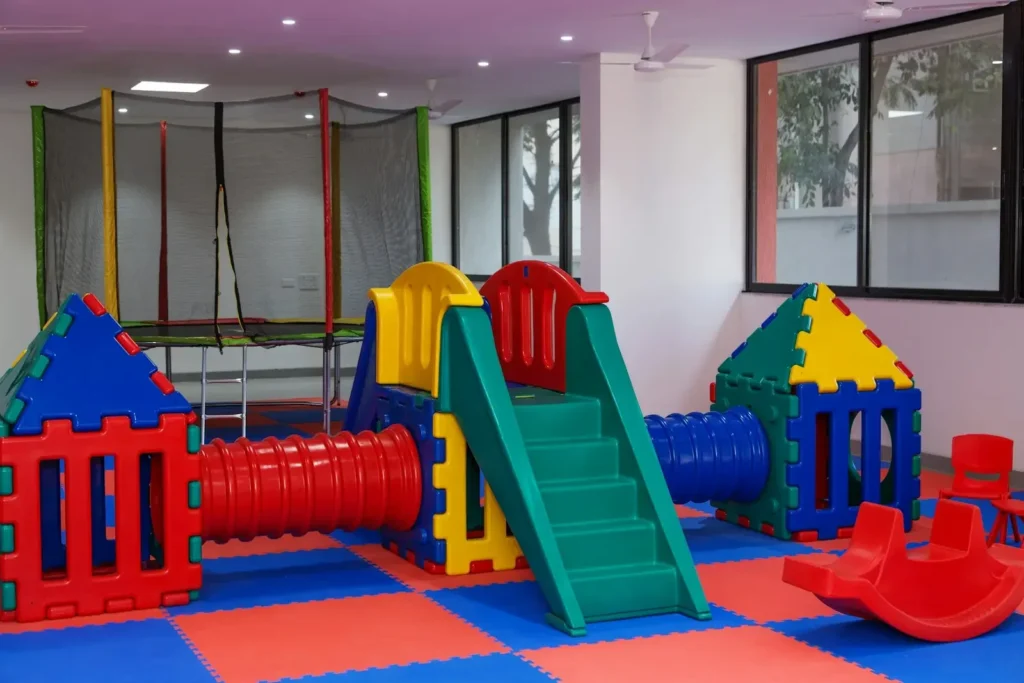
A report written for one structure does not carry over to a different model or layout, even within the same colorful series, Naughty Castle Range, because the tested configuration is part of what was approved.
Compliance file checklist before you pay a deposit
| Document | What it should state | Common gap |
|---|---|---|
| Equipment test report | Standard, edition, model, configuration, results | The report covers a different configuration than the one ordered |
| Surfacing test report | ASTM F1292 or EN 1177, critical fall height achieved | Flooring tested separately from the structure height |
| Toddler zone documentation | ASTM F2373, where the zone serves children under two | The baby area inherited school-age assumptions |
| Fire performance evidence | The test standard used for foam, covers, and netting | No report for the netting or the vinyl cover |
| Chemical documentation | Lead and phthalate limits, volatile substance screening | Reports for paint only, nothing for plasticized parts |
How the standards you choose affect cost, design, and schedule
Standards change drawings, materials, and the number of tests, so they change cost long before anything is shipped. A project built to one market’s rules costs less to certify than one built for two, and the cheapest way to lose that saving is to choose the destination market after the structure has been designed.
Where the money goes in a certified build
When buyers compare quotes for a soft play area for sale, the gap between highest and lowest usually sits in four places: the grade of the impact-attenuating soft play flooring, the density and fire treatment of foam and covers, the specification of netting, and the volume of testing and documentation included. Flooring is often priced separately from the structure, and it is the item most easily downgraded to reach a headline figure.
Indoor playground equipment cost moves with footprint, clear height, age mix, and port, so compare quotes item by item against one specification rather than by total. An indoor playground equipment manufacturer that quotes against a stated standard and lists the included reports is easier to compare than one quoting a lump sum, and the same applies to soft play equipment wholesale orders split across sites.
Multi-market and multi-phase projects
Two decisions made at the design stage set the testing bill: the destination market, because a venue serving both the United States and the EU is normally tested against both frameworks, and whether the layout is fixed before production. Any change to levels, slides, or containment after testing invalidates the report, so soft play builders keep tested and as-built drawings identical.
If you are comparing quotes for a soft play project, send the site plan, the destination market, and the expected age groups, and our team will confirm which standard set and which documents the project needs.
FAQ
Is EN 1176 or ASTM F1918 a legal requirement or voluntary?
Both are voluntary consensus standards. No federal rule in the United States requires ASTM F1918, but building departments, insurers, and franchise agreements routinely ask for documented compliance. In the EU, EN 1176 is harmonised rather than mandatory, yet equipment that fails it is treated as evidence of negligence after an accident.
Does a soft play area need new certification after a renovation or layout change?
It depends on whether the change alters the tested configuration. Adding a play level, moving a slide, or changing containment normally requires reassessment. Replacing a worn mat with the certified model usually does not, provided it matches the tested specification. Either way, log the change.
What happens at customs if the paperwork names the wrong standard?
A mismatch between the documents and the actual product is what triggers a hold, and the remedy is documentary. The standard, its edition, and the model should appear consistently on the technical file, the invoice, and the packing list, and the EU responsible person should review the set before the container leaves the factory.