
Nearly every park, kindergarten and community playground has one piece of equipment that draws children’s immediate attention, and that piece is almost always the slide. Procurement staff, architects and facility managers often use different terms to describe slides during project bidding. Some refer to slides by shape, some by method of installation, and others by function. This naming confusion frequently occurs when budgeting for outdoor playground equipment. The name listed on drawing documents determines which safety standard applies, which catalog item the quotation references, whether the unit is delivered as separate components or pre‑assembled integrated play systems, and what foundation requirements will be needed for installation.
On most public playground sites, slides fall into two broad categories: standalone single‑function slides and composite integrated slides that attach to multi‑level play towers. Suppliers across Europe, Southeast Asia and Australia usually refer to them as freestanding slide units and slide attachments. Specifiers often use the general term sliding play equipment before finalizing exact model selection for a project.
Marketing names carry less weight than actual structural mechanics. To make better purchasing decisions, start with how slides work and how children interact with them.
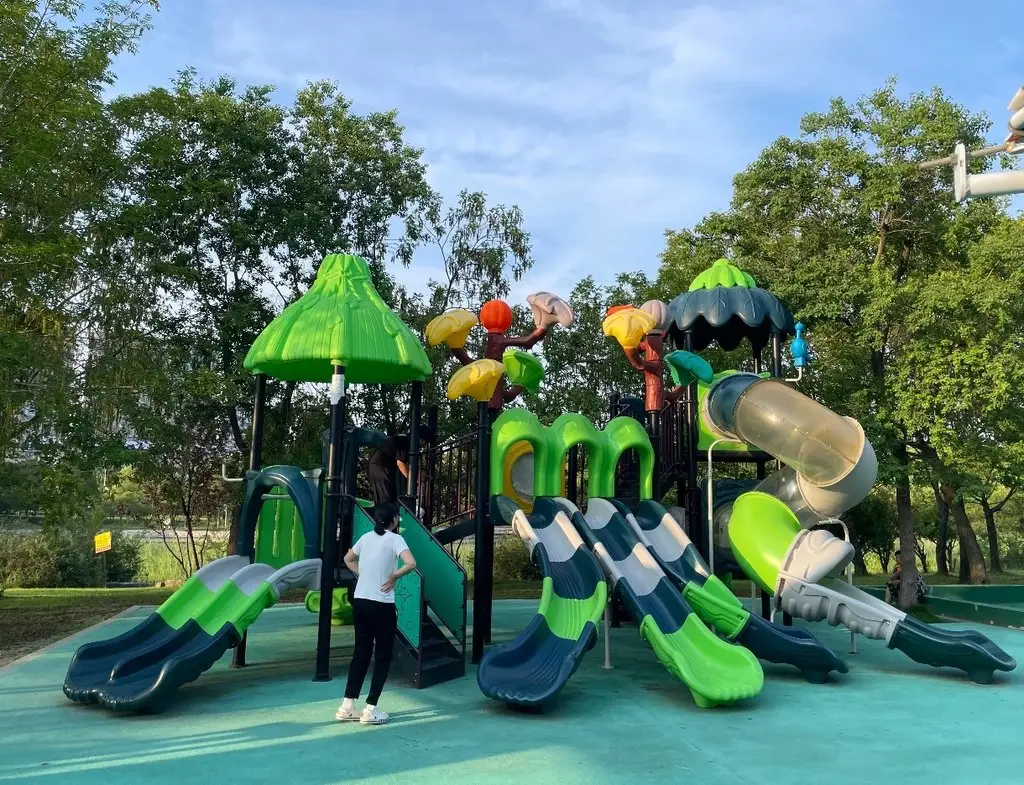
What Is the Sliding Equipment on Playgrounds Actually Called?
Ask ten playground practitioners and you will get four or five different names, as titles mostly depend on slide shape and assembly form. A slide fixed independently on the ground without connecting to other play towers is a freestanding slide; a sliding lane built as part of multi‑level play structures is an integrated composite slide. Both belong to the larger purchasing category: sliding play equipment.
| What people call it | What it actually describes | Where the term is common |
|---|---|---|
| Straight slide | Flat open sliding lane with linear downward slope | Global public park and kindergarten projects |
| Spiral / curved slide | Helical winding sliding surface, partial or full circular turn | Commercial amusement and large community venues |
| Tube slide | Fully enclosed tunnel‑style sliding channel | Indoor‑outdoor combined play areas |
| Double‑lane slide | Wide platform with two parallel sliding paths for multiple kids | Preschool and high‑traffic public playgrounds |
| Wave slide | Sliding surface with gentle undulating profile | Supplier catalogs and specification documents |
| Composite play‑tower slide | Slide integrated with climbing ladders, platforms and panels as one unit | Most tender documents for public playground renovation |
Misunderstandings often come from the last entry. A slide attachment bolted onto an existing play tower is a component, not a complete standalone sliding unit. Its safety assessment differs greatly from freestanding slides with independent support frames. When communicating your requirement to suppliers, avoid vague nicknames and answer three practical questions instead: how many children will slide at one time, is this slide going to be freestanding or attached to a play structure, and does the site require permanent ground anchoring or portable installation.
Which Main Types of Playground Slides Are Available Today?
Six mainstream slide designs cover most commercial playground sales. Riding posture, fall‑height and intended age range are far more important than marketing names; these indicators define capacity, supervision needs and applicable crowd.
| Design Type | Riding Posture | Typical Capacity | Usual Age Band |
|---|---|---|---|
| Straight open slide | Sit facing forward, feet first | 1‑2 children sequentially | Preschool to school‑age |
| Spiral curved slide | Seated forward inside a curved lane | 1 child at a time | 5‑12 years old |
| Enclosed tube slide | Seated inside a closed tunnel channel | 1 child at a time | 5‑12 years old |
| Double‑lane wide slide | Side‑by‑side sitting, feet forward | 2‑4 simultaneous riders | Preschool & school‑age |
| Wave undulating slide | Forward seated over rolling surface | 1‑2 children | 4‑10 years old |
| Composite tower‑mounted slide | Access via internal climbing ladder & platform | Sequential multi‑user flow | 3‑12 years old |
Slide construction follows mature industry patterns. Sliding surfaces are molded from HDPE high‑density polyethylene or fiberglass FRP. Support frames adopt hot‑dip galvanized steel. Connection fasteners use 304 stainless‑steel anti‑theft lock screws. Where composite slides are used, platform decks are built with anti‑slip textured panels. The quality of sliding surface material and frame welding determines how well equipment performs after years of heavy public‑use. Before confirming color choices, buyers should confirm UV‑stabilization grade and spare‑part reference numbers. You can read further comparison in this guide about playground equipment materials.
Why Do Kids Love Sliding, and What Developmental Benefits Do Slides Bring?
Sliding exercise helps develop children’s vestibular sense, gross motor coordination, spatial awareness and physical confidence. Children actively seek sliding experiences because their proprioceptive and balance systems are still growing and calibrating. Obvious developmental gains include leg‑arm muscle strength, balance judgment, body‑position awareness, plus social‑skill practice through turn‑taking.
When kids climb ladders upward, they build limb strength and coordination. While gliding down the slope, children process speed, distance and spatial feedback combining sight and physical sensation. Young children’s reaction to sliding speed differs from that of teenagers and adults; many kids will want repeated runs down the slide right after finishing one descent.
Social development is equally meaningful. Children must queue, wait for the bottom landing zone to clear, and observe basic safety rules to avoid collisions. Group play on double‑lane slides teaches sharing and turn‑taking. While slides support sensory‑motor play for children, clinical evidence for pure therapeutic treatment effects remains limited. You may reference developmental benefits in planning documents, but avoid overstated medical‑therapy claims.
How Are Slides Categorized Within the Broader Playground Equipment System?
Public playground equipment can be sorted into two major groups: stationary play equipment and motion‑type play equipment. Slides belong to motion‑type categories. Other moving‑play families include swinging, rotating, seesawing and spring rocking equipment.
| Family Group | Typical Examples | Movement Characteristic |
|---|---|---|
| Stationary climbing equipment | Net climbers, boulders, overhead ladders, balance beams | Child moves; play structure stays fixed |
| Sliding equipment | Straight, spiral, tube, wave, double‑lane slides | Gravity‑driven downward glide along fixed surface |
| Swinging equipment | Belt swing, bucket toddler swing, tire swing | Pendulum arc movement |
| Rotating equipment | Merry‑go‑round, bowl spinner, rotating ring | Revolve around central vertical axis |
| Seesaw equipment | Fulcrum seesaw, spring‑centred seesaw | Reciprocating tilting motion |
| Spring rocking equipment | Spring animal rockers, rocking boats | Limited oscillating spring‑powered movement |
Procurement documents need consistent terminology. Mixing component‑level, unit‑level and whole‑play‑area descriptions is a top reason for incomparable supplier quotations. A single slide lane counts as one component. A composite play unit combines platforms, ladders and multiple play events into one assembled set. A full play site includes surfacing, drainage, seating, accessible routes and all play apparatus. Always request pricing matching your actual purchase scope.
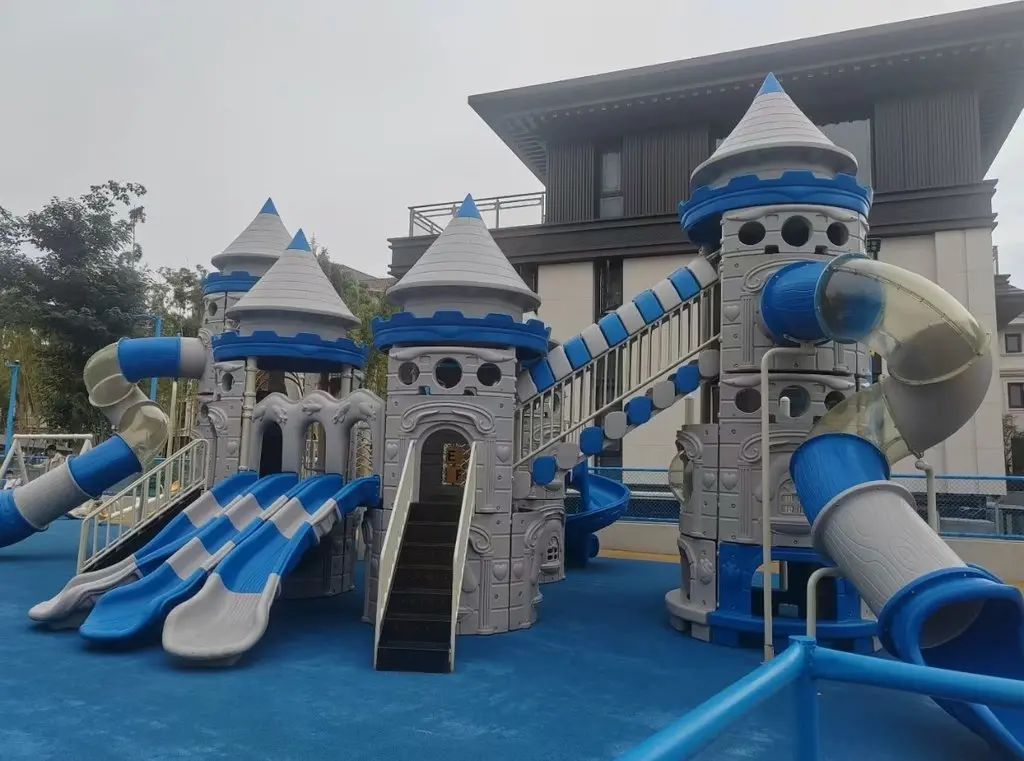
What Safety Regulations Apply to Playground Slides?
Two core standard systems define safety parameters for playground slides. The CPSC Public Playground Safety Handbook specifies geometry, fall‑height and landing‑zone requirements for North‑American public projects, while ASTM F1487‑25 and European EN 1176 set global performance requirements for composite play‑tower slides. No single standard can fully replace another.
For open‑lane slides, key measurable limits include: maximum allowed fall height defined by age group; sufficient run‑out landing distance after slide exit; adequate use‑zone clearance surrounding the full equipment footprint; no sharp exposed edges on sliding surfaces, entry platforms or exit areas; handrail height specifications at slide access points; elimination of shear‑and‑pinch hazards on supporting frames underneath platforms. Toddler‑focused playground zones require lower platform heights and gentler slide slopes.
Three common‑site inspection points catch most real‑world slide failures:
Insufficient use‑zone clearance, where benches, trees or other play equipment intrude into the required safety landing area.
Surface degradation: plastic fading, surface scratching, and fiberglass chipping caused by UV exposure and heavy‑duty public use.
Loose fasteners, where mounting screws can be manipulated or removed by children.
Why Are High‑Platform Composite Slides Not Recommended for Toddler‑Only Zones?
Composite slides with tall access platforms have not been banned outright, but they have gradually disappeared from dedicated toddler play areas for four practical reasons. Tall climbing ladders demand higher motor‑skill levels; long sliding distances bring greater landing‑impact force; these structures require large surrounding safety zones; poorly maintained sliding surfaces increase friction‑burn risks for small children.
Park‑safety program surveys show composite tower slides over 1.2 m fall‑height appeared in roughly 62 % of mixed‑age playgrounds in 2001, falling to around 23 % of toddler‑exclusive zones by 2005. Injury statistics indicate slide‑related incidents mostly involve improper behaviour: climbing upwards against the sliding lane, multiple children sliding together, or landing‑zone congestion, rather than pure equipment‑manufacturing defects.
The industry solution is separation of zones. Low‑height gentle‑slope slides are reserved for toddlers, while taller composite slides serve school‑age children. Where higher slides are deployed, platform guardrail height must comply with standards, landing zones must install impact‑absorbing safety surfacing, and full use‑zone dimensions must be strictly respected.
How to Specify a Slide for Parks, Kindergartens and Community Projects?
Complete specification work in five sequential steps: confirm target age band first; then set user capacity and riding mode; next define use‑zone and safety surfacing requirements; then review ground anchoring plus site drainage; finally confirm maintenance access and spare‑part availability. Most project change‑orders for slides trace back to step three: specifying slide dimensions without calculating necessary fall‑and‑landing zones.
- Lock in target‑age band; keep high‑fall‑height composite slides outside exclusive toddler zones.
- Set maximum simultaneous‑user numbers according to manufacturer official rated capacity, not based on marketing‑photo visual estimates.
- Draw out full safety use‑zone and specify impact‑attenuating playground surfacing matched to slide critical fall‑height.
- Verify foundation‑anchoring drawings, bolt‑torque specifications and drainage planning to keep water away from steel support footings.
- Agree spare‑part replacement cycles and store official spare‑part lists within project hand‑over documentation.
| Parameter | Information you should request | Hand‑over site‑verification method |
|---|---|---|
| Slide model & maximum user capacity | Rated capacity, permitted age range | Equipment nameplate and official manual pages |
| Critical fall height | Vertical drop from platform to finished surfacing | On‑site tape measurement cross‑referenced with surfacing certificate |
| Full safety use zone | Dimension drawing for exact slide configuration | Physical tape measure survey on‑site |
| Ground anchoring system | Foundation drawing, bolt torque requirements | Signed official installation‑completion records |
| Surface material specification | UV‑resistance grade, spare‑part part numbers | Material test report and spare‑parts inventory sheet |
Accessible inclusive slide options deserve separate budget consideration. Wheelchair‑transferable accessible slides carry higher cost than conventional models and alter surrounding‑site layout. The Access Board playground guide defines requirements for accessible routes and ground‑level play components. Raised‑height accessible slides rarely satisfy inclusive requirements alone; they are often paired with low‑ground‑level play activities.
FAQ
Can playground slides be installed indoors?
Yes. Indoor slide installation removes outdoor weather‑aging concerns but does not eliminate safety rules. Indoor slides still require defined landing‑and‑use zones with protective matting, sufficient overhead clearance height above the highest platform, plus fixing specifications adapted for concrete suspended floors rather than outdoor compacted‑soil ground. Soft‑play indoor equipment follows separate standards, so do not copy outdoor‑slide specifications directly into indoor‑play tender documents.
Can a slide be retrofitted onto an existing old play‑tower structure?
A slide may only be added as a formally rated matching component, and only if the original host‑structure load capacity and platform layout permit modification. A freestanding slide cannot simply be bolted onto legacy static play‑tower decks. Sliding brings special dynamic impact loads and expands required surrounding safety zones. Always review the original equipment manufacturer load rating before adding any slide attachment.
Which documents should be kept within permanent site‑records files?
Retain the installation manual, nameplate capacity information, critical‑fall‑height declaration, safety‑surfacing test certificates, installation records including anchoring torque data, plus routine periodic‑inspection logs. Whenever an incident review occurs, these five document sets will answer nearly all questions related to equipment specification, installation and ongoing maintenance.


