
Most adults who grew up before the 1990s remember a plank, a steel fulcrum and a hard landing. Walk into a new park today and that same ground holds climbing nets, spinners and slide towers, but no seesaw. The gap is not nostalgia. It is the result of four decades of guideline changes, insurance math and site planning decisions that reshaped public outdoor playground equipment from the ground up.
Seesaws were never banned. They were phased out one site at a time because the older fulcrum design carried a liability profile agencies stopped accepting, because a seesaw consumes far more ground than its footprint suggests, and because federal guidelines issued in the early 1980s stopped recommending the design for toddlers and preschoolers. The equipment still exists, mostly as spring-centered units, and the standard written specifically for it was reissued as recently as 2019.
What actually happened between the wooden plank era and the modern play area is worth tracing in order.
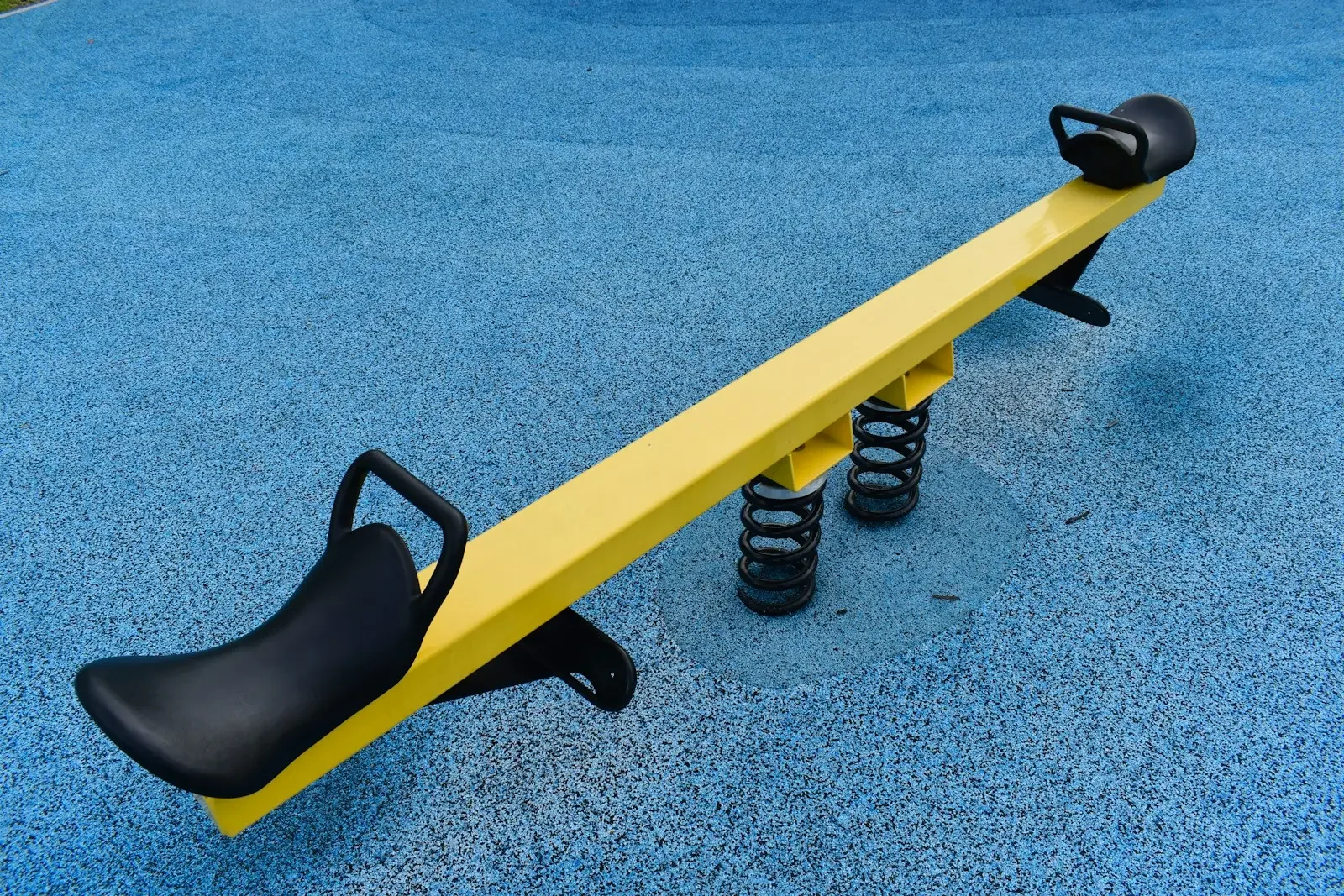
Were Seesaws Actually Banned?
No. No federal rule in the United States and no European standard prohibits the seesaw, and the technical document written specifically for it remains current.
EN 1176-6:2017+AC:2019, the part of the European playground series devoted to rocking equipment, still specifies safety requirements and test methods for seesaws intended for permanent installation, with Annex A giving guidance on unconventional forms. ASTM F1487 covers seesaws in the United States under the same performance framework it applies to other playground equipment, and the CPSC handbook gives them a full section rather than excluding them. The difference between ASTM F1487 and EN 1176 explains why both documents address the same equipment from different angles.
The word banned comes from local practice rather than from law. Park agencies removed seesaws in bulk during the 1980s and 1990s, and the removal was so complete that it read as prohibition. The CPSC handbook is explicit that its contents are guidelines, not a mandatory rule, while noting that some states, local jurisdictions, risk managers and insurers may require compliance. A removal decision was a site-level judgment about exposure, not a compliance deadline.
Why Were Seesaws Removed From Public Playgrounds?
They were removed because the hazard sits in the design rather than in the users: a fulcrum seesaw lets one child end the ride for the other, and the receiving end is the ground.
In New York City, seesaws were standard equipment in more than 600 playgrounds built between 1934 and 1960. By 2016, one remained. The mechanism behind that collapse repeats across most municipal inventories, and it runs through three separate calculations.
The liability and insurance calculation
A wooden plank pivoting on a steel fulcrum has no damper. When one child dismounts at the top of the arc, the other descends without control and the impact travels through the tailbone and spine. Fingers caught under the descending end were a routine injury. Once federal guidelines tightened in the early 1980s, keeping an old unit in service meant defending a design that current guidance no longer recommended, and agencies found it cheaper to cut the bolts than to retrofit.
Space, layout and maintenance economics
A seesaw occupies a footprint that is mostly empty air. The use zone must extend at least 6 ft from each outside edge, and the arc above the plank has to stay clear of adjacent structures, so one unit can claim a rectangle that would hold two climbing pieces serving six children at once. That trade is hard to defend in a dense neighborhood. Timber planks also checked, splintered and rotted, and every board replacement required re-leveling the fulcrum.
Age fit and supervision load
The fulcrum design depends on two children cooperating to keep the motion controlled, which is a negotiation most three- and four-year-olds cannot manage. An operator who keeps one unit in a mixed-age area therefore creates a supervision gap around it, and the cheapest way to close that gap is to remove the unit rather than to fence and staff it.
What Safety Rules Apply to a Seesaw Today?
A current seesaw complies by geometry and by cushioning: the seat line cannot exceed 25 degrees from horizontal, footrests are prohibited, and shock-absorbing material must sit under each seat.

The July 2025 edition of the CPSC Public Playground Safety Handbook sets these conditions in section 5.3.5, and they are specific enough to write directly into a specification. The handbook is a guideline document rather than a mandatory rule, but it is the reference most insurers, inspectors and state licensing agencies work from.
| Condition | What the handbook specifies |
| Seat travel | Maximum angle between the line connecting the seats and the horizontal is 25 degrees |
| Footrests | None |
| Fulcrum | Must not present a crush hazard |
| Cushioning | Partial car tires or other shock-absorbing material embedded in the ground under the seats, or secured to the underside |
| Handholds | At each seating position, for both hands, non-rotating, not protruding beyond the seat sides |
| Use zone | Minimum 6 ft from each outside edge, with 6 ft or 9 ft separation from adjacent equipment depending on play surface height |
| Age | Fulcrum seesaws not recommended for toddlers or preschool-age children |
Two lines in that table are commonly missed in procurement. Fall height is measured from the highest point any part of the seesaw can reach, not from the seat, which changes the surfacing calculation on taller units. And the absence of footrests is a fulcrum rule: the handbook notes that footrests may not be appropriate on a spring-centered unit that behaves like a fulcrum.
Fulcrum Seesaws vs Spring-Centered Seesaws
The spring-centered version is the reason the seesaw never fully disappeared from playground equipment catalogs: a centering device removes the uncontrolled drop, which is the single failure that made the older design indefensible in preschool settings.
The handbook states plainly that preschool-age children are capable of using spring-centered seesaws, because the centering device prevents abrupt ground contact when one child dismounts and because the ride does not require two children to coordinate their actions. The two products share a name and almost nothing else.
| Attribute | Fulcrum seesaw | Spring-centered seesaw |
| Motion source | Lever pivoting on a central fulcrum | Spring or elastomer at the center |
| Coordination needed | Two children acting together, one at each end | One child can ride alone |
| Failure mode | Uncontrolled descent when the opposite seat empties | Damped return, no hard landing |
| Age suitability | Not recommended for toddlers or preschoolers | Preschool-age children can use |
| Footrests | Prohibited | Permitted unless the unit behaves like a fulcrum |
| Governing reference | Section 5.3.5.1 | Section 5.3.5.2, following spring rocker guidance |
For a mixed-age public site, the spring-centered unit is the only version that can sit inside a preschool zone without a supervision exception. For a schoolyard serving ages seven and up, the fulcrum unit is still permitted and still delivers the cooperative weight transfer that a spring rocker cannot.
What Replaced the Seesaw on Modern Playgrounds?
Rotational and spring-based equipment absorbed most of the seesaw’s play value: speed, vestibular stimulation and a controlled loss of balance, delivered without a partner who can drop you.
Spinning equipment is the closest functional substitute. A spinner delivers the same acceleration and disorientation in a compact footprint, needs no second user and is easy to supervise. The handbook caps peripheral speed at 13 ft per second and requires a clear area 6 ft beyond the platform, which is a far smaller claim on a site than a seesaw’s swing envelope. Catalog ranges of spinning playground equipment now cover sit-and-spin discs, standing rotation platforms and multi-user units, each mapping to a different age band.
- Spring rockers reproduce the up-and-down arc for the youngest users with a damped return.
- Balance beams and wobble boards train the same weight shift without a partner dependency.
- Climbing nets and overhead ladders absorb the upper-body challenge that older seesaw users were chasing.
- Ground-level play panels and transfer platforms meet accessibility requirements a traditional seesaw could not.
None of these is a like-for-like swap. The seesaw was unusual in requiring two children to negotiate a shared outcome, and no single replacement restores that.
Do Playgrounds Still Have Seesaws Today?
Yes. Seesaws remain in playground equipment catalogs and in service, mostly as spring-centered units and increasingly as inclusive designs with back support, a transfer platform and a wheelchair-accessible seat.
Remaining installations cluster in three places: older parks that never removed theirs, school grounds where the age band suits the fulcrum design, and custom themed projects where the seesaw is a deliberate heritage element. New York’s surviving units show the pattern, including metal versions installed in the 1990s with car tires embedded under the seats, which met the guidance of the period and outlasted the wooden planks around them.
Accessibility changed the commercial case. The 2010 ADA Standards require at least one of each type of ground-level play component to be on an accessible route, and a seesaw with a transfer platform and back support can satisfy that requirement where a spring rocker often cannot. The Access Board’s guide to play areas sets out how ground-level components are counted against the number of accessible elements a site must provide.
A specification for a new unit should settle five things before price is discussed:
- Age band, and whether the site is a preschool zone.
- Seat height, travel angle and fall height, so the surfacing can be sized.
- Cushioning method and how it is anchored against displacement and vandalism.
- Handhold geometry for both hands, non-rotating, inside the seat width.
- Use zone dimensions against the real layout, not the catalog footprint.
Why Did Wooden Playgrounds Disappear as Well?
Timber structures went the same way for a different reason: preservative chemistry, splinter and rot maintenance, and the cost of custom fabrication pushed public buyers toward steel, aluminum and rotationally molded plastic.
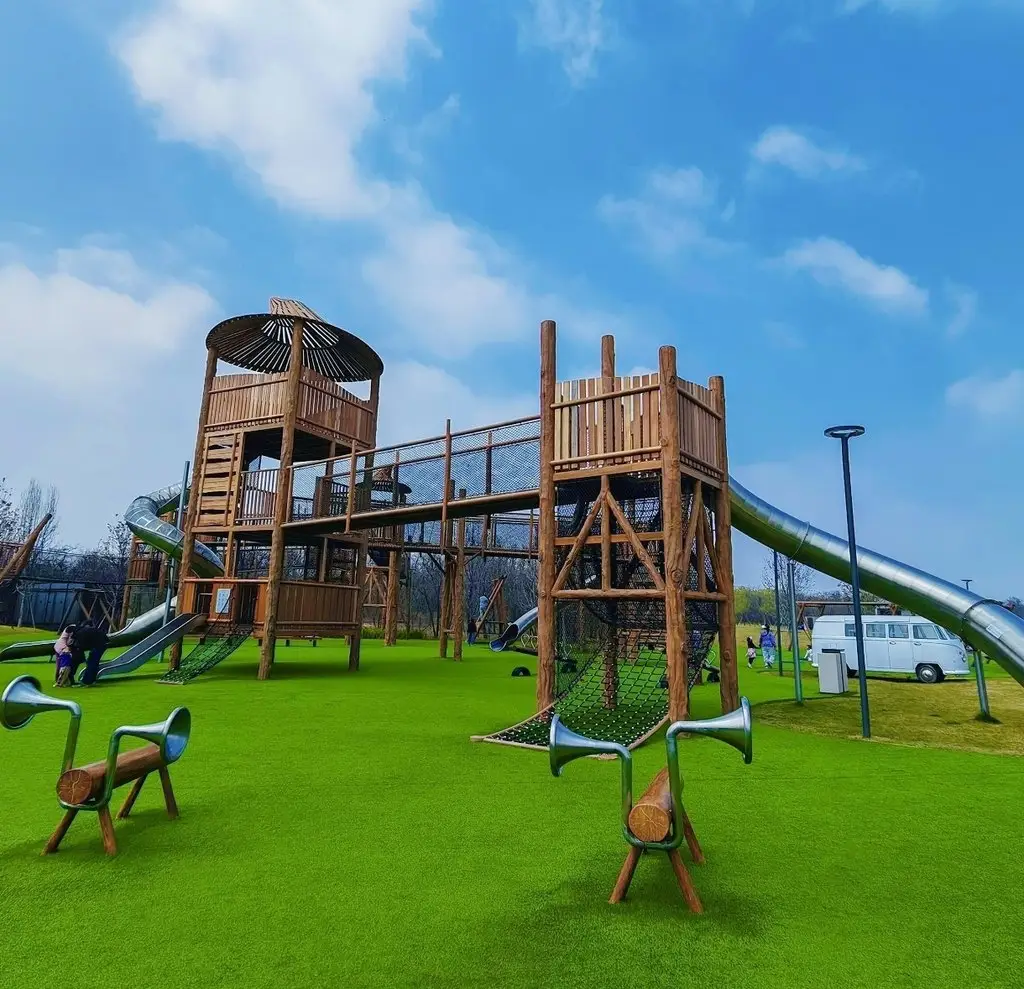
Before 2004, chromated copper arsenate was the standard preservative for residential timber, including decks and play sets. In December 2003, manufacturers voluntarily discontinued CCA-treated wood for homeowner uses, and the EPA records that it does not require removal of existing structures or surrounding soil, only that a penetrating protective coating may reduce leaching. That distinction matters: the material was not recalled, but new public procurement no longer had a defensible reason to specify it.
The practical case closed faster than the chemical one. Timber checking produces splinters at hand height, end grain takes on water and rots at ground contact, and every inspection cycle adds another board to the replacement list. Coated steel and outdoor playground materials such as LLDPE panel stock now deliver a longer service interval at a lower maintenance load, which is what a parks department is actually buying when it replaces playground equipment.
Custom timber structures survive in destination playgrounds, where the design value justifies a project-specific maintenance program. They are not catalog items, and they are not what a school district buys on a fixed annual budget.
FAQ
Three questions come up once a site has decided the seesaw is worth the ground it takes.
Do seesaws build skills that other equipment does not?
Yes, one in particular: negotiated risk with a peer. A fulcrum seesaw is the only common piece of playground equipment where a child’s safety depends on another child’s behavior, so the ride teaches reading a partner, signaling intent and stopping. Spinners and spring rockers deliver the vestibular input without that social load, which is why some play advocates still argue for keeping a few fulcrum units in age-appropriate zones.
Can a seesaw be added to an existing playground without replacing the surfacing?
Often yes, if the fall height of the new unit is at or below what the existing surface was rated for. Fall height is measured from the highest point any part of the seesaw can reach, so a low spring-centered unit may sit inside an existing engineered wood fiber bed. A fulcrum unit with a higher arc usually needs a thicker bed or a different product, and the use zone must still extend 6 ft from each outside edge.
What does it cost to add a seesaw to an existing playground?
The equipment is rarely the largest line. A spring-centered unit is one of the cheaper items in a manufacturer catalog, but added surfacing area, edge restraint, installation labor and any layout change needed to protect the use zone usually exceed the unit price. On a retrofit, cost the surfacing and labor first and treat the equipment as the remainder.


