
Every park and school yard has one piece that children sprint toward before anything else, and it is almost always the thing that turns. Adults who did not grow up with the vocabulary describe it by shape instead of name, which is why the same deck gets called five different things in one procurement meeting. The confusion is not trivial, and it is a question park departments hear every time they budget for outdoor playground equipment. The name on the drawing decides which standard applies, which catalog page the quote comes from, and whether the item arrives as a component or as a free-standing unit with its own footing detail.
At most public playgrounds the spinning thing is either a merry-go-round, a shared rotating platform that several children push and ride at once, or a spinner, the umbrella term for every other rotating device, including bowl seats, rotating rings, stand-up poles and sit-in cups. Suppliers in the United Kingdom, Ireland and Australia call the platform version a roundabout, and specifiers use rotating play equipment when the exact model has not been chosen yet.
The names matter less than the mechanism behind them, so start with what actually turns.
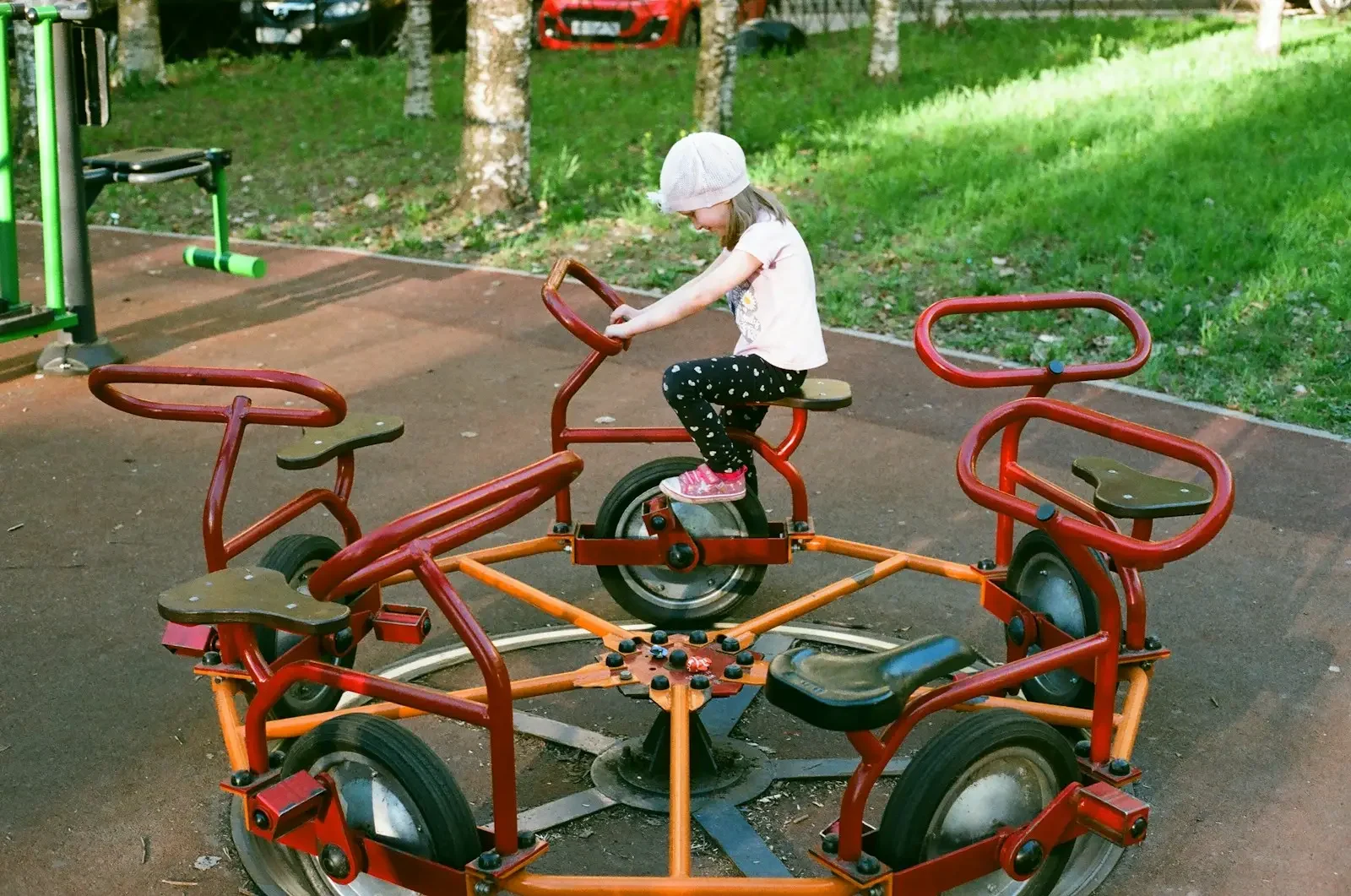
What Is the Spinning Thing at Playgrounds Called?
Ask ten people and you will get four answers, because the shape decides the name. A flat deck that several children ride together is a merry-go-round, and a single seat, ring or pole that one or two children turn is a spinner. Both sit under the same purchasing heading, rotating play equipment.
| What people call it | What it actually describes | Where the term is common |
| Merry-go-round | Shared rotating platform with handholds, pushed by riders or bystanders | North American parks and schools |
| Roundabout | The same platform, named after the traffic circle it resembles | United Kingdom, Ireland, Australia |
| Carousel | Rotating platform with themed figures and a powered drive | Amusement settings rather than public playgrounds |
| Spinner | Any free-standing rotating device that is not a platform | Supplier catalogs and specification sheets |
| Spinning bowl or dizzy disc | Tilted seat that one rider turns with body weight | Retail and parent-facing writing |
| Ships wheel or activity wheel | A wheel that turns in a child’s hands while the child stays still | Component lists on composite structures |
The last row is where purchase orders go wrong. A wheel bolted to a deck is a component, not rotating equipment, and it is evaluated differently from a device that carries the rider around an axis. When you describe the item to a supplier, skip the nickname and answer three questions instead: what moves, how many children ride at once, and whether the unit is anchored or portable.
Which Types of Spinning Playground Equipment Are Available?
Six designs cover almost everything sold today: deck, bowl, ring, pole, cup and hand-turned component. Riding position, not the marketing name, tells you the age band, the rated capacity and how much supervision the piece needs.
| Design | Riding position | Typical capacity | Usual age band |
| Platform merry-go-round | Sit or stand on a shared deck | 4 to 12 riders | Preschool and school age |
| Bowl spinner | Recline or sit in a tilted bowl | 1 rider | 5 to 12 |
| Rotating ring | Stand, hold the ring, walk it round | 3 to 6 riders | School age |
| Stand-up spinner | Grip a central pole on a small platform | 1 to 2 riders | School age |
| Sit-in cup with backrest | Seated with feet in a footwell | 1 to 2 riders | Preschool |
| Hand-turned wheel or panel | Standing on a fixed deck, hands only | 1 user | Preschool and up |
Construction follows a recognizable pattern. Decks are molded from linear low-density polyethylene or high-density polyethylene, frames are hot-dip galvanized steel, spindles are stainless, and the rotating assembly runs on sealed bearings. The bearing, not the deck, decides whether the equipment still feels worth queuing for in year five, so ask for a bearing class and a replacement part number before you ask about color. A useful comparison of deck and frame options sits in this guide to playground equipment materials.
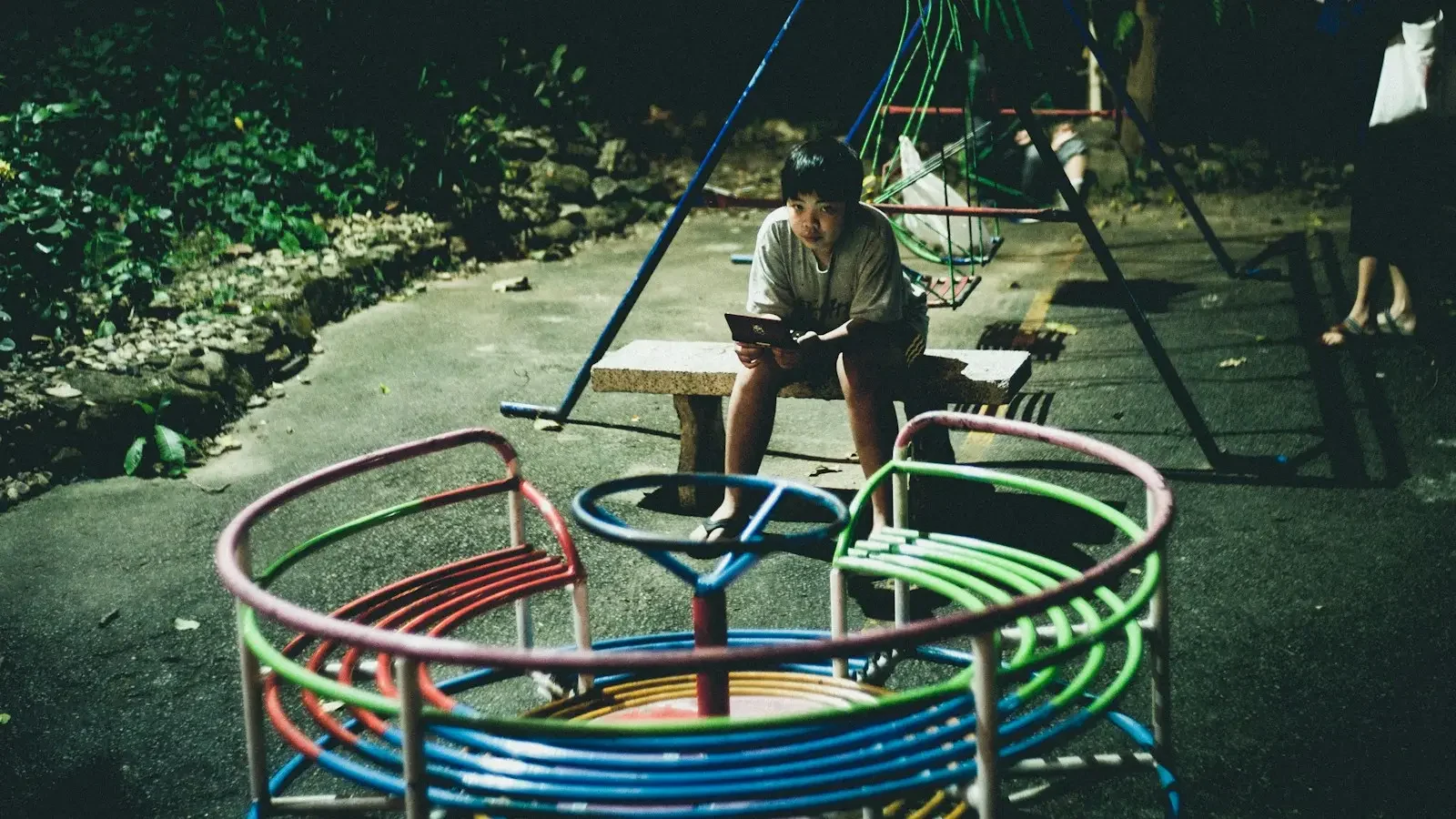
Why Do Children Spin, and What Does Spinning Develop?
Spinning feeds the vestibular system, the inner-ear network that reports head rotation and body position, and children seek it out because that system is still being calibrated. The visible payoff is balance, body awareness and the negotiation that shared spinning forces on a group.
Fluid in the semicircular canals shifts as the head rotates, and the resulting signal is combined with vision and joint feedback to produce a sense of where the body is and how fast it is moving. Children recover from rotation faster than adults do, which is why a spin that leaves a parent unsteady barely registers with a six-year-old, and why the same child asks for another turn immediately.
The social side is just as consistent. A platform needs pushers as well as riders, a ring needs several children to walk it around, and both require somebody to agree on when to stop. Occupational therapists do build rotational movement into sensory work with children, but the clinical evidence for sensory integration as a treatment remains limited. Keep the developmental argument in your planning documents and leave the therapeutic claims out of them.
What Is the Equipment on a Playground Called More Broadly?
Public playground equipment falls into two families. Stationary equipment is what a child climbs across or balances on, and moving equipment carries the child through a motion. Rotating devices are one of five moving types, alongside slides, swings, seesaws and spring rockers.
| Family | Examples | Motion |
| Stationary climbing | Arch climbers, overhead ladders, nets, boulders | Child moves, structure stays fixed |
| Sliding | Straight, spiral and tube slides | Downward travel on a fixed chute |
| Swinging | Belt, bucket and tire swings | Pendulum |
| Rotating | Merry-go-rounds, bowls, rings, poles | Rotation about an axis |
| Seesawing | Fulcrum and spring-centered seesaws | Reciprocating tilt |
| Rocking | Spring rockers and rocking boats | Oscillation on a spring |
Purchasing documents use three different levels of the same vocabulary, and mixing them is the most common source of a quote that cannot be compared. A component is a single event, such as one spinner. A composite structure combines a deck, an access route and several events into one play unit. A play area is the whole site, including surfacing, drainage, seating and the accessible route between them. Ask for pricing at the level you are actually buying.
What Safety Limits Apply to Spinning Equipment?
Two documents set the numbers for rotating playground equipment. The CPSC Public Playground Safety Handbook fixes the geometry and speed of traditional rotating platforms, and ASTM F1487-25 carries the performance requirements a free-standing spinner has to meet. Neither accepts the other as a substitute.
The handbook treats the merry-go-round as the reference case and calls it the most common rotating equipment on public playgrounds. Its limits are specific enough to check with a tape measure and a stopwatch: peripheral speed capped at 13 feet per second, a use zone extending at least 6 feet beyond the platform perimeter, a standing or sitting surface no higher than 14 inches for preschool areas and 18 inches for school-age areas, an underside clearance of at least 9 inches, no up-and-down motion, no accessible shearing or crushing points in the undercarriage, and no component, including handgrips, projecting past the perimeter.
The same document rules rotating platforms out of areas intended for toddlers. Free-standing spinners, which the handbook does not cover in the same detail, fall back on the current ASTM F1487 and EN 1176 frameworks, and the two systems are not interchangeable.
Three checks catch most of the failures seen on existing sites:
- Use zone intrusion, where a bench, tree pit or adjacent swing bay sits inside the 6 foot ring
- Bearing wear, where the deck still turns but no longer coasts, so children push harder to get the same ride
- Fastener access, where a spindle cap can be loosened by hand and removed by a child
Why Do Playgrounds Not Have Seesaws Anymore?
Seesaws were not withdrawn for failing a safety test. They lost on four practical counts at once: fulcrum models need two children of similar weight to cooperate, they are excluded from toddler and preschool areas, they occupy a wide use zone, and the older timber versions struck asphalt directly.
The decline is well documented in park audits. Surveys by the National Program for Playground Safety put seesaws on roughly 55 percent of playgrounds in 2000 and about 11 percent by 2004, with schoolyards falling from 13 percent to 7 percent over the same period. Injury statistics followed the removal: seesaws accounted for about 2 percent of playground emergency visits between 2009 and 2014, far behind monkey bars, swings and slides. Faced with a piece that needed re-engineering, extra space and constant supervision, most agencies simply deleted it from the plan.
The design did not disappear so much as split. Spring-centered seesaws survived because the centering device stops a sudden drop when one child dismounts, and federal guidance allows preschool children to use them under the spring rocker rules, footrests included. Where a fulcrum seesaw is still in service, the tilt is capped at 25 degrees, footrests are prohibited, shock-absorbing material must sit under the seats, and the use zone runs 6 feet from each outside edge.
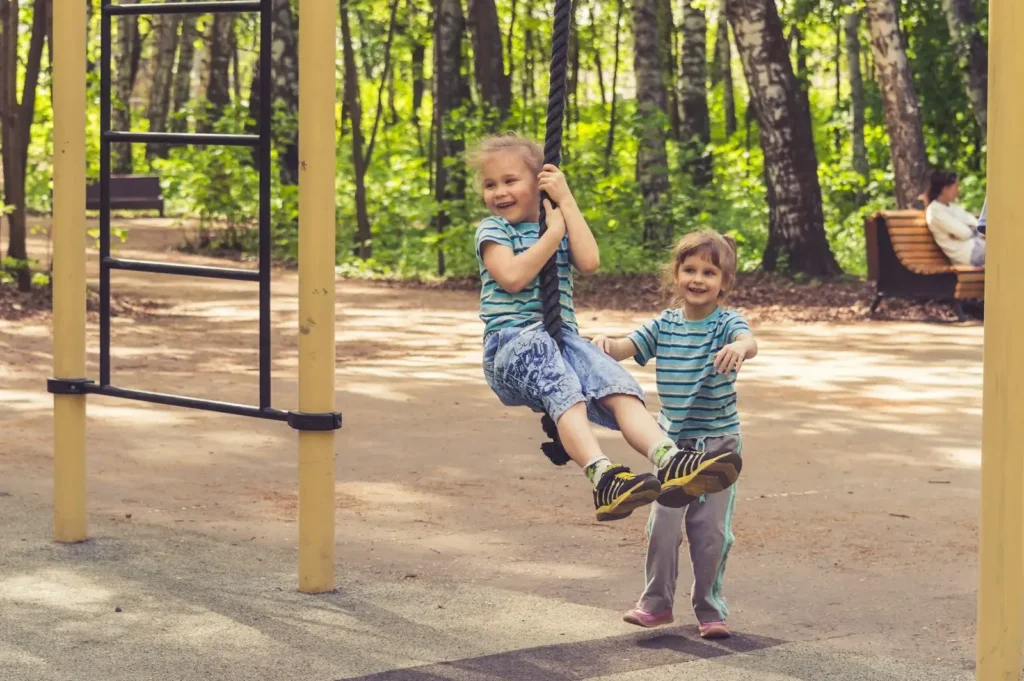
How Do You Specify a Spinner for a Park or School?
Specify in five passes: age band, then capacity and riding position, then use zone and surfacing, then anchorage and drainage, then maintenance access and spare parts. Most change orders on rotating playground equipment trace back to the third pass, where the deck was sized but the fall zone was not.
- Fix the age band and exclude the piece from toddler areas if it carries riders around an axis.
- Set the rider count and permitted positions from the manufacturer’s rating, not from how many children fit in a photo.
- Lay out the fall zone and specify playground surfacing against the fall height at the deck edge.
- Confirm the footing detail, the anchor torque and where water drains away from the base.
- Agree on bearing replacement intervals and put a spare parts list in the handover file.
| Parameter | What to ask for | How to verify at handover |
| Deck diameter and rider count | Rated capacity and permitted positions | Nameplate and manual page |
| Fall height | Deck edge to finished surfacing | Measured height against the surfacing certificate |
| Use zone | Dimensioned drawing for the exact model | Tape measure on site |
| Anchorage | Footing detail and torque specification | Signed installation record |
| Bearings | Expected service life and part number | Spare parts list |
Inclusive versions deserve their own line in the budget, because an accessible rotating platform with a wheelchair bay costs materially more than the standard deck and changes the surrounding layout. The Access Board play area guide sets out how many ground-level components an accessible route must reach, which is why a raised rotating deck rarely counts toward that total on its own and is usually paired with a ground-level spinner.
FAQ
Three questions come up after the layout is agreed and before the purchase order is signed.
Can spinning equipment be installed indoors?
Yes, and indoor installations skip the surfacing calculation but not the supervision problem. Indoor playground equipment still needs a defined fall zone with mats, a clear height above the highest rider, and a fixing detail suited to a suspended slab rather than soil. Soft contained play areas fall under separate standards from outdoor equipment, so do not carry an outdoor specification straight into an indoor tender.
Can a spinner be added to an existing play structure?
Only as a rated component, and only if the host structure’s capacity and the deck layout allow it. A free-standing spinner cannot be bolted to a deck designed for static events, because the dynamic load and the fall zone both change. Check the structure’s original rating before you add anything that turns.
Which documents should stay in the site file?
Keep the installation manual and nameplate capacity, the fall height declaration, the surfacing test certificate, the installation record with anchor torque readings, and the inspection log. When an incident is reviewed, those five items answer almost every question about whether the equipment was specified and maintained as intended.


