
Most outdoor toys for toddlers are bought in a burst of enthusiasm in spring and abandoned by late summer. A one-year-old and a three-year-old are separated by a third of their height, twice their vocabulary, and a different relationship with gravity, yet the same shelf is expected to serve both. Choosing well starts with accepting that the 1-3 window is not one stage but three, and that the toy has to change as the child does.
The best outdoor toys for toddlers 1-3 are the ones that match the motor stage a child is in right now and still offer a second and third way to play: a water and sand table, a low climber with a short slide, a push-to-ride toy that later becomes a balance bike, one soft ball, and a box of chalk and bubbles. None of them needs a battery, and none of them needs an adult to operate it.
What separates that short list from the hundreds of items that end up faded in a corner comes down to four tests that any parent, grandparent, or childcare buyer can apply in a showroom.
What Makes an Outdoor Toy Worth Buying for a 1-3 Year Old
An outdoor toy earns its space when it passes four tests: it supports several play patterns, it takes under two minutes to set up, it survives a full year outdoors, and it fits the child’s current motor stage.
The first test is play patterns per square foot. A molded plastic figure does one thing; a bucket, a scoop, and a patch of sand do a dozen, because the child supplies the scenario. The second is friction: anything that needs assembly, inflation, or a hose connection before play starts gets used less than something a toddler can walk up to and touch. The third is weather, covered below. The fourth is stage fit, and it is where most purchases go wrong: adults buy for the birthday rather than the body.
The World Health Organization recommends at least 180 minutes of physical activity daily from age 1, with 60 of those minutes at moderate to vigorous intensity from age 3, and no sedentary screen time before age 2. A yard with the right equipment makes that volume of movement the default rather than a daily negotiation.
Match the Toy to the Motor Stage, Not the Birthday
The useful dividing lines are twelve to eighteen months, eighteen to twenty-four months, and two to three years. What a child can do at each point decides which categories are safe and which will sit unused.
| Stage | What the child can do | Toys that fit | Too early |
| 12-18 months | Pulls to stand, cruises, squats to pick things up | Push-along walker, low crawl ramp, soft ball, nesting cups | Balance bike, pedals, climbing above 2 ft |
| 18-24 months | Walks steadily, runs stiffly, kicks a ball, climbs furniture | Water and sand table, push trike with parent handle, slide under 3 ft, chalk | Standing scooter, trampoline, ride-on with motor |
| 2-3 years | Jumps, climbs with confidence, steers, starts role play | Balance bike, low climbing frame, mud kitchen, wide-deck scooter | Pedal bike, high platform structures, team sports gear |
Water and Sand Toys: The Highest Play Value per Dollar
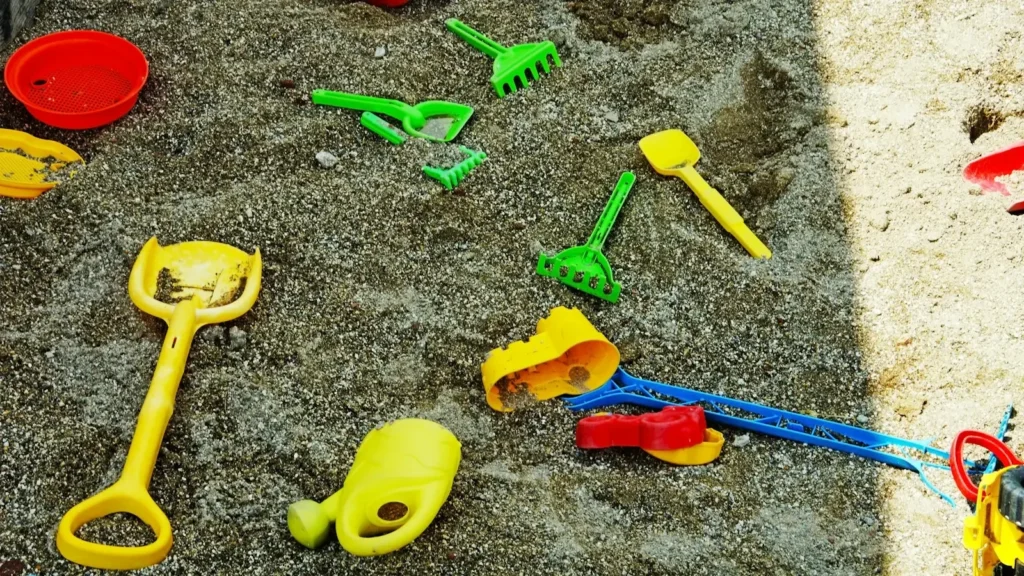
Water and sand are the highest-value outdoor category for ages 1 to 3, because pouring, scooping, filling, and emptying cover fine motor control, cause and effect, and early measurement in a single activity that a child will repeat for an hour without prompting.
Three formats cover almost every yard. A water table suits patios and small spaces, keeps water at waist height, and drains in seconds. A sandbox with a tight lid handles heavier, longer sessions and supports digging and building, but only if it is covered after every use. A splash pad is the flattest and safest option for a one-year-old, since it leaves no standing water at all.
Water needs supervision within arm’s reach in a way no other category does. Any container that holds more than a few inches of water is a drowning risk for this age group, including buckets, paddling pools, and the reservoir of a water table. Empty and invert everything at the end of a session.
Sand needs its own discipline. A lid keeps rain out, keeps animals out, and prevents the crust that forms after a week of weather. Budget for fresh sand each season rather than a new box.
Ride-On Toys and Wheeled Play by Stage
The wheeled progression for 1-3 is push trike, then low trike, then balance bike, then a wide-deck scooter around age three. Skipping straight to a pedal bike with training wheels teaches a child to steer while leaning on a crutch, which is the harder skill in the wrong order.
At twelve to eighteen months the toy is a walking aid: a push trike with a parent handle lets an adult steer while the child holds on. Between eighteen months and two years, a low trike with a wide wheelbase and no pedals is enough. From about two, a balance bike takes over, and it is the single best wheeled investment of the toddler years because balance is the part of cycling that takes real practice.
One dimension is non-negotiable: with the seat at its lowest setting, the child must be able to plant both feet flat on the ground. A bike that is too tall gets refused, and a refused bike does not get ridden. Helmets apply from the first ride, including a lap of the driveway.
Scooters belong at the end of the range, around three, and only with a wide deck and lean-to-steer geometry.
Climbers, Slides and Backyard Play Structures
The best large outdoor item for this age is a low, wide climbing structure with two or three routes up and a short slide, not a tall slide with a ladder. Height adds risk without adding play value at this stage; variety of routes adds play value without adding height.
The Consumer Product Safety Commission handbook for outdoor home playground equipment calls for a use zone of at least 6 ft around equipment, protective surfacing that extends 6 ft beyond the structure, and, under swings, surfacing that runs twice the pivot height in both directions. Openings in guardrails and barriers must be either smaller than 3.5 in or larger than 9 in, so that a head cannot enter but not exit. Where a platform sits between 30 and 48 in high, the guardrail needs to be at least 25 in.
For a toddler, that means a short list of specifications. Keep the highest platform under about 3 ft. Choose a slide with a deep trough and a long, level run-out rather than a steep drop. Prefer a structure with a ramp as well as a ladder, because a one-year-old can crawl up a ramp but cannot safely climb a vertical ladder. Many manufacturers build exactly this profile as a multi-function play set with a slide, a low platform, and a swing bay in one footprint.
A portable plastic climber can be moved into shade and stored for winter; a fixed structure in outdoor playground equipment grade is built for daily use by several children and needs an anchored footing.
Balls, Bubbles, Chalk and the Low-Cost Classics
The cheapest outdoor toys get used most often, because they impose no rules: a soft ball, a bubble wand, a bucket of chalk, and a set of scoops let a toddler decide what the game is. Tools outperform toys at this age almost every time.
The ball is the first piece of sports equipment a child needs. Choose one that is soft enough to catch with the face and large enough not to fit in the mouth, roughly 6 to 8 in across for a one-year-old. Bubbles teach tracking and lung capacity. Chalk works on any hard surface and disappears with rain, which makes it the lowest-maintenance creative material available.
Household items belong here too. A cardboard box, an old sheet, a watering can, and a few kitchen containers will hold a toddler’s attention longer than most purpose-built electronics.
Battery-powered outdoor toys fail in a predictable way. The sound and light module is the first thing to go, the battery compartment is the second, and outdoor humidity accelerates both. A toy that needs six batteries to be interesting is usually not interesting.
This is also the category that makes the best gift: nothing to assemble and no size to grow out of.
What to Skip Before Age Three
Three categories are worth skipping entirely before age three: bouncing equipment such as trampolines, motorized ride-ons, and any toy with small detachable parts. The first two carry injury patterns this age group cannot manage, and the third is a choking hazard that regulation already treats as a banned product category.
Regulation is explicit on the last point. Under 16 CFR Part 1501, any toy intended for use by children under 3 years of age that presents a choking, aspiration, or ingestion hazard because of small parts is classified as a banned hazardous substance. In practice the small-parts cylinder test applies, and products sold for this age band should state the age grading clearly on the packaging.
| Item to skip | Why | Wait until |
| Trampoline | Collision and cervical injury risk; coordination not developed | Age 6, with enclosure and one user at a time |
| Motorized ride-on | Speed beyond reaction time; no brake control | Age 4 to 5, on flat ground |
| Water pool without barrier | Drowning risk in inches of water | Supervision-dependent, not age-dependent |
| Loose magnets and button cells | Ingestion causes internal injury | Age 6 or older |
| Balloons | Burst fragments are a leading choking item | Age 8 |
Slides deserve a separate note, because a slide that is fine for a five-year-old can be wrong for a two-year-old. Metal chutes heat up enough in direct sun to burn bare legs, open chutes let a toddler roll off mid-descent, and a chute that ends more than a few inches above the ground produces a hard landing. The patterns are consistent enough to be documented as recurring slide injuries, and most are avoided with a lower, enclosed chute and a level exit.

Materials, Weather Resistance and Storage
What decides whether a piece of outdoor equipment survives three summers is the wall thickness and UV stabilization of the plastic, the treatment of the timber, and the coating on the steel, not the color or the theme. Buyers who compare those three rarely replace the same item twice.
Rotational molding in linear low-density polyethylene produces the thick, flexible walls used on most toddler climbers and water tables; high-density polyethylene is stiffer and more UV-resistant but cracks rather than flexes under impact. Timber needs pressure treatment or a rot-resistant species, and cut ends need re-sealing. Galvanized steel should show a continuous zinc coating with no bare edges at welds.
| Material | Strength outdoors | Weak point |
| LLDPE | Flexible, impact-resistant, color through the wall | Softens and fades in prolonged UV without stabilizers |
| HDPE | Stiff, strong UV resistance | Can crack at sharp impact in cold |
| Treated timber | Repairable, heavy, ages well | Splinters, rot at ground contact, needs annual check |
| Galvanized steel | Long service life, high load capacity | Coating damage at welds and fixings |
Folding, stacking, and lidded designs are worth a premium in a small space. This guide to outdoor playground materials breaks the trade-offs down by component.
Consumer-Grade vs Commercial-Grade
Household and commercial equipment follow different standards and are not interchangeable. Home playground equipment falls under ASTM F1148; public and commercial play equipment falls under ASTM F1487, which assumes continuous, multi-user, supervised use. Home equipment in a childcare center wears out fast and leaves the operator without the documentation an inspection asks for.
The practical signals of commercial grade are thicker walls, through-bolted rather than snap-fit connections, replaceable wear parts, UV-stabilized color, and a written test report covering the applicable standard.
FAQ
Three questions come up after the shortlist is settled: how much gear is enough, what makes a safe gift for a first birthday, and when the equipment has to change.
How Many Outdoor Toys Does a Toddler Actually Need?
Fewer than most families own. Three to five pieces that cover different motor patterns, such as one water or sand item, one wheeled item, one climbing item, and a ball, will carry a child through the whole 1-3 window. Rotating two out of sight every week restores novelty at no cost.
What Is a Practical Outdoorsy Gift for a One-Year-Old?
Choose by the adult’s storage situation first and the child’s stage second. A push-along walker suits a twelve-month-old in a flat yard; a compact water table suits an apartment patio; a soft ball and a set of scoops suit a family with no outdoor space of its own. Avoid anything that requires tools, batteries, or a permanent footprint, because those gifts tend to migrate to a garage.
Do Outdoor Toys Need Replacing When a Child Turns Three?
Only the items tied to a motor stage. A water table, chalk, a ball, and a sandbox typically last from two to five. A push trike and a low slide are usually outgrown by three and should be passed on rather than stored. The replacement that matters at three is the climbing structure: heights and route variety that suit a two-year-old limit a three-year-old who now climbs confidently.


