
A buyer comparing soft playground equipment usually starts with a shortlist of catalogs and ends with quotes that cannot be compared. One prices a toddler zone by the square metre and leaves surfacing out. Another quotes a three-level structure and calls it complete. A third sends photographs instead of a specification. The equipment photographs well, which is the problem: foam, vinyl and netting look alike in a brochure and behave very differently after two years of daily use by children in shoes.
There is no single best soft play set, and a supplier who names one without asking about your room is selling a catalog rather than a solution. The best set is the configuration that satisfies four variables at once: the age band it serves, the footprint and sightlines of the room, the peak number of children it must hold at the busiest hour, and the capital left after surfacing, freight, installation and spares are counted. For most commercial venues that lands on a modular contained structure of 80 to 150 square metres with a separate toddler zone and one signature feature, specified against ASTM F1918-21 or EN 1176-10:2023.
The sections below work through those variables in order, then test the answer against standards and against payback.

What Counts as Soft Playground Equipment?
Soft playground equipment is play equipment whose contact surfaces and structure are built from padded, deformable materials rather than rigid steel or timber: a foam core, a coated fabric or vinyl skin, welded seams, and a concealed frame that carries the structural load.
The build is a stack, and each layer is a separate purchasing decision. A cross-linked polyethylene or expanded polypropylene core, specified from about 25 kilograms per cubic metre upward, holds the shape and absorbs impact. A PVC-coated or phthalate-free polyurethane skin takes abrasion from shoes and buckles. High-frequency welding closes seams without the stitch holes that let water into the foam. A steel frame carries platform and slide loads where the set is multi-level.
A typical set carries padded platforms, steps, ramps, slide runs, tunnels, netting, ball pits, soft blocks and perimeter walls. Density, skin thickness and seam method separate a set that survives a decade from one patched by year three, and none appears on a one-page quotation.
What separates this category from outdoor playground equipment is containment rather than softness. An outdoor structure is supervised from outside; a contained structure holds children inside padded walls and netting, so access, egress and sightlines become the binding constraints. ASTM F1918-21 scopes the category to users from the 5th percentile 2-year-old to the 95th percentile 12-year-old, and excludes public playground equipment, home equipment, amusement rides and toys.
What Is the Best Soft Play Set?
The best soft play set is the smallest configuration that still serves your peak age band at your busiest hour without blind spots. Size for the busiest ninety minutes rather than the average day, then choose the archetype that fits that footprint and age mix instead of the one with the most features per square metre.
Five configurations cover most commercial rooms, and each fails in a predictable way, from the toddler set to the ball pit play structure.
| Set type | Age band | Minimum footprint | Main constraint |
| Toddler soft play set | 1 to 3 | 30 to 60 m2 | Outgrown by age four, needs an older zone beside it |
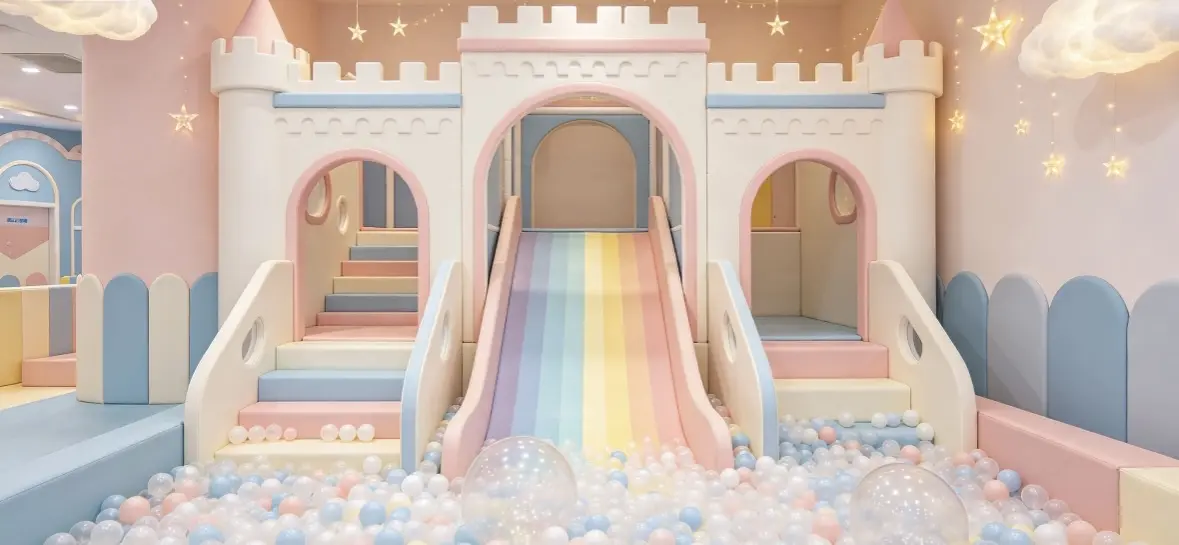
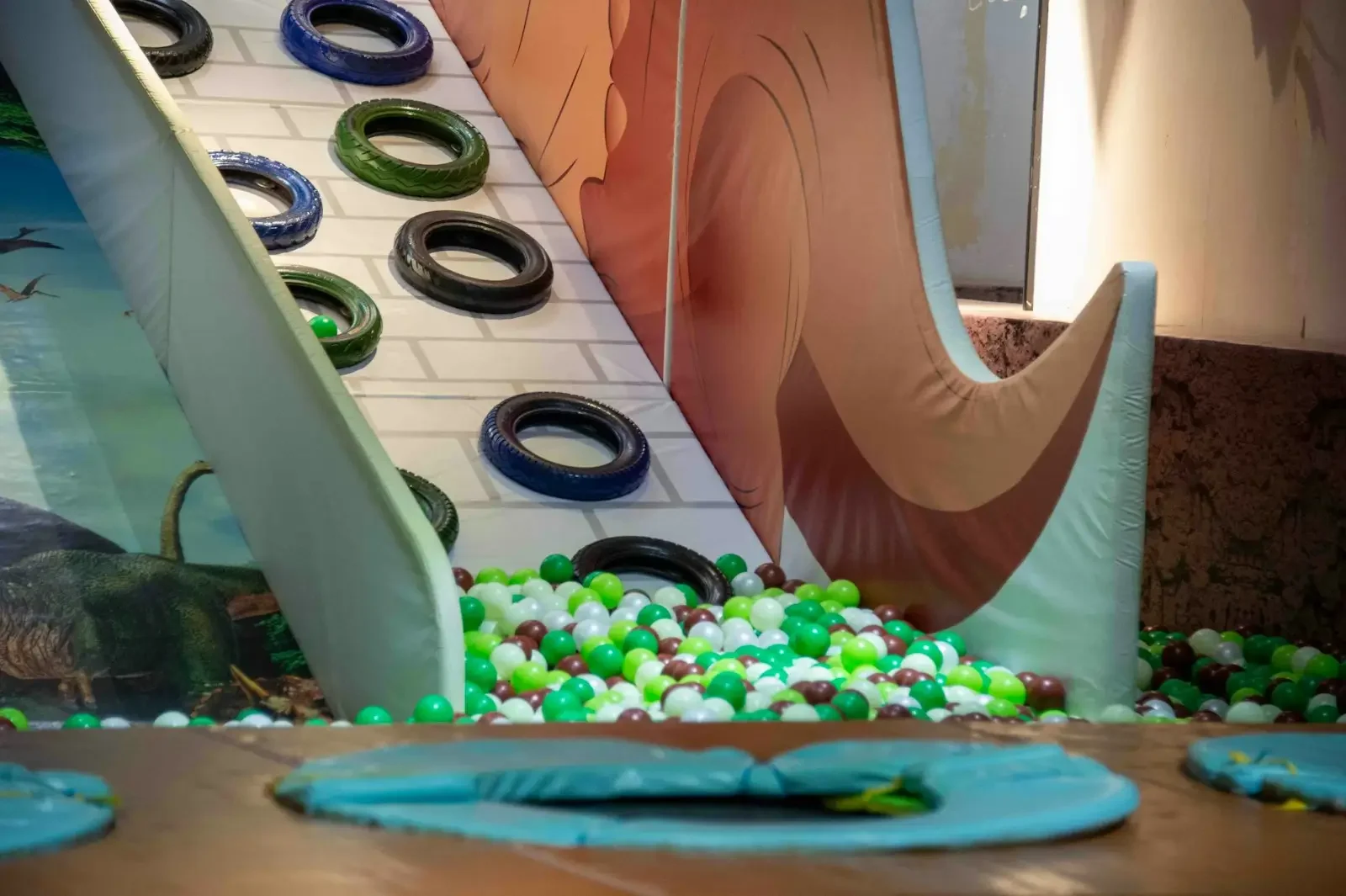
| Ball pit and slide combination | 2 to 8 | 60 to 120 m2 | Ball loss and daily cleaning load |
| Multi-level contained structure | 4 to 12 | 150 to 400 m2 | Clear height and exit count |
| Modular foam block and mat set | 1 to 6 | 20 to 50 m2 | Needs resetting and storage |
| Themed custom soft play zone | 2 to 10 | 100 to 300 m2 | Theming cost and longer lead time |
Match the Set to the Age Band
A set for one to three year olds is low, wide and heavily padded, with step heights a new walker can manage and no drop over 300 millimetres. A set for five to twelve year olds needs vertical challenge: climbing nets, tube slides, barriers. The common error is mixing both in one undivided structure. Certification says a structure is safe for a range; it does not say the range should share one space.
Match the Set to the Footprint and Sightlines
Plan on one child per 1.5 to 2 square metres of play floor, and expect capacity per square metre to fall as levels rise, because upper decks consume footprint without adding floor. Clear height governs what is buildable: about 2.6 metres allows a single level, three levels need 5 to 6 metres. Sightlines matter more than capacity wherever coffee is sold.
How Much Space and Budget Does a Soft Play Set Need?
Budget soft playground equipment at USD 80 to 300 per square metre and assume it is only 30 to 45 percent of what the room actually costs. The gap is surfacing, freight, installation, spares and commissioning, and it is where first-time budgets fail.
| Footprint | Equipment budget | Installed cost | Typical venue |
| 40 to 80 m2 | USD 6,000 to 18,000 | USD 9,000 to 27,000 | Preschool, clinic, cafe corner |
| 80 to 150 m2 | USD 18,000 to 40,000 | USD 27,000 to 60,000 | Mall annex, family entertainment center |
| 150 to 300 m2 | USD 40,000 to 80,000 | USD 60,000 to 120,000 | Standalone soft play center |
Installed cost covers equipment, surfacing at USD 20 to 80 per square metre tested to ASTM F1292, and installation at 15 to 25 percent of equipment value. Four lines sit outside it: sea freight on a 40-foot container at USD 3,000 to 8,000, spares at 3 to 5 percent of equipment value, commissioning, and insurance inspection or staff training. Order spares with the container, because a net panel shipped alone costs more than one shipped inside it.
Are Soft Play Sets Worth It?
A soft play set is worth it when capital cost per admission lands below roughly a tenth of the ticket price. Above that ratio the equipment cannot repay itself on admissions alone, and the business depends on parties, food and memberships to carry the capital.
Run the arithmetic before signing. A 120 square metre set at USD 180 per square metre is USD 21,600 of equipment; add USD 6,000 of surfacing and USD 3,000 of installation for about USD 30,600 of capital. At one child per 2 square metres the set holds 60 children per session, so five sessions a day at 45 percent occupancy over 360 days gives roughly 48,600 admissions a year, or USD 0.63 of capital per admission. Against a USD 8 to 12 ticket the equipment recovers itself within months.
Three variables move that result more than purchase price. Throughput depends on session turnover, not floor area, so a queue beats another 20 square metres. Attachment spend on parties, socks and food often exceeds ticket revenue per head. Uptime decides everything: a closed slide removes the reason families return.
What Maintenance Does the Calculation Depend On?
Write the inspection cadence into the operating plan before opening. Daily checks cover fixings, padding alignment, netting tension and debris. Weekly checks cover seams, closures and slide joints. Quarterly checks cover foam compression at high-traffic landings. An annual documented inspection by a competent person is what insurers and licensing regimes ask for. Budget net panels and high-wear pads as consumables, not capital.
What Should You Look for in Playground Equipment Brands?
A brand name is not a specification. What separates one set of soft playground equipment from another is core density, seam construction, the document pack that travels with the order, and whether spares exist five years after delivery, and all four are checkable before a deposit is paid.
| Request | What a strong answer contains |
| Core specification | Named material, density in kg per cubic metre, compression set figure |
| Seam sample | Welded, not stitched, with a peel test result for the actual skin |
| Document pack | Per-material fire and chemical reports naming grade and thickness |
| Spares list | Net panels, pads, balls, fixings, with prices and lead times |
| Warranty terms | Exclusions stated, response time in days, who pays return freight |
The buying errors repeat. Comparing price per square metre without comparing scope, where one quote includes surfacing and one does not. Accepting a structure-level certificate that never names the materials installed. Approving a drawing that shows slides but not the rescue route. Skipping the audit, which should confirm density by sample, seam method by cutting a test piece, and stock for the exact components quoted. The sourcing side is covered in this guide on where to buy soft play equipment.
How Do Safety Standards Apply to Soft Playground Equipment?
Soft playground equipment is governed by ASTM F1918-21 in the United States and EN 1176-10:2023 in Europe, and the two are not interchangeable: a structure built to one has not thereby met the other.
ASTM F1918-21, published on 31 July 2021, covers materials and manufacture, performance, access and egress, equipment, structural integrity, maintenance, fire safety and evacuation. The European counterpart is EN 1176-10:2023 for fully enclosed play equipment, sitting alongside EN 1176-1 and EN 1176-7:2020 for installation, inspection and operation.
One point catches buyers repeatedly. The CPSC Public Playground Safety Handbook is the document most American operators cite, and it explicitly excludes soft contained play equipment from its scope. It is a sound reference for outdoor playground equipment and a misleading one here.
The Documents That Prove Conformance
Ask for reports, not claims. An order should carry per-material reports for foam, coated fabric, netting and padding, each naming the material, thickness and method: ASTM E84 or NFPA 701 in the United States, EN ISO 11925-2 or EN 1021 in Europe. Add chemical compliance, the installation record, the as-built drawing and the manual. A certificate for another installation or a reconfigured layout does not transfer. This breakdown of soft play safety certifications compares the two.
The Layout Rules Buyers Discover Too Late
These are dimensional requirements, and they cannot be fixed after the container arrives. EN 1176-10:2023 requires an internal route for an adult carrying an injured child, at least 1,300 millimetres high and 700 millimetres wide, with surface-mounted items limited to 400 millimetres. No point inside may sit more than 18 metres from the nearest exit. Exit count follows capacity: two points up to 20 users, a third for 21 to 50 once the highest platform exceeds 4 metres, four where 101 to 200 users stand above 6 metres.
What About Outdoor Play Equipment for Children?
Outdoor play equipment for children is the better buy when the site has secure outdoor ground, a climate that supports year-round use, and a dominant age band of six and over; soft playground equipment wins when the space is enclosed, the weather is unreliable, or most users are under five.
The regulatory paths differ as much as the products. Outdoor public equipment is assessed against ASTM F1487 or EN 1176-1, with CPSC guidance applying, and surfacing depth is set by the fall height of the highest accessible component. Soft indoor equipment answers to F1918 or EN 1176-10 and depends on the building for fire, egress and accessibility approvals.
Outdoor equipment costs less per child place and carries more children per square metre in open layout, but it is seasonal and harder to supervise across a large footprint. Indoor soft play costs more per child place, runs all year and concentrates supervision inside walls. Where both are possible, the usual answer is a compact outdoor structure for school-age children plus a soft indoor set for the under-fives, serving two age bands on one staff rota rather than two seasonal peaks.
FAQ
Three questions come up once configuration and standard are settled, and none of them is answered in a supplier catalog.
How long does delivery and installation take?
Allow two to three weeks for drawing approval, 25 to 45 days for production and 30 to 45 days for sea freight. Installing a 120 square metre set takes three to ten working days on site. Custom theming adds engineering and production time, so a themed set should be ordered a quarter ahead of opening.
What flooring is required under a soft play set?
It depends on the fall height the structure creates, not on the room’s use. The floor must be tested to ASTM F1292 or EN 1177 at or above that height; a soft-looking carpet satisfies neither. Bonded rubber, rubber crumb and foam-backed vinyl are common indoors, with thicker build-ups at slide exits. The tested assembly must match the installed one.
Can a soft play set be installed on an upper floor?
Usually yes, but the structure is not the constraint, the slab is. Equipment weight is modest; the occupants plus a party crowd form the design load, and a structural engineer should confirm the imposed load. Two conditions apply upstairs: clear height must still allow the platform levels you want, and the rescue route, exit distances and evacuation strategy must work from that floor, which is where mezzanine designs usually fail.


