
Indoor play has become a standard amenity in shopping centers, clinics, airports, restaurants and daycare buildings, and most of that build-out is soft: foam cores wrapped in vinyl, fixed to low frames, sized for children who fall over rather than fall from height. Soft play is a procurement category that looks simple in a catalog and is difficult to compare in a quotation, because two suppliers can price the same floor area three times apart and both describe the material as high density foam. Buyers who arrive with outdoor playground experience assume the same rules carry over, but soft play structures answer to a different standard and a different document set.
You can buy soft playground equipment from a manufacturer that builds to your floor plan, a trading company that resells factory output, a regional distributor that supplies and installs, or a resale market of frames pulled from closed venues. For most commercial projects the factory route gives the widest design range and the lowest unit price, while the distributor route buys local installation and faster after-sales at a premium of roughly a quarter to a half.
The sections below separate those routes, price them per square meter, and set out the paperwork that should arrive before a deposit leaves your account.
What Counts as Soft Play Area Equipment?
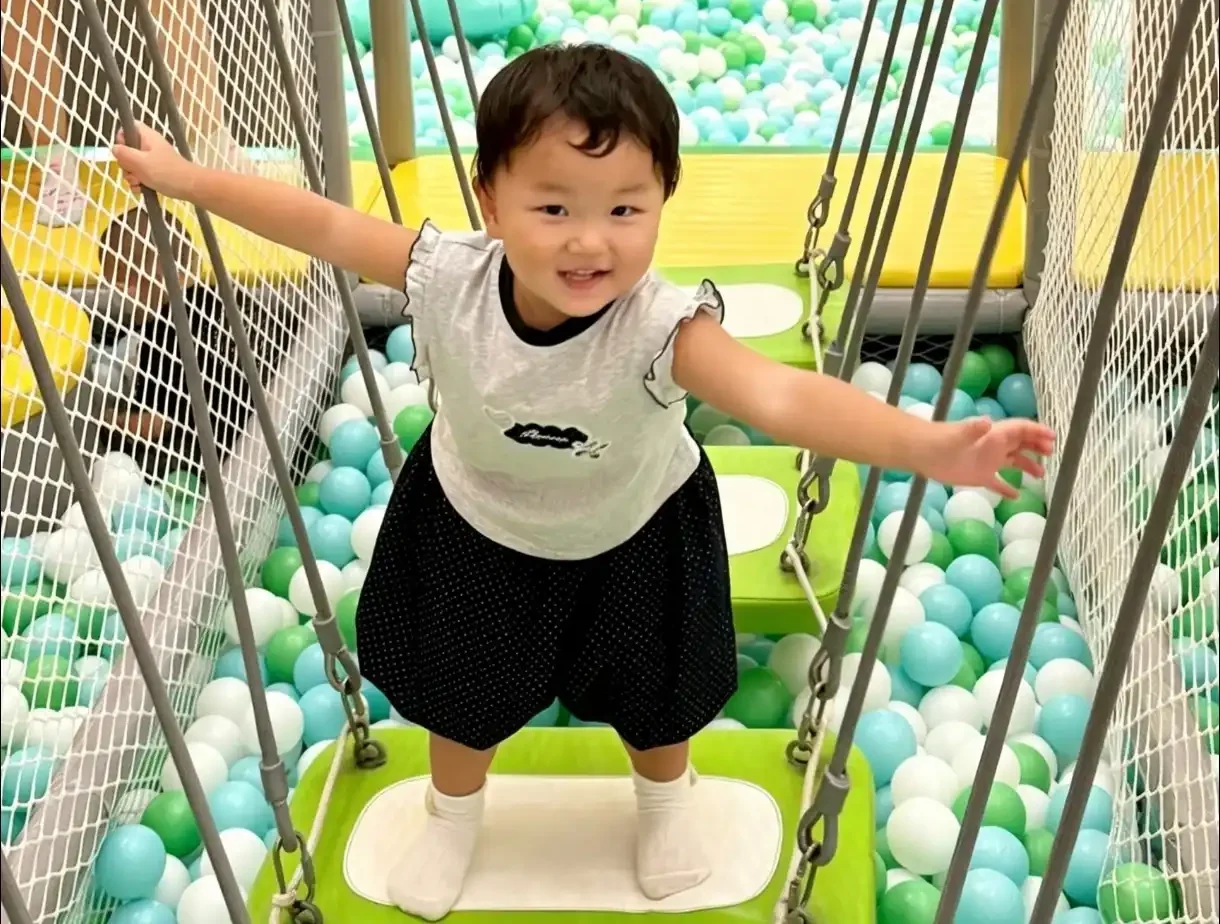
Soft play area equipment, usually sold as soft playground equipment, is the indoor branch of the playground equipment market: padded, foam-cored products installed for children from about six months to twelve years old, designed so that the playing surfaces, the edges and the fall zone form one soft system rather than separate equipment standing on a hard floor.
Five product families account for most of what gets quoted, and buyers who can name them get more comparable prices because each family carries a different cost driver.
| Family | Age band | What buyers use it for |
| Padded play frames | 2 to 12 | Multi-level towers, slides, tunnels and crawl decks inside a soft envelope |
| Toddler units | 6 months to 3 | Low steps, mini slides, balance beams and mirrors for pre-walking groups |
| Soft blocks and loose pieces | 1 to 5 | Build-and-stack play and obstacle courses staff rearrange daily |
| Ball pits | 2 to 10 | High-throughput attraction and the usual visual center of a venue |
| Wall and floor padding | All ages | Protecting columns, edges and the perimeter of an adjacent hard-floor zone |
Construction comes down to three decisions: the foam core, usually cross-linked polyethylene or expanded polypropylene with density specified at 25 kg/m3 and above; the cover, either PVC-coated fabric or a phthalate-free PU; and the frame, steel or timber for anything children climb above knee height. Ball pits show why line items matter, since the shell, the ball fill and the surrounding ball pit play structure are quoted separately and the ball count alone can move a budget by a few thousand dollars.
How Soft Play Differs from Standard Playground Equipment
Four differences change how a specification is written. Soft contained play is assessed under ASTM F1918 or EN 1176-10 rather than ASTM F1487, because the equipment is enclosed and the hazards are entrapment, squeeze points and head clearance inside the structure. Free fall heights are lower, typically under two meters, so surfacing is specified to a lower critical fall height. Capacity is higher per square meter, because children turn over quickly in a soft zone. Sightlines become a design constraint, since an enclosed structure can hide a child from the supervisor standing two meters away.
Where Can I Buy Soft Play Area Equipment?
Soft play equipment reaches buyers through five routes: direct from the factory, a trading company, a regional distributor that installs, the used market and B2B marketplaces, and the right route depends on whether the binding constraint is unit price, installation labor or a fixed opening date.
| Channel | Typical order | What you give up |
| Factory direct | 30 m2 and up, full container or shared | You arrange freight, customs, installation and site supervision |
| Trading company | Small mixed orders across product types | Design depth and any late specification change |
| Regional distributor | Turnkey projects under 200 m2 | Unit price, usually 25 to 60 percent above factory |
| Used and refurbished | Replacing a single zone | Warranty, color match and any current test report |
| B2B marketplace | Samples and single units | Verified compliance documents |
The cheapest quotation is rarely the cheapest project. A factory price excludes ocean freight, duty, unloading, assembly labor and the cost of discovering at installation that a frame does not fit the room. Add those before comparing, and ask each seller whether the number is ex-works, delivered to port or installed, because a 40 percent gap between two quotes is often nothing more than three Incoterms.
Where Can I Buy Soft Play Equipment Wholesale?
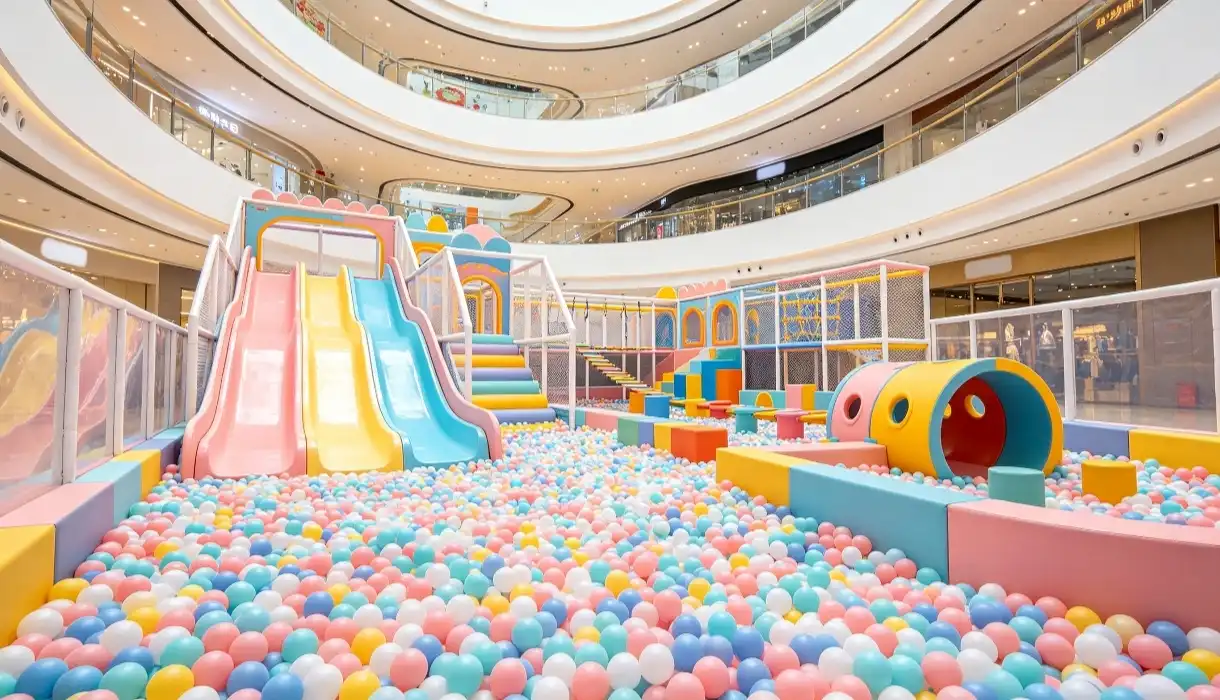
Wholesale in this category means buying at factory level, priced per square meter of finished play area, with a minimum order usually set between 20 and 100 square meters or expressed as a container load; the unit price falls as area grows because design, tooling and freight are spread across more product.
| Order size | Typical MOQ basis | Price band per m2 |
| Single zone or trial | 20 to 50 m2 | USD 140 to 300 |
| Mid-size venue | 100 to 300 m2 | USD 110 to 220 |
| Container program | 300 m2 and above | USD 80 to 160 |
Three commercial terms decide what you actually pay. Quotation basis matters most: free on board leaves freight and duty with you, cost and freight adds the shipping line, and delivered duty paid puts one number on the table but hides how much of it is logistics. Payment is normally 30 percent on design approval and 70 percent before shipment. Lead time runs 25 to 45 days of production after the drawing is signed, plus 30 to 45 days at sea. Because foam modules are bulky, a container fills by volume long before it reaches its weight limit, so packing efficiency is a real cost line. Request a bill of materials naming foam density, cover weight, steel gauge and hardware, since a quotation that says standard materials cannot be compared or enforced.
What Does Soft Play Area Equipment Cost?
Soft play structure runs USD 80 to 300 per square meter ex-factory, a standalone toddler installation of 40 to 80 square meters usually lands between USD 5,000 and USD 30,000, and the equipment is only 30 to 45 percent of what the venue costs to open.
| Cost line | Typical range |
| Equipment, supply only | USD 80 to 300 per m2 |
| Impact-attenuating floor | USD 20 to 80 per m2 |
| Ocean freight, 40-foot container | USD 3,000 to 8,000 |
| Installation | USD 10 to 60 per m2, or 15 to 25 percent of equipment |
| Design, permits, training, launch | USD 5,000 to 25,000 per project |
The spread inside the equipment band is explained by finish rather than by area. Basic modular builds sit near USD 80 to 120 per square meter, standard themed work around USD 120 to 180, and custom sculpted or licensed-theme work above USD 180, where the added cost is modeling, hand finishing and a longer production slot. A practical rule is to take the playground equipment quotation and add at least 30 percent before treating it as a project cost; for a full venue the share of capital going to play equipment, floor, freight and fit-out is closer to the split described in this breakdown of commercial indoor playground equipment cost.
Where Do Schools and Daycares Buy Soft Play Equipment?
Schools and daycare operators buy through cooperative purchasing contracts, published tenders and approved-vendor lists rather than retail channels, and the technical specification inside those documents decides which suppliers can respond at all.
A cooperative contract is fastest for a single site: the bidding has already been done at state or regional level and the buyer purchases against an awarded price list. A public tender is slower but allows a specification written around the actual room. Either way, the specification should name the standard rather than the product: ASTM F1918 or EN 1176-10 for the structure, ASTM F1292 for impact attenuation with a head injury criterion of 1,000 or lower and a peak deceleration of 200 g or lower, CPSIA limits for lead and phthalates, and a fire test method accepted in the destination market. Institutional buyers also tend to reference the CPSC public playground safety handbook for fall heights, use zones and supervision, even where the equipment itself falls under the soft contained standard.
The response package is what separates a real supplier from a broker: type test reports naming the model, a children’s product certificate, liability insurance, an installer with documented experience, and a maintenance schedule with a spare parts price list. Evaluation should weigh age zoning, capacity per square meter, sightlines and cleaning access at least as heavily as unit price, because a structure staff cannot see into becomes a daily staffing cost.
Where Can I Find Affordable Soft Play Equipment Without Cutting Safety?
Affordable soft play equipment comes from narrowing scope rather than thinning foam: modular layouts, standard colorways, fewer bespoke shapes and locally sourced flooring can remove 20 to 40 percent from a quotation without touching the components that protect a child.
- Choose modular over bespoke. Repeatable modules skip modeling, mold making and hand finishing.
- Stay on a standard color card. Custom dye lots carry minimums and a color-matching surcharge.
- Cut the number of sculpted elements. Two feature pieces read as a theme; twelve do not read twelve times better.
- Buy flooring locally. Impact flooring is heavy and low in value per kilogram, so freight usually erases the saving.
- Phase the build. A first zone that opens and earns is often better than a complete build six months later.
- Re-cover instead of replacing. Covers usually wear out before foam cores do, and re-covering a sound frame costs far less than new modules.
Four things should never be traded for price: foam density, cover thickness and welded seams, anchoring to the floor and frame, and fire documentation. Each is invisible in a photograph, cheap to downgrade in production, and expensive to discover after opening.
How Do You Verify a Soft Play Supplier Before Paying a Deposit?
Verification runs on three document layers plus one look at the production floor, and the most common failure is a genuine test report that covers a different product than the one you ordered.
| Layer | What it proves | Document to request |
| Structural | Entrapment, fall height, barriers, anchoring | Type test report to ASTM F1918 or EN 1176-10 naming the model |
| Material | Heavy metals, phthalates, skin-contact limits | EN 71-3 report, CPSIA test data, 16 CFR 1303 for coatings |
| Fire | Ignition behavior of foam and cover | Test to the method accepted in your market |
A fourth layer is specific to soft play and rarely requested: colorant and plasticizer migration, which shows up as staining on children’s clothing three months after opening.
Documents That Must Match Your Exact Order
The sample identifier on the report has to match the model on the quotation, not merely the supplier’s name. Check that the standard edition is current rather than superseded, that the report covers every component including balls, nets and pads rather than only the main frame, and that a children’s product certificate exists for the shipment. Where third-party testing is required, the certificate should name the laboratory. The same document set is described in more detail under soft play safety certifications.
What a Factory Audit Should Show
On a visit or a scheduled video call, ask to see foam stored away from sunlight and moisture, cutting and sewing lines running, high-frequency welding on cover seams rather than stitching alone, and a final inspection station. A supplier who cannot show a welding line is buying covers from someone else.
FAQ
Three questions come up once the specification is agreed and the deposit is being negotiated.
Is soft play equipment suitable for outdoor use?
No, not in its standard build. Vinyl covers degrade under ultraviolet light, covers are welded for hygiene rather than for weather, and foam that absorbs moisture loses both its shape and its impact performance. Products for sheltered outdoor use exist, with marine-grade covers, drainage and UV-stabilized foam, but they are a separate specification.
Can a soft play area be expanded later?
Yes, if the first phase is planned for it. Leave modular connection points, keep spare frame capacity, record the color batch because dye lots shift between production runs, and check that ceiling height allows a second deck. Retrofitting is possible, but the second phase costs more per square meter, since freight minimums no longer spread across a full order.
Does an indoor soft play area need a certified inspector?
It depends on jurisdiction. Many authorities do not require a certified inspector for indoor soft contained play, but insurers and school districts frequently require an annual third-party audit, and the inspection scope should reference ASTM F1918 rather than the public playground standard. An annual audit is worth commissioning regardless, because the failures that matter most, compressed foam, split seams, loosened anchors and missing pads, are the ones staff stop noticing.


