
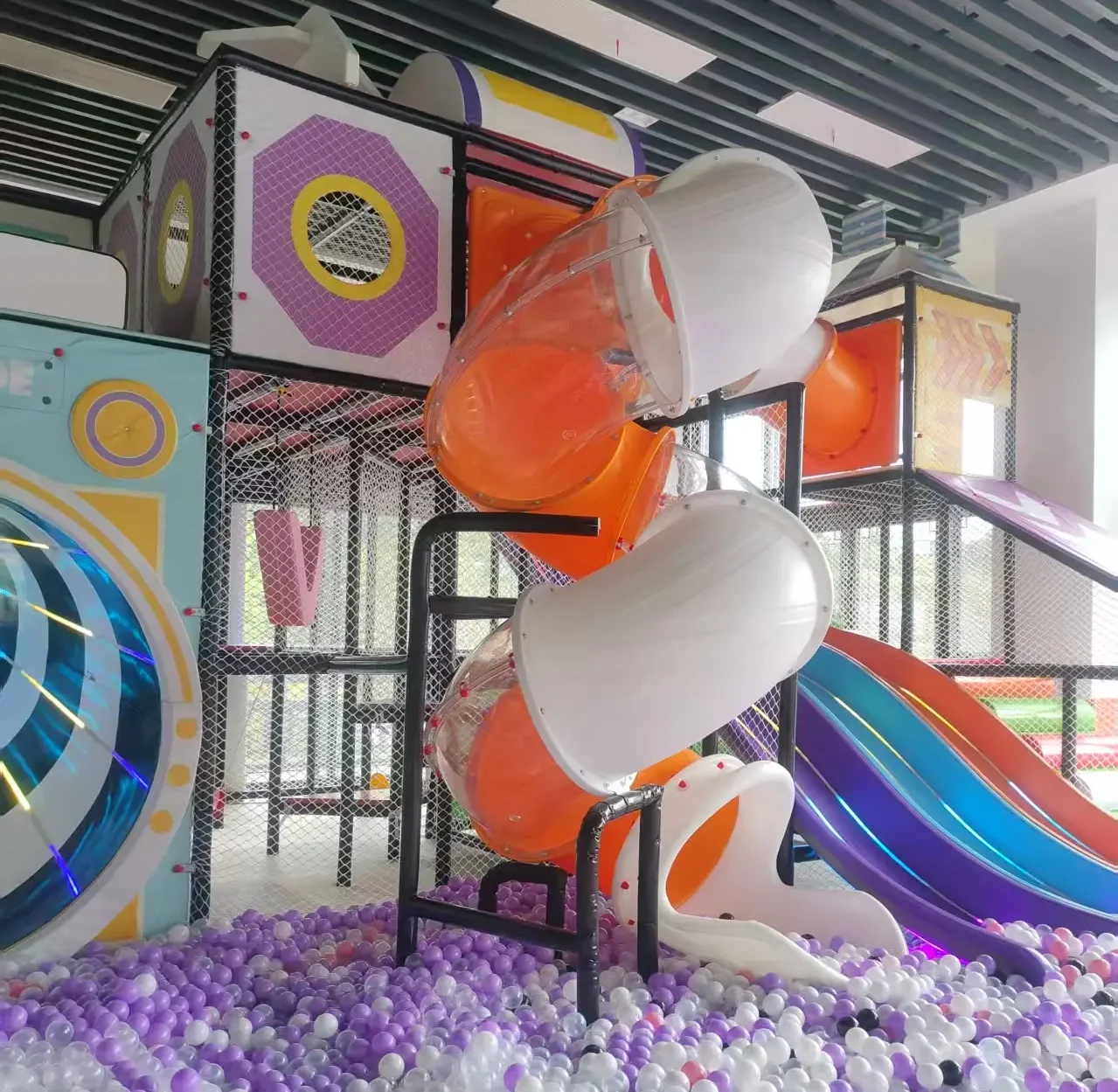
Indoor play has become a standard revenue line for shopping centers, family entertainment centers, hotels, clinics and schools, and the equipment behind it has moved a long way from a padded corner with a ball pit. Multi-level steel and foam structures now arrive with engineering drawings, load calculations and third-party test reports. For a first-time buyer the difficulty is not finding sellers. It is that four very different kinds of seller answer the same search query, and only some of them will still be reachable when a net section needs replacing in year three. Most projects begin by shortlisting a themed format, comparing colorful naughty castle systems against open climbing layouts, and only then working backwards to a supply route.
You can buy indoor playground equipment through four routes: directly from the manufacturing factory, through a regional distributor, through a specialty dealer or integrator that designs and installs, or through a wholesale marketplace. Factory direct produces the lowest equipment price and the widest customization; a dealer or integrator costs more but owns installation, certification paperwork and after-sales response.
The sections below compare those routes against the two questions every buyer asks next, what the project costs and what has to be true about the building before anything is ordered.
Where Do Buyers Purchase Indoor Playground Equipment?
Four routes cover almost every commercial purchase: factory direct, regional distributor, specialty dealer or integrator, and wholesale marketplace. The right choice depends on whether you can manage engineering, freight and installation yourself, not on which route quotes the lowest number.
| Channel | Typical buyer | What it costs you beyond the invoice |
| Factory direct | Operators with a fixed layout, or buyers replacing a known structure | Freight, customs clearance, site readiness and installation supervision |
| Regional distributor | Buyers who need local stock and fast spare parts | Narrower catalog and less design freedom |
| Specialty dealer or integrator | Schools, malls and family entertainment centers buying a turnkey attraction | Highest headline price, but one party is accountable for the finished space |
| Wholesale marketplace | Small operators testing a concept, or buyers adding individual modules | Documentation is often incomplete and certification status unclear |
| Trade expo | Buyers comparing several suppliers in one week | Travel cost, and display models are not the delivered product |
The useful test is not price per square meter but who signs the handover. If the seller supplies drawings, ships a container and leaves, you are the general contractor whether you intended to be or not. That arrangement is workable for an operator with a construction background and a local crew, and it is where most first projects fail. Trade expos are worth attending for one reason: you can stand on the structure, push a net and judge foam density, which no catalog photograph will tell you.
How Much Does It Cost to Set Up an Indoor Playground?
A complete indoor playground equipment and fit-out package typically runs from about USD 50,000 for a small play cafe to well over USD 1,000,000 for a large family entertainment center. A standard 5,000 sq ft venue with a multi-level structure, safety flooring and professional installation usually lands between USD 150,000 and USD 400,000.
| Footprint | Play structure | Total project budget |
| 2,500 to 5,000 sq ft | USD 25,000 to 60,000 | USD 50,000 to 150,000 |
| 5,000 to 10,000 sq ft | USD 60,000 to 150,000 | USD 150,000 to 400,000 |
| 10,000 sq ft and above | USD 180,000 to 300,000 | USD 650,000 to 1,000,000 |
The structure is rarely more than half of the total. Safety flooring, freight, installation labor, permits and the cafe fit-out absorb the rest, and they scale with the building rather than with the equipment order. A published commercial indoor playground equipment cost breakdown usually shows the same shape: equipment at 40 to 55 percent, logistics and installation at 20 to 30 percent, and the remainder in site works.
What Drives the Price Per Square Foot?
Equipment alone prices at roughly USD 15 to 40 per square foot, and a turnkey installation at USD 40 to 70 per square foot. Six factors move that number:
- Ceiling height and level count. A third level adds play capacity without adding floor area, which lowers the cost per usable play position.
- Module density. Slides, tube runs and interactive panels cost far more per square meter than open net climbing.
- Theming. Custom molds and sculpted fascias are priced once and do not amortize across a second venue.
- Surfacing. Poured rubber and foam tile differ by a factor of three in installed cost.
- Freight. A 40-foot container from an export factory to a European or North American port is a fixed cost that hurts small orders most.
- Installation labor. Crews that travel internationally are billed at daily rates plus flights, lodging and meals.
What Do You Need to Start an Indoor Playground Before Ordering Equipment?
Before ordering indoor playground equipment, you need a building that can physically take it: clear height of roughly five to six meters for a three-level frame, an unbroken floor plate, floor loading capacity for the structure plus occupants, sufficient power, fire egress that the play frame does not block, and an insurer who accepts the attraction.
Work through these in order, because each one can invalidate a layout that has already been quoted:
- Clear height measured under sprinklers, ductwork and light fittings, not slab to slab.
- Usable floor area after columns, stairs, escape routes and the cafe.
- Floor loading and anchoring permission, especially on suspended slabs and inside leased retail units.
- Power capacity for lighting, interactive equipment and any motorized rides.
- Fire strategy: material reaction to fire, travel distances, and whether the structure sits inside an escape route.
- Insurance and licensing conditions, which in some jurisdictions dictate supervision ratios and maximum occupant load.
The boundary between building work and equipment work is where schedules slip. A supplier drawing shows the frame and the fall zone; it does not show the slab, the drainage or the ceiling clearance. Sizing the space correctly at the start is cheaper than redrawing it later, and square footage planning is usually the first document worth commissioning.
How Do You Verify a Supplier Is Genuinely Compliant?
Ask for the test report behind every claim, then confirm the report covers the exact model and the standard revision you are buying. A supplier who cannot name the testing laboratory, the standard edition and the tested configuration is reselling indoor playground equipment, not manufacturing it.
Two reference documents do most of the work. In the United States, the CPSC Public Playground Safety Handbook sets the safety expectations that insurers, inspectors and school districts reference, and ASTM F1487 is the performance specification those expectations point to. In Europe the equivalent pair is EN 1176 for equipment and EN 1177 for surfacing. Neither is a marketing claim. Both describe test methods and pass criteria, which is why a certificate without an attached report is close to meaningless.
Documents to Request Before a Deposit
- Third-party test reports naming the laboratory and the standard revision, with photographs of the tested configuration.
- Validation under a third-party certification scheme such as IPEMA, which publishes validated products so a buyer can check a claim independently.
- Reaction-to-fire classification for foam, vinyl and netting, since these drive insurance acceptance more often than structural strength.
- Material certificates for steel grade and coating thickness.
- A factory audit or a live video walkthrough of the production line, not a showroom.
- Two or three installed projects of similar size that you can contact without the salesperson present.
What Changes When You Import Directly from a Factory?
Direct import reduces indoor playground equipment prices by 40 to 60 percent against local dealer pricing, but it transfers freight, customs, installation and warranty logistics to the buyer. The saving is real only if all of those costs are quoted before the order is placed.
| Responsibility | Usually the factory | Usually the buyer |
| Structural design and drawings | Yes | Approval and local code check |
| Packing and container loading | Yes | Choice of shipping term and insurance |
| Ocean freight and port charges | Only under delivered terms | Yes under ex-works or FOB terms |
| Import duty and sales tax | No | Yes |
| Site installation | Supervision only, unless contracted | Crew, tools and lifting equipment |
| Warranty labor | Parts only | Local labor to fit them |
One line item is routinely forgotten: spare parts in the first container. Allocating three to five percent of the equipment budget to foam covers, net sections, fasteners and vinyl patches avoids paying express air freight six months later for a part that costs a few dollars.
Where Do Schools and Public Agencies Buy Playground Equipment?
Schools and public agencies mostly buy through cooperative purchasing contracts or a formal tender, not from retail listings. Both routes demand documentation that a consumer purchase never asks for, and both take longer than a private operator expects.
A cooperative purchasing contract is a competitively awarded agreement that a public body can buy from without running its own tender, which can cut months from a project. Where no such contract is available, the district issues a request for proposals and evaluates bidders on compliance, references and total cost rather than unit price. Funding usually comes from three sources at once: capital budget, parent fundraising and grants, which is why the package has to be assembled before the specification is locked.
Institutional buyers add requirements that change the equipment itself: accessible routes, ground-level play events, a documented inspection by a certified playground safety inspector, and a complete document set for the procurement file. Equipment validated to ASTM F1487 and supplied with third-party validation is far easier to defend at that stage than equipment described only in a brochure.
Where Can You Buy Outdoor Playground Equipment?
Outdoor equipment comes from three different supply types: site-built custom fabricators, catalog module suppliers and contract suppliers serving parks and municipalities. The split exists because foundations, drainage and wind loading change the engineering, not because the play value differs.
An indoor buyer adding an outdoor area should expect a different commercial structure. Outdoor projects carry civil work, so the supplier is often a contractor who pours footings and certifies the installation. Catalog modules ship faster and suit phased budgets but assume a level, drained surface. Public outdoor projects revert to the same cooperative contract and tender routes described above. Buying both sides from one supplier looks efficient, but it only works if that supplier is strong in both, and the warranty terms for the two environments are rarely identical.
What Should the Purchase Contract and After-Sales Plan Cover?
A purchase contract for indoor playground equipment should fix five things: what is warranted and for how long, how quickly a fault is answered, spare part pricing, who supervises installation, and the acceptance criteria. Missing any one of them turns a price advantage into an operating cost.
- Warranty split by component: structural frame, foam, vinyl, netting and electrical parts, each with its own term.
- Response time in writing, distinguishing a safety fault from a cosmetic one.
- Spare part price list locked for the warranty period, with lead times.
- Installation supervision scope, including days on site and who pays for delays.
- Acceptance criteria and the inspection report that closes the project.
Maintenance then decides how long the asset performs. Daily checks by staff, monthly functional inspections and an annual professional audit are the standard rhythm, and it is worth agreeing that schedule with the supplier before handover so the daily operation and maintenance guidelines match the components actually installed.
FAQ
Three questions tend to surface after the specification is settled and before the deposit is paid.
Can indoor playground equipment be bought used?
Yes, usually from venues that are closing or upgrading. The risks are concentrated in the soft components: foam loses resilience, vinyl cracks along fold lines and netting degrades under UV even indoors. Certification does not transfer with the hardware, and a used frame with no drawings is difficult to insure. It is only worth considering when the structure is modular, the seller holds the original documentation and replacement covers are still in production.
Is a CE mark enough documentation for a US installation?
No. The CE mark is a self-declared statement of conformity with European directives and does not demonstrate compliance with ASTM F1487 or CPSC guidance. Buyers in the United States should ask for test reports against the applicable ASTM standard, and European buyers should ask for EN 1176 reports rather than the mark alone. A supplier holding genuine reports will send them without negotiation.
Can a play structure be expanded in phases later?
Yes, if the frame is modular and the load path was designed for it. Specify the expansion point at purchase: reserved connection nodes, spare power capacity and egress width sized for the larger final layout. Retrofitting a frame that was never designed to grow usually costs more than the original structure, because the added section needs new columns and a new fall zone.


